Kitchen & Bath: Working With Mirrors
Whether you simply hang a small oval in a gilded frame over your sink, or cover every available inch of wall with plate-glass mirrors, a bathroom doesn’t look complete until the mirror is hung. As part of our glazing business in Brewster, Mass., my husband, Paul, and I cut and install numerous plate-glass bathroom mirrors every year. With that experience, we’ve developed good techniques — along with definite opinions — for working with mirrors.
The multilayered process used to create mirror glass involves an initial application of a sensitized layer of tin to the glass, for adhesion. The second layer, of silver, is applied for reflectivity, and a third, copper, layer is added to protect the silver. The Guardian Industries mirror glass we purchase (from Karas & Karas Glass in South Boston, Mass.) is the best-quality American-made mirror available (see “Sources of Supply” at end of article). These mirrors meet the highest standards of the industry, are produced on state-of-the-art equipment, and have a unique dual coating applied over the reflective layering to resist silver corrosion and “black edge,” an undesirable flaw that characterizes antique and not-so-antique mirrors alike. The primary coat that protects and seals the silver and copper to the glass is impervious to moisture penetration that could lead to silver corrosion. To protect the primary coat, Guardian adds a specially formulated scratch-resistant coat. This double-coat backing greatly improves mirror performance and also helps reduce the possibility of damage in transit.
When we go out to measure a job, we like to discuss the aesthetic options and essential prep with either the homeowner or the general contractor. Because we’ve done so many installations, we’ve experienced almost every conceivable problem that can arise.
Here’s Looking at You
Wall-to-wall mirrors are effective at brightening the room and making a small room feel larger. But if there’s a toilet on the wall of choice, we remind our customers that males in the household may prefer not to stand before a mirror there.
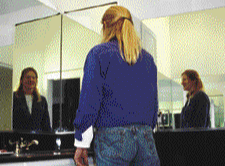
Often, large bathrooms will have “his and hers” vanities installed on opposite walls, which means that the two mirrors face each other. We’ve done many of these installations in recent years. The resulting “funhouse” effect does make the room look bigger — almost endless — but it may be visually disturbing to some folks (see Figure 1). If so, smaller, task-sized mirrors will limit the effect. Mirrors are priced by the square foot, so, unless there’s a good reason (like an insistent customer) to cover the walls, we suggest that the money might be better spent elsewhere.
Figure 1.Opposing mirrors create a “funhouse” effect, which may be delightful or disturbing, depending on the client. An advantage is that a small bathroom can seem larger.
Mirror Height
After checking the walls for plumb and the countertop or backsplash that the mirror will sit on for level, we discuss the height of the mirror. For example, if the customers want the mirror to go all the way to the ceiling, we ask if they’ve considered the task of cleaning the mirrors; in most cases, it would require either a stepladder or a slippery climb onto the vanity to reach the top. Another important consideration is what the mirror will be reflecting. If there’s a window on the opposite wall, and the customers want the added light or view, that’s fine. But if there’s only a blank wall or the upper half of the bathroom door to reflect, why bother? Of course, we’ll do pretty much whatever our customers want, regardless of the reason. On one job, the client, a mother of three “messy” boys, wanted mirrors all the way to the ceiling and over much of the walls because she thought it would be easier to constantly clean mirrors than bare walls.
Light fixtures. The type and style of the lighting fixtures also affect mirror height. We recommend going right up to the base of a horizontal strip light but keeping the top of the mirror slightly down from the base of a top-mounted decorative fixture. If the light fixture has hanging globes or shades, we like to keep the top of the mirror below the lowest projection rather than tucked up behind; a mirror in that position will reflect the back side of the globe or shade, which tends to gather dust.
Cutouts. We can always drill right through the mirror and mount the light fixture directly on the glass. The best are sconce-type fixtures with an escutcheon that will cover the hole in the mirror (which may not be pretty) by a comfortable margin. If there’s an outlet or switch right where we want the mirror to be, we can sometimes incorporate it into the mirror and cap it with a mirrored cover plate, giving the bathroom a slick, custom look (Figure 2). One bathroom we did had mirror entirely covering three out of four walls, floor to ceiling. It was a very small room, and the idea was to make it look larger. We had to drill holes for the toilet and sink supplies, along with the light fixtures and all the outlets. Although we accomplished the objective, I’d hate to have to clean that room!
Figure 2. Existing outlets can be incorporated into the mirror field and capped with a reflective cover plate.
To make holes and cutouts in a mirror, we use a special tripod-type drill press and an abrasive diamond-edged hole saw, with a steady flow of water to cool and lubricate the cut (Figure 3). We can cut hole diameters from 1/8 inch up to 4 inches (used for most lighting fixture cutouts). To cut an opening for a standard, rectangle GFI electrical outlet, we drill two 2-inch-diameter holes, one above the other, and notch the middle out with a scoring tool and a pair of nibblers (Figure 4). Obviously, the measurements for electrical cutouts must be dead accurate in order for the special mirrored cover plate to cover the outlet holes. The cover plate dimensions are slightly larger than standard-issue plastic covers, but you still don’t have much wiggle room.
Figure 3. A proprietary tripod drill press uses diamond abrasive bits to cut circular openings in mirror glass.
Figure 4.To create a rectangular box opening, the author drills multiple holes, then finishes the job with a scoring tool and a nibbler.
Once we’ve cut the mirrors to size, we feed them through our factory-edging machine to create an “aris” polished edge. An aris polish has a slight bevel top and bottom, with the face of the edge flat. After cleaning to remove the mirror dust, we spray the freshly cut and polished edges with a sealer, a clear coating specially formulated to help prevent silver deterioration and the appearance of black edge.
Black Edge
Usually first seen at the bottom edge of a bathroom mirror, black edge is caused by household corrosives, like glass cleaner, toothpaste, or hand soap, pooling on the backsplash ledge at the bottom edge of the glass. It’s no different from the tarnish that develops on silverware, except that it can’t be polished away. On lesser-quality mirrors that haven’t been edge-sealed after cutting and polishing, the edge can start to deteriorate in as little as a month. We’ve also seen discount-store mirrors or mirrored medicine cabinets, purchased by our customers for their bathrooms, that began turning black in the box.
Concealment. We recommend using a chrome-finish aluminum J-channel at the base of any mirror that rests on a backsplash (Figure 5). The 3/4-inch-high face of the J-channel doesn’t prevent the corrosion but does effectively conceal it, as the black edge normally won’t creep higher than 1/2 inch or so. Another advantage of using J-channel is that it allows the installer to make spacing adjustments. If an adjacent wall isn’t plumb or the backsplash isn’t level, we can use small, clear vinyl shims inside the channel to slightly tilt the mirror.
Figure 5. Chrome-plated J-channel supports the mirror until the mastic sets up and hides shims, but also conceals “black edge” corrosion on backsplash-mounted mirrors.
There are always clients who reject the channel because they want the mirror to stand alone. We can, and do, forgo the channel if that’s the case. Instead, we’ll apply a thin bead of clear silicone along the bottom edge to help prevent any moisture from getting to the back of the mirror. That mirror, once glued to the wall, isn’t going to be easy to remove (certainly not in one piece) and replace. For that reason, we press the J-channel option. J-channel is available in almost any conceivable finish to match the bathroom’s decor — brushed nickel, brass, or white, for example.
We also use J-channel or L-channel to mount mirrors up off the backsplash or vanity top. These aluminum extrusions are nailed through the wallboard into the studs to support the weight of the mirror. A piece of electrical tape over the exposed nail heads prevents them from scratching the mirror backing. The channel gives the necessary support to the mirror while the mastic sets up, and helps ensure that the mirror doesn’t creep down.
Mirror mastic. To make sure the mirror stays where you want it and that the mirror backing and coating aren’t damaged, you need to use a strong, appropriate mirror mastic. Other adhesives may etch through the protective coatings and show through in patterns of corrosion. We use Glazers Choice mirror adhesive because of its extremely reliable hold, and we always use more than is probably necessary, because we believe more is better for this job (Figure 6). We’ve been called to jobs where another company’s mirrors have fallen off the wall because the installers were too stingy with the glue. In one instance, our client had just finished bathing her infant in the bathroom sink and was walking out the door when the mirror fell off the wall, hit the goose-neck faucet, and shattered, leaving a large shard embedded in the floor. When we arrived to install the replacement, I was appalled by the small daubs of glue the previous installers had used for such a large mirror. We always err on the side of caution, and, after 18 years in this business, I’m proud to say that not one of our mirrors has ever fallen.
Figure 6. Heavy mirror glass calls for a generous application of special mirror mastic. Drywall substrates must be dust free and sealed for a secure bond.
The mastic is self-filling, which can be helpful in the case of a slightly bowed wall. For a small inward bow, we can use a thicker bead of mastic to build it out. But if the bow is pronounced and protruding, the framing has to be corrected. We check the wall planes for flatness with a long straightedge during initial measuring to prevent this type of last-minute snag. A mirror won’t bend to conform to a severe outward bow and, if you force it, will probably crack as soon as any pressure is applied at either end, like during a simple cleaning.
Surface prep. Mirror mastic requires a clean, dry surface that is free of dust and dirt. Both the wall and the mirror surface must be the same temperature to prevent condensation. Porous surfaces, such as unpainted plaster, drywall, or concrete, must first be sealed with a good latex or acrylic primer before we can safely mount the mirror. If a bathroom is to be wallpapered, we ask that the mirror locations be left uncovered. Although mirror mastic will stick to wallpaper, wallpaper glue isn’t strong enough to hold the weight of a mirror on the wall. The mastic sets up in about 20 minutes but attains full, 200-psi cure strength in 24 hours under normal conditions.
We always get a great feeling of accomplishment when the homeowner walks into a new bathroom and sees what a difference the mirrors make.
Kathy and Paul McLellan own Mayflower Glass Company, Inc., in Brewster, Mass.
Glazers Choice Cleveland, Ohio 888/655-3430 Guardian Industries Auburn Hills, Mich. 248/340-1800 Karas & Karas Glass Co. South Boston, Mass. 617/268-8800 |