Home elevators used to be something that only the wealthy could afford. They’re still not cheap, but they’re becoming increasingly common. My company installs elevators in central California. Some of our clients install residential elevators for convenience — they live in multistory houses and don’t want to climb or haul things up the stairs. Other clients need elevators to continue living in their homes when they become disabled or develop a health condition that prevents them from safely using stairs.
There’s a third reason elevators have become more common: In some areas around here, land is so expensive and lots so small that the only way to build is up. Putting in an elevator may add cost, but it also increases the pool of potential buyers.
Residential elevators are smaller than commercial units. The most common commercial elevator will lift 2,500 pounds and is about 5×7 feet inside. A typical home elevator is 3×4 feet inside and has a load capacity between 500 and 1,000 pounds.
Anatomy of an Elevator
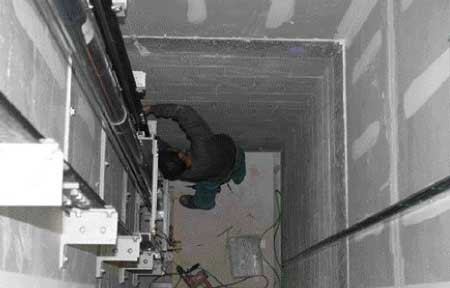
An elevator consists of a hoistway (shaft), guide rails, cab (car), controls, and lifting machinery. The rails are bolted to one side of the shaft and prevent the cab from swinging around as it’s raised and lowered by cable.
Elevators are categorized by the type of lifting mechanisms they employ. The most common systems are winding-drum and roped hydraulic. Traction elevators, a third type, occasionally show up in homes but are primarily used in commercial buildings.
Winding drum. The mechanism for a winding-drum or roped-drum elevator works like the winch on a truck. An electric motor turns a drum that has a steel cable (or rope) attached to it. The drum is often installed on the bottom floor of the building next to the hoistway. The cable passes through a hole in the wall, up the side of the shaft, over a sheave (pulley), and down to the sling that supports the cab. On some models, the motor and drum are on top of the rails or in the attic above.
The selling point for roped-drum elevators is that they’re less expensive than hydraulic units. The downside is that they’re noisier and don’t ride as smoothly. Stops and starts feel hard because the motor runs at only one speed. The exact stopping point is somewhat dependent on the amount of weight in the car, so the cab may not stop exactly flush with the floor.
Roped hydraulic. The lifting power for a roped hydraulic elevator is provided by a hydraulic pump that’s connected to a long piston with a sheave on top.
The pump is installed in a machine room, and the piston is bolted to the wall in the hoistway. A pair of cables anchored to the floor of the shaft pass up through the sheave and then down to the large L-shaped frame (cantilever sling) that supports the cab. The cab moves 2 feet for every foot that the piston moves.
Roped hydraulic elevators cost more than drum units but are quieter and ride more smoothly. The pump can be installed at a remote location because hydraulic lines can be run through the walls like plumbing. The ride is smooth because the piston is controlled by a two-speed valve that allows the cab to start slowly, speed up, and then slow down before stopping. There’s a greater degree of control, so the cab stops flush with the floor, no matter what the load.
We install only roped hydraulic elevators. The units we use are made by Concord, but there are many other manufacturers (see list at end of article).