K&B: Top Five Tile Callbacks
Do any of the following complaints sound familiar?
“Help! We just had a party and our five-year-old tile floor is cracked all over.”
“My contractor just put in a wheelchair-accessible shower for our daughter, and now water is leaking through into the basement.”
“The contractor says my tile is growing, and now I have a big hump in the floor. How do I make it stop?”
“My grout is all soft and powdery, and it comes out when I vacuum. The contractor came out and put water in it and said it would make it harder. But it didn’t work.”
I gleaned these comments from calls I received the week before I wrote this article. Sadly, as director of the Ceramic Tile Education Foundation, I hear nearly identical complaints almost every week. The worst part is that all of these problems are installation related, which can cause a tile professional like me to be downright depressed.
Why all the problems? In probably 98% of the cases, the reason, pure and simple, is failure to follow instructions and observe established installation guidelines. I never thought, during my nearly three decades as a tile contractor, that the day would come when I would agree with that statement. However, after four years of fielding tile-related complaints in my new position, I must report that it’s true.
In compiling my list of the top five tile failures, I consulted with Bob Daniels, executive director of Tile Council of America (TCA), and Noah Chitty of TCA Technical Services. Combined, the three of us handle approximately 5,000 calls and e-mails a year. Surprisingly, we all agreed on the top five problems, although we ranked them somewhat differently. So here, in random order, are the top five tile-failure calls we receive.
Lousy Floor Prep
Substrates must be clean — meaning free of all foreign matter, paint, curing compounds, dirt, and anything else that interferes with bonding. One contractor actually sent me a tile with paint overspray and sawdust imbedded in the thinset. He wanted to know why it didn’t stick to the substrate.
When you’re installing tile over concrete, cracks, joints, and curing compounds must be dealt with. There is no such thing as a “dead crack” (a term I hear often). If you encounter a crack, you’ll need to apply a crack-isolation membrane. But be aware that not all membranes allow you to relocate the control joints that are already in the substrate.
Be sure to read the multipage directions that come with the product; don’t rely on the summarized directions printed on the box or bucket.
Wrong Thinset, Poor Coverage
If you set much tile, you’re sure to encounter a variety of substrates, tile types, and installation conditions. Happily, there is a thinset mortar available for every application, so use the right one! Manufacturers don’t make six to ten types just so they can charge different prices. They are different products with different properties and recommended uses.
Once you’ve obtained the proper product, you’ll need proper coverage. That’s important in the installation of all types of tile, and it’s particularly critical when large-format tile (8×8 inches or larger) is used.
On interior substrates, you should have evenly distributed thinset over 80% of the surface; for exterior or wet areas, the requirement is 95%, evenly distributed. The trowel notch-size instructions listed on the bag of thinset are general recommendations, not gospel. The manufacturer has no way of knowing whether you’ll be installing lug-back, waffle-back, ribbed-back, or some other type of tile.
Most products contain a reference to ANSI A108, Specifications for the Installation of Ceramic Tile, which is where you will find the rest of the requirements for proper installation. (ANSI A108 is available from TCA for $15; www.tileusa.com, 864/646-8453). Encourage your installers to practice troweling in one direction on large-format tile, and you will be far less likely to get customer complaints about cracked tile or broken corners.
No Movement Joints
A thorough discussion of movement accommodation joints would take many pages to address. Tile expert Bob Young once wrote that many tile installations are held down by the Three Gs: God, Grout, and Gravity. However, even the Three Gs have little influence on the integrity of an installation if the tiles have nowhere to move.
All building materials move, each at a different rate. This is a problem that must be considered in every installation, regardless of size.
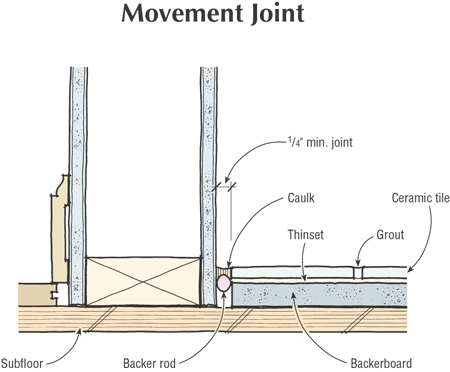
Packing grout into the wall line at the perimeter of the room is a leading cause on the failure list. A minimum 1/4-inch joint along the entire perimeter of the installation must remain free of grout, backerboard, and thinset (see illustration below). Floor tiles must be allowed to move. At the edge of a room, leave a gap between the backerboard and tile and the wall. If there is no baseboard, finish the gap with backer rod and caulk. Don’t use grout; it will crack.
Where there is no baseboard, use backer rod and caulk to fill the gap at the perimeter. If an installation is regularly exposed to sunlight, you must place movement joints at intervals no greater than 12 feet. Complete recommendations are contained in the TCA Handbook under detail EF171.
Insufficient Waterproofing
Many consumers, and apparently some builders, have the misconception that tile and grout constitute a waterproof surface. A gentleman recently called me about the shower in his new $500,000 home, which he said had been installed three times and was still not right. The first time, the installers didn’t realize that they needed waterproofing; once they became aware of the requirement, they put it in incorrectly.
Waterproofing should be considered for any tile installation that will be subjected to more than moderate moisture levels — an occasional spray, for instance.
This is one aspect of tile installation where manufacturers have excelled, in particular with trowel-on membranes, sheet products, and even preformed curbs, jambs, and entire shower bases. Nevertheless, the skill level required for this work goes beyond what’s needed to install floors.
To work as designed, any waterproofing system must be properly installed; in fact, the margin for error is zero. If the installer fails to install vapor membranes behind walls where required, or drives nails through the bottom 8 inches of the shower pan, or nails backerboard curbs through the membrane, he won’t have to wait long before the dissatisfied customer tries to relieve him of his wallet.
Improper Installation of Backerboards
All the benefits of using backerboards are rendered useless unless specific installation instructions are followed. For example, all backerboards intended for floor use require a leveling bed, not just a little thinset and a few fasteners. Let me repeat that: A leveling bed is required!
The purpose of thinset under the panel is not confined to bonding. It also provides a solid, void-free backing surface. Some backerboard manufacturers specifically do not want the panel bonded, so they recommend dry-set mortar for the leveling bed.
Proper fasteners are critical: It’s their job — not that of the thinset — to secure the panel. Minimum head diameter for backerboard fasteners is 3/8 inch. This means no drywall screws! Galvanized roofing nails are acceptable, however. When using pneumatic nailers, you must place the head of the gun firmly against the backerboard surface before you pull the trigger. This helps prevent the panel from resting solely on the ridges or, even worse, riding up the nail.
Leave gaps between sheets and treat them according to the manufacturer’s recommendations. If you don’t leave appropriate gaps in the supporting wood panel, edge swelling may push the whole backerboard off the floor, resulting in tile cracks at the sheet perimeter.
Finally, backerboards are nothing more than backerboards. They provide no structural value. If the subfloor provides inadequate support, backerboard is not an answer.
Keep in mind that subfloor recommendations are minimums. You need adequate strength to support the tile job. If the subfloor has been open to the weather and has delaminated or swollen, you may need to replace it or add a new layer to get the strength back.
Dave Gobis is a third-generation tile setter and the executive director of the Ceramic Tile Education Foundation (CTEF, 864/222-2131, www.tileschool.org).