From the Top Down
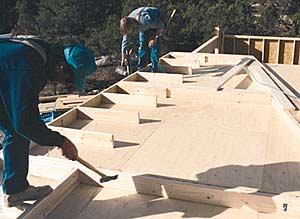
When I’m getting ready to frame a complex house, I do my figuring from the roof down instead of from the sill plates up. Most framers look first at the foundation plan, then the floor plans, and so on; I look first at the roof. In a complicated house, it’s easy for the designer to get lost in the elevations. Because I’ve seen my share of roof plans with eaves that pass through windows and hip beams that cut through doorways, I make sure all of the roof planes come together properly before I start calculating wall heights. Once I can visualize how the roof creates the spaces below, I can figure out how to frame the walls that support the roof. I rarely use the elevations provided on the plans without double-checking. The roof design determines the wall elevations; unless the roof changes, the wall heights can’t change. It’s also important when framing rake and other tall walls to work in the proper sequence. You want to avoid leaving a tall wall standing alone on the subfloor with braces all over the place. Whenever possible, frame any adjacent walls first and stand the balloon wall between them. To ensure that I don’t miss any rake walls, I typically figure the elevations before I plate my subfloor. The more complicated the roof, the more you need to pay attention to how to plate your walls and the heights of those walls. I write down as much information as I can directly on the plates or on the subfloor nearby so that I don’t need to keep referring to the plans when I’m building the wall (see Figure 1).
Figure 1. While laying out rake walls, the author draws details at full scale on the subfloor. To avoid having to continually refer to the plans while framing, he also writes dimensions for plates, studs, jacks, trimmers, and headers directly on the deck. I write down the lengths of the longest and shortest studs and the length of the top plate from short to long point, plus the length of trimmers and cripples, window rough openings, and header lengths. With an inexperienced crew, I may even cut the top plate, king studs, and headers, and position them on the subfloor near the layout marks. In some cases, I also write down the kind of lumber that should be used. It’s difficult to find 2-by material these days that is both long and straight, so I often use laminated veneer lumber (LVL). Also, because LVL studs are stronger and stiffer than sawn lumber, they are often specced by engineers for tall walls. With sawn studs, engineers sometimes spec doubled studs to add strength to the wall. I usually block balloon walls every 8 feet to strengthen the diaphragm. I install the blocking on edge so that it also serves as fire blocking. When it comes time to lay out a rake wall, I first snap out the perimeter of the wall at full scale on the subfloor (Figure 2).
Figure 2. The perimeter of a rake wall is snapped out on the subfloor, along with lines for all studs, and headers and sills for window and door openings. |
I also snap out the king and common studs, as well as the headers and sills of all window and door openings. If there are any beam pockets in the wall, I lay out their elevations on the subfloor as well. For instance, if I have a large ridge beam that needs to sit in a pocket in the rake wall, I draw a full-scale mockup of how the rafters connect to the ridge beam so that I know the exact elevations of the beam and post in the rake wall.
Rake Wall Math
I use a calculator to figure the elevations, and I double-check my layout as I go. Because my calculator falls out of my pouch a lot, I don’t use an expensive feet-and-inch model; instead, I have a Texas Instruments scientific calculator. It has all of the trigonometry functions I need, plus three memories (which is three times what I have). Once you learn how to convert decimals to feet and inches on a regular calculator, it’s easy to do all the job-site math.
Rake wall height.
To figure the high point of a rake wall where it intersects the ridge, I first measure the deck and convert feet and inches to decimals. (The building footprint has a way of growing or shrinking a little, so I prefer to use actual measurements rather than reading the dimensions off the plans.) For example, if the house is 26 feet 6-3/4 inches wide, the span (the measurement to the center of the ridge) is 13 feet 3-3/8 inches. Convert the inches to decimals (see ), and plug the results into the formula. In this example, the center of the ridge is at 13.28 feet which, when multiplied by the roof pitch, gives you the rise in feet of the highest point of the rake wall. For a 6/12 pitch, the formula is: 6/12 = .5 .5 x 13.28 = 6.64 Add this to the height of the wall at the eaves and you’ve got the elevation of the rake at its highest point. If the eaves are at 8 feet, the total height is 14.64 feet (8 + 6.64). Whether or not you add the length of the rafter plumb cut to this dimension depends on how you treat the rake wall at the roof line. I usually cantilever lookouts over the rake wall, tying them into the rafters one or two layouts back. For a shallow overhang (less than 18 inches), I use 2x6s on the flat, so I typically frame the rake wall 11/2 inches shorter (measured square to the rafter) than the elevation of the rafter tops. For lookouts on deeper overhangs, I use 2x6s on edge, so I frame the rake 51/2 inches lower than the top of the rafters. With some truss roofs, such as scissor trusses, I have seen framers build rake walls to the underside of the truss. But this creates a place where the wall can buckle, and you also have to remember to order a shallower gable truss so you can shoot the lookouts over the top without notching. With trusses, I prefer to omit the gable truss and frame the rake wall to the underside of the lookouts.
Length of top plate.
To figure the length of the top plate from short to long point, I typically use the following keystrokes on the calculator, in this order: pitch ÷ 12, inverse tangent, cosine, 1/x. For instance, with a 6/12 roof pitch, the unit length (the length of the sloping plate per foot of horizontal run) of the top plate is:
6/12 = 0.5 Inv. Tan = 26.565 (degrees of pitch) Cosine = 0.894 1/x = 1.118 |
To find the plate length in decimals, first round off 1.118 to 1.12, then multiply by the span: 1.12 x 13.28 = 14.87 feet. Now convert to feet and inches. The article “Stacking Supported Valleys” (9/97), by Will Holladay, concerning methods for figuring rafter lengths, is helpful for rake wall top plates as well. Mr. Holladay does a great job of taking the mystery out of the math.