GR150
Fastener range: 1 1/2″ x .148/.131″
Magazine capacity: 30 nails
Fastener type: Bright or galvanized joist nails
Collation: 33°: paper or plastic
Size (H x L x W): 91/2″ x 121/4″ x 33/4″
Weight: 4.4 pounds
Street price: $240
GR250
1 1/2″ x .148/.131″ and 2 1/2″ x .148/.162″
30 nails
Bright or galvanized joist nails
33°; paper or plastic
11″ x 11 3/4″ x 3 3/4″
4.8 pounds
$250
Grip-Rite Tools
800/676-7777
If there’s one part of framing I don’t enjoy, it’s installing metal hardware — hangers, hurricane clips, hold-downs, straps, and anything else we’re required to use. Lucky for us that there are specialized nail guns — hardware nailers — to make this job faster and easier to do. The best-known models are based on conventional framing guns and use either the nail itself or a probe to guide the nail into holes in the hardware. We’ve had one of these tools for years, but sometimes we have to install hardware in places too hard to reach with a gun. Then we resort to driving bulk fasteners with a palm nailer or — even worse — by hand.
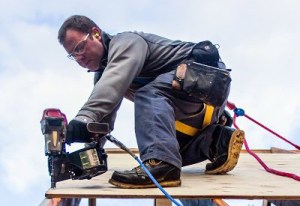
So I was game when JLC asked me to try out two newer guns designed for metal hardware, the Grip-Rite GR150 and GR250 joist-hanger nailers. Over a period of months we used these tools to install joist hangers, hurricane clips, and hold-down straps on the new houses we were framing. Both guns look and work like palm nailers but have magazines that take collated nails. According to the manufacturer, these tools are safer than conventional models, cost less, and use less expensive fasteners.
Performance
The Grip-Rites performed very well. They’re small, light, and simple to use. They drive nails faster than is possible by hand but not as fast as a stick nailer. They jammed occasionally, but no more frequently than conventional guns do.
Remodelers will probably appreciate the compact size of these tools, which makes it easier to get at hardware that’s tucked away or located where a bigger gun won’t fit. (Since we frame new homes, the size of the tool was not a big issue for us.)
Nail size. These two guns are nearly identical; the one difference is that the GR250 is taller and drives longer fasteners. If I were to buy one of them, it definitely would not be the GR150, which shoots only 11/2-inch nails. The GR250 would be a better choice; in addition to driving 11/2-inch fasteners, it shoots 21/2-inch fasteners, a size we often use.
Single vs. Multiple Blows
Like all palm nailers, these guns have no triggers and use multiple blows to drive nails. All the user has to do is push down on the tool. The Grip-Rite joist-hanger nailers have very few features, but with this type of gun, that’s to be expected. They were designed for a single purpose: nailing on hardware.
The negative side to using these — or any multiblow gun — is that you need to apply pressure while the nail is driven in. With single-shot guns, by contrast, all it takes is a squeeze of the trigger. Also, it can be hard to hold a joist hanger while using a multiple-blow gun because all that pounding makes the hanger move.
Multiblow guns consume a lot more air than single-shot models do, which can be a problem if many carpenters are using the compressor at the same time. Though we didn’t notice anything unusual while driving 11/2-inch nails, we did find that the compressor ran a lot when we drove large numbers of 21/2-inch fasteners.
A safer nailer. Placing the nail in the hole was easy with the GR150 and GR250, and unlike conventional guns, which drive fasteners with a single blow, these tools didn’t recoil if we missed and hit metal. That lack of recoil makes multiblow models safer than conventional guns; there’s no chance the tool will bounce back and hit you. (One time when I was using a conventional hardware nailer, I missed the hole and the gun flew back and hit me in the forehead hard enough to leave an imprint of the cap.)
Another argument in favor of multiblow guns is that I have never heard of anyone getting shot with a nail from one.
Cost Argument
The manufacturer claims that these tools are less expensive than conventional hardware nailers to buy and use. The GR250 retails for about $250; the GR150 is $10 less. Compare that with the price for Paslode’s conventional hardware nailer: about $350. On the other hand, for $20 more than the cost of a Grip-Rite you could buy a Bostitch N88RH-2MCN and have a framing nailer and positive-placement nailer in one.
Less expensive fasteners. Conventional hardware guns require hardened nails, which cost more than the regular nails used by these Grip-Rite tools. The prices vary some depending on who you buy from and where you are, but we pay about $17 per 1,000 for bright 11/2-by-.148-inch fasteners for our Paslode nailer. For a Grip-Rite, the same-size nails cost $14 per 1,000.
Given that we use less than 1,500 nails to install all the hardware in a 2,400-square-foot house, that just doesn’t strike me as a huge savings. If we built decks or did some kind of structural retrofit work where we nailed up loads of hardware, the savings might be more significant.
The Verdict
Both Grip-Rite joist-hanger guns are excellent products; if they were the only hardware nailers on the market, I’d think they were some of the best tools around. But since I already own a single-blow hardware gun, I have something besides a hammer or a regular palm nailer to compare them to.
I like that these tools are light, but their small size is no great help to us framing new homes. I might feel different if we remodeled or framed complicated custom homes. And although it’s nice that the guns cost less than conventional models, we don’t install enough hardware for the slightly lower fastener price to make much of a difference.
So, all things considered, I’d still rather use a single-blow hardware gun, because it’s faster.
Tim Uhler is a lead framer for Pioneer Builders in Port Orchard, Wash.
Toolbox: Masonry Tools
by Patrick McCombe 
Freedom from Exhaustion.
Because of the very real risk of carbon monoxide poisoning, it’s generally a bad idea to use a gas cutoff saw indoors. Instead, most contractors settle for less-powerful electric versions. But there’s another option: hydraulically powered saws like Atlas Copco’s 14-inch LS 14, with a 51/4-inch depth of cut, and 16-inch LS 16, with a 61/4-inch depth of cut. Both models draw power from a portable hydraulic power pack (approximately $4,100 to $8,200, depending on size) and feature adjustable blade guards; for longer or more precise cuts, they can be cart-mounted. The LS 14 lists for $1,700 and the LS 16 for $1,750. Sound too steep? Check for these and similar machines at a local rental yard that caters to professionals. Atlas Copco, 800/760-4049, www.atlascopco.com

Clear the Air.
What’s worse than chasing mortar joints with a dusty handheld grinder? My answer: Nothing. Fortunately, though, you can cut down on the mess with Bosch’s specialty 5-inch grinder. The maker claims that the see-through blade guard on the 1775E makes prepping masonry for tuck-pointing virtually dust-free — and safer for the operator. The grinder’s 81/2-amp soft-start motor spins at 11,000 rpm and contains sealed bearings and epoxy-coated windings for longer life. The tool weighs about 51/2 pounds and sells for about $200. Bosch, 877/267-2499, www.boschtools.com

Mega Mortar Mixer.
Mixing mortar or concrete by hand might be a good way to keep a brain-dead helper out of trouble for a while — but then again, maybe you should just send him home and rent a mixer. If you own a skid-steer loader, inquire at your local rental yard about a Bobcat Concrete Mixer Attachment. The model shown has a 1/5-yard batch capacity and — so you don’t need a second person inside the cab — remote control. It works with most of the machines in the company’s line of track, skid, and all-wheel steering loaders and sells for about $4,000. You can rent it for between $100 to $200 per day. Bobcat, www.bobcat.com
Toolbox: Tool Storage

Model 1535

Model 1539

Model 1544
Soft Landing.
Want your tools organized and within easy reach? Try a soft-sided tool organizer, such as CLC’s new offerings. These specialized tool rigs have some cool features: an integral small-parts tray on the 1535 ($60); plenty of vertical tool pockets on the 1539 ($88); and a drop-down parts organizer on the 1544 ($55). All three packs have heavy-duty shoulder straps and roomy interiors for larger tools, safety gear, and snacks. CLC, 800/325-0455, www.clccustomleathercraft.com


Easy Roller.
Ever find yourself envying your auto mechanic’s cool roll-around tool chest — but just can’t bring yourself to shell out thousands for your own? The Stanley four-drawer FatMax Rolling Tool Center may be just the ticket. Equipped with ball-bearing slides, an eight-outlet power strip, and a solid-birch top, it’s touted as the manufacturer’s “most durable and robust” tool-storage unit. It measures 27 inches wide, 18 inches deep, and 42 inches high; full-height corner bumpers protect walls and doorways. It costs $300, NASCAR stickers not included. Stanley, 800/782-6539, www.stanleytools.com
Walk-In Tool Storage.
Most contractors who leave their tools on site use some kind of a steel box to secure them. A box that’s too small, though, makes things even easier for thieves: They can grab all the tools at once. For a toolbox that’ll challenge even the brawniest bandit, check out Knaack’s Model 91 StorageMaster Chest. At 47 inches tall, 30 inches deep, and 72 inches long, this 409-pound behemoth isn’t going to leave the site without a fight. The 16-gauge steel body has a deadbolt-style locking system and a unique drop-down ramp that makes loading and unloading big tools a bit easier. It costs about $1,100. Knaack, 800/456-7865, www.knaacksecure.com