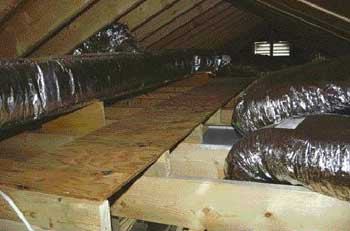
A low-slope roof pitch doesn’t leave much in the way of navigable attic space above a flat ceiling. That doesn’t prevent use of the void for duct and wiring runs, and it doesn’t affect the requirement for a scuttle for service access. But, because the ceiling joist bays are typically piled with itchy batt or blown-in insulation that buries the joists, human crossings are at best unpleasant.
Chatham, Mass., builder Chip Hardy solves this problem and reduces his scrap pile at the same time by creating a crawl-way above the attic insulation.
After snapping a guide line down the attic’s length, he uses construction glue and toenails to fasten 18-inch-long 2×4 riser blocks, on edge, to the top edge of the joists. He decks over the top of the blocks with plywood scrap of varying thickness — whatever’s left after decking and sheathing.
Given a minimum ceiling joist depth of 2×8, the risers create an 11-inch-deep bay under the crawl, with negligible effect on the insulation’s thermal value. Hardy’s hvac contractors are particularly pleased with this provision, and he figures he’ll be patting himself on the back when the time comes for him to service a gable vent, chase a wire, check a duct, or perform some other future task.