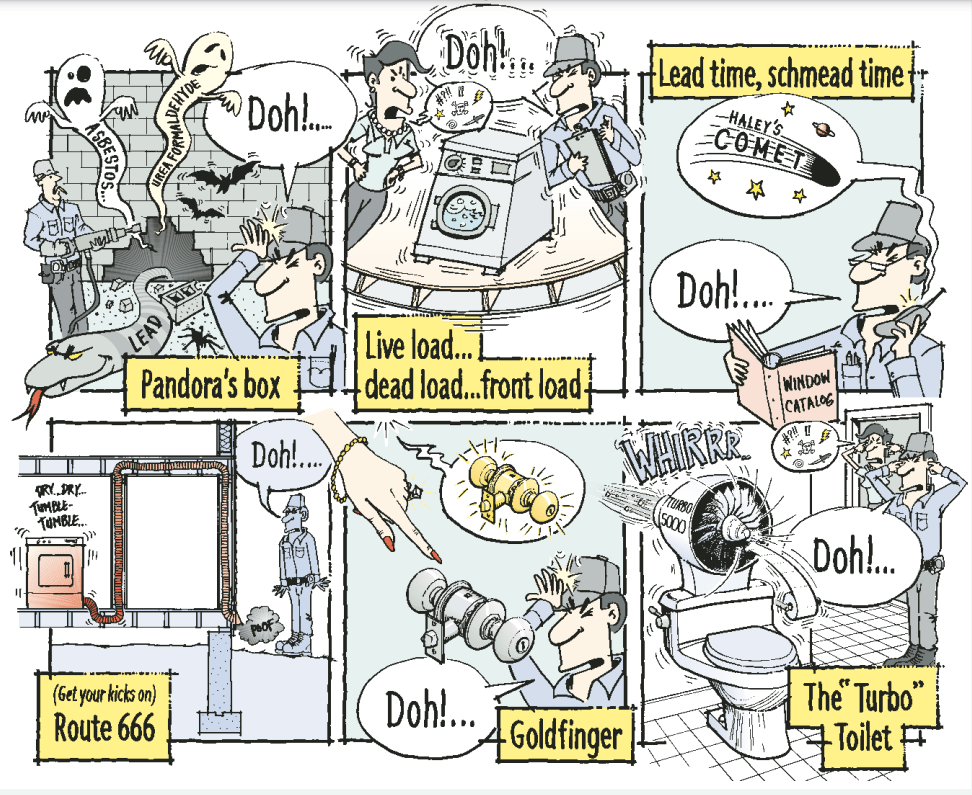
One of the most striking things about our industry is just how many chances there are to make mistakes. For every opportunity you have to get something right, it seems, there are a thousand more to get it wrong.
For instance, several years ago we had problems with an addition we built that contained a master suite above a garage. Even with a high level of insulation in the garage ceiling, the bathroom pipes froze over the unheated garage.
The experience left us determined not to make that particular expensive mistake again, so we made a change in how we did similar projects. Not only would we insulate the garage, but we’d also hang an industrial-style heater from its ceiling. The goal, of course, was to keep the temperature of the garage safely above freezing — 45°F to 50°F or so. With this approach, we could pretty much guarantee against frozen pipes. Plus, clients loved the warm cars in the morning and the warm floors in the upper rooms. Problem solved and everybody’s happy, right?
To download a complete copy of the CDRC, go to www.jlconline.com/public/constructionchecklist.doc.
Wrong. Recently, we built the same sort of addition, insisted on putting in the garage heater, and found that this time the vibrations from the heater traveled right up through the floor into the bed posts and kept the homeowners awake on cold nights. No cheap solutions here, unfortunately (at least none that were acceptable to the homeowners).
Heading Off Trouble
Such problems are frustrating but inevitable. The very nature of custom building and remodeling is that you’re constructing the prototype and the finished product all at once. You can only debug as you go.
What you can avoid, however, is the excruciating and needlessly expensive frustration of making the same mistake twice. We’ve found over time that the best way to avoid repeat mistakes is by using what we call the construction document review checklist — or CDRC, for short.
Our CDRC is a 25-page (and growing) list of construction issues that we want to make sure we’ve not only covered in our drawings and specifications but also accounted for in our budget. For example, we want to make sure we’ve specified — and budgeted for — tempered-glass windows wherever they’re needed, whether near a tub or shower, beside a door, or close to the floor. The CDRC includes questions that address this issue and hundreds of others just as important.
The checklist is organized into 19 sections, each corresponding to a category in our estimate spreadsheet: foundations and masonry, electrical, hvac, cabinets and countertops, and so on. Some categories, like painting, have relatively few questions; others, such as electrical, have several pages all to themselves.
Although most of the issues in the CDRC are dealt with in the normal course of designing and estimating a project, we find that it’s essential to do at least one thorough review of the documents just to make sure nothing slipped through the cracks. This review happens at a meeting that involves the architect, the lead carpenter, the estimator, the product selection person, and me (as salesperson). We do not include the client, principally because we don’t want the meeting to become a design discussion.
The document review consists, quite simply, of going through the 25 or so pages of the CDRC line by line. The process, I have to admit, is really boring. It’s tempting, just to speed things up, to gloss over or rationalize away any gaps in the project information that we uncover while reviewing the checklist.
We’ve learned, though, how important it is to plow through the list and deal with the issues that need to be dealt with then and there. The location of the vacuum breaker for the hand-held spray at the whirlpool tub is not on the elevation? Let’s put it in — these are very picky clients and we can’t leave something like that as a surprise at the end. They’ve chosen brass finishes for the faucets? Let’s make sure the brass disclaimer is in the specifications, so the homeowners aren’t surprised when the finish starts showing wear.
Yes, it’s a tedious process — but, as I frequently remind myself, it’s also the most important and profitable use of my time that I can possibly be making at that particular moment.
Timing the Meeting
On large jobs, we’ll sometimes break the CDRC review into three or four meetings, each covering just some of the categories and including appropriate key subcontractors.
But for most jobs, we go through the list in one two- to three-hour sitting, typically at the house we’ll be working on. We try to have the meeting about four weeks before the anticipated contract signing, so that the documentation we’re reviewing (drawings, specifications, list of products and finishes) is substantially complete.
If we have the CDRC meeting too soon, we sometimes find we have to do it all over again later because of changes in the project. (Even if we have to do it twice, though, it’s time well spent). On the other hand, if we hold the meeting too late, we often find we’re not leaving ourselves enough time to alter the documents and pricing as needed to respond to any gaps we uncover.
When we were first implementing this process, we occasionally found ourselves holding the CDRC meeting pretty late — even after the contract signing, in a couple of cases. The surprising thing was that the meeting was still incredibly useful, even though it was too late to change the contract price. It let us know what we had missed early enough that we could still head off lots of problems and expenses and cut our losses considerably.
A Growing List
We’re constantly adding items to our checklist. Whenever we run into a problem or a mistake on a job, our first instinct is to consider whether there’s a question we could add to the CDRC to head off that issue in the future.
We recently had to buy an extra roll of expensive vinyl flooring, for example, because we hadn’t accounted for the fact that it can be laid in only one direction. To make maximum use of the material, we had budgeted for two perpendicular runs in a T-shaped space. As soon as we realized our mistake, we added a question to the CDRC to help us anticipate and budget for that situation in the future. In another instance, I found myself the reluctant owner of a whirlpool tub that had the special-order pillow attachment at the wrong end.
Those are two costly mistakes we will never make again, as long as we use our checklist.
“Regular, disciplined use of the checklist not only saves us money in avoided mistakes and averted misunderstandings — it also gives us much greater project control.”
Another prime opportunity to add things to the CDRC is at the project recap meeting we hold after each completed job. At this event, which involves the same cast of characters that attended the CDRC meeting, we go through the job step by step, with an eye toward identifying issues we could reasonably avoid in the future by asking the right CDRC questions. Each job postmortem yields a handful of new items for the CDRC, and each of those items represents a potentially expensive mistake we’ve managed to avoid.
Exit Strategy
Regular, disciplined use of the construction document review checklist saves us lots of money in avoided mistakes and averted misunderstandings. And not only that — we’ve discovered yet another, unexpected benefit to using the checklist: It gives us much greater project control.
I always tell our clients that we will not start their project until we’re ready to finish it — that is, until we know everything we need to know for successful completion. I can now define “ready to finish it” by giving a client a copy of the CDRC — all 25 pages — and telling them that we will start their project when we have satisfactory answers to every question in that document. This way, rather than coming across as arbitrary and obstructionist, I come across as thorough and professional. All but the most immature or impatient clients understand the value of that level of project planning and preparation. The others either would not hire us to begin with, or will fire us once they realize we’re serious about our process. I am comfortable with either outcome.
Our CDRC helps us position each job for success by ensuring that we have a clear exit strategy from the very start of construction. This improves estimate accuracy, crew morale, and client satisfaction. It’s our single most valuable document — far more essential to our profitability than any other form, contract, or template.
For a time, in fact, I felt the CDRC was so valuable I had to protect it like an essential trade secret, or possibly try to cash in on its value and package it for resale to the industry. I’ve since come to realize that I’m much better off sharing the concept and the content with anyone who thinks he or she might be able to make good use of it.
In return, I ask only that those of you who do use our CDRC occasionally share with me any items, warnings, or questions you add to the list, so that I can benefit from your expensive mistakes in the same way that — I hope — you’ll benefit from mine. That would be the best possible outcome for all of us in this industry.