Kitchen & Bath: Kitchen Lighting Options
A kitchen lit only by a central fixture has an institutional feel. Countertop light never seems quite bright enough because the ceiling fixture behind the user casts a shadow on the task area. Paradoxically, lighting only the countertops leaves the general area only dimly lit and makes the cabinets seem even darker.
The rather obvious solution, seen in every properly illuminated kitchen, is to provide both types of lighting, ambient and task. A third type, accent lighting, highlights objects or points of interest and gives the space added visual definition. Designers call this method “layering the light” and use it to aesthetic and functional effect in the kitchen and elsewhere (below).
Task Lighting
When designing the overall system, it’s best to begin with the task lighting, then fill in as needed. Task areas are best lit with bright, continuous, or overlapping zones of light. Fluorescent tubes work well here because of their large surface area and high light output per watt. Most objections to fluorescent lighting can be successfully addressed by specifying the right type in the right location. There are many types of fluorescent tubes, and some are better than others. T8 lamps (“T” for tubular, “8” for diameter in eighths of an inch) offer excellent light color options and have a narrow overall profile — lamp and fixture typically measure about 1 1/2 inches. The smaller T5 (5/8-inch-diameter) lamp (below) is difficult to find in any color other than “warm white” and “cool white.”
(Both of those are poor choices. Avoid color complaints by looking for two numbers: Indoor fluorescents should have a color temperature of 3,500K or lower. The Color Rendering Index, CRI, is the other number to look for. It indicates how accurately a given lamp displays colors. Always select lamps with a CRI above 80. Because each manufacturer designates color properties differently, the CRI can be difficult to determine. You may have to refer to the specific product literature, always a good idea anyway.)
The hardest thing about a tubular fluorescent fixture is making it look good. This isn’t a problem in an undercabinet installation, because the fixture is typically masked by a valance or recessed cabinet bottom. Look for fixtures that use electronic ballasts to eliminate the hum and flicker associated with magnetic ballasts.
Incandescent undercabinet lighting systems depend on many lamps to provide overlapping, shadowless illumination (below). Separate lamps consume more power, generate excess heat, and require more frequent replacement. Incandescent lamps are easier to control with dimmers than fluorescent, but that isn’t a common concern with task lighting.
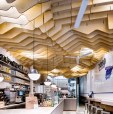
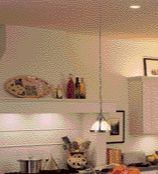
Pendants and downlighting. Above an open island or peninsula countertop, hanging, or pendant, fixtures offer plenty of design opportunities and bring the light close to the task area where it’s most effective (below).
Alternatively, directional “spot” lamps in recessed downlighting cans or track-mounted fixtures can be used to spotlight the sink area. It’s a good idea to provide separate switches for these areas so that they can “jump to life” while in use but be deemphasized when not. Line-voltage PAR30 halogen lamps use power up to 30% more efficiently than standard incandescents and are well suited for use in track and recessed cans used for task lighting.
Low-volt halogen fixtures using MR16 lamps (below) are popular with consumers because of the many design options and the dramatic effects provided by their crisp, white light. But these lamps cast strong beam patterns and hard shadows and so should be carefully planned for when used for task lighting.
Although more efficient and one to two times longer lasting than incandescent lamps, low-volt lamps also rely on transformers to step down the voltage, driving up the initial cost of these systems.
Ambient Lighting
The general, overall light in the kitchen, usually mounted in the center of the ceiling and controlled by a switch at the room’s entry, is known as ambient lighting. In California, the energy code mandates the use of lamps that produce a specific level of illumination per watt consumed, effectively limiting the choice to fluorescent. So the trick is to disguise the fixture, and there’s no end to the creative strategies. Catalog shopping unearths multiple variations on the central fixture theme, usually a light box with some type of diffuser panel suspended in front of the tubes (below).
Indirect lighting, reflected off a light-colored ceiling, is another good way to go (below). If wall cabinets aren’t filled in solid to the ceiling, the space above provides a good location for a tube array. A wall-mounted box valance can serve the same purpose. In regions with more lenient codes, incandescent and halogen fixtures can be used in the same manner and controlled with dimmer switches for atmospheric effects.
Accent Lighting
The halogen MR16 “spotlight” lamp (below) is one of the best accent lights and is available in a huge variety of styles. You can use it for lighting artwork, architectural details, collectibles, or food presentation areas.
You might consider the kitchen table as a task area, or just as reasonably treat it as an accent focus. Decorative pendants are used to good effect in many designs, adding light, color, style, and, when dimmer controlled, variable atmosphere to the space.
Light effects. Miniature track lights or low-voltage linear systems (below) mounted in an overcabinet location can throw subtle accent light on the ceiling.
They’re sometimes also mounted in the cabinet kickspace for a similar showy effect or inside glass-front cabinets to highlight special items (below). These slim energy-efficient fixtures are typically a low-watt incandescent configuration, to allow dimming. Fluorescents can be dimmed, but the special ballasts are generally too expensive to consider for residential applications.
Computer desks are often installed in the kitchen. Computing is one task that generates its own light, but an accent light can still be a useful and decorative supplement here. It’s best to use a fluorescent fixture to minimize reflected glare on the screen.
Zone the Light
With such a combination of lighting options in a room, it makes good sense to circuit lights separately, in zones. By mixing types of lights, an endless variety of lighting “moods” is possible. Accent lights should be low-voltage and dimmable. The light over the sink should have its own switch, as should lights over the island, counters, and kitchen table.
Controlling all the lights in the kitchen with a single switch deprives the user of economy and aesthetics. Programmable switching systems, such as Lutron’s RadioRA (below), are a fairly recent development. A preset lighting “scene” can be recalled anytime with the touch of a button.
A motion sensor isn’t handy only for spooking vagrants — it’s also a great way to control a walk-in pantry light when the user’s hands are full. And the lamp can be made to turn off again, automatically, after a preset interval, eliminating that forgotten light behind a closed door.
| Sources of Supply | |
Ambient, Task & AccentBasic Source 707/586-5483 http://www.basicsourcelighting.com Cooper Lighting / Halo 847/956-8400 d’ac lighting 914/698-5959 Juno Lighting 800/367-5866 Kichler Lighting 800/875-4216 Lightolier 508/679-8131 | Lithonia Lighting 770/922-9000 Progress Lighting 864/599-6000 http://www.progresslighting.com W-A-C Lighting 800/526-2588 Cable LightingPegasus Associates 412/269-0773 http://www.pegasusassociates.com ControlsLutron 888/588-7661 |