High Standards for Ceramic Tile
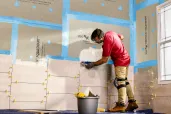
What’s so tough about sticking ceramic tile to a floor, wall, or countertop? Well, hundreds of thousands of failed installations speak volumes. And, contrary to the old adage, what you don’t know can hurt you. The Tile Council of America (TCA, Anderson, S.C.; 864/646-8453, www.tileusa.com) speaks back with its own volume, the 41st edition of the 2003-2004 Handbook for Ceramic Tile Installation. The new edition of the guide promises “14 new installation methods,” and “almost 200 editorial changes,” in its 47 pages. Clearly, ceramic tile installation is a dynamic field. The question is, how often do tile installers update their knowledge base and methods? Are the tile subcontractors you hire, or you yourself, exercising the necessary due diligence? Both tile consumption and tile technology have grown by leaps and bounds in recent years, but some inside the industry note a deficit of trained ceramic tile installers. Dave Gobis, of the Ceramic Tile Education Foundation and a member of the TCA Handbook conference, cites current sales figures of 2.8 billion square feet, a growth rate of 100% over the last 7 years and 200% over the last 14. Meanwhile, according to the U.S. Census, the number of people describing themselves as tile installers lags seriously behind that product growth. A reliable resource. The TCA develops its details and outlines only by consensus among a board of active national and regional cross-industry representatives. This means that adhesive manufacturers, flatwork masons, ceramic and glass tile manufacturers, backerboard producers, tile installers, gypsum manufacturers, and various association and council members sit down and come to terms on each and every installation detail published.
On the other hand, it means that any method or item that could not achieve consensus is left out. You can safely consider the Handbook an authoritative, up-to-date, and indispensable reference, but, because of the process, it may not be exhaustive in its coverage of newer materials and technologies. Note that the Handbook is designed to function hand in glove with ANSI A108, the 1999 American National Standard Specifications for the Installation of Ceramic Tile (ANSI, New York, N.Y.; 212/642-4900, www.ansi.org; $15) for complete installation and material specifications. ANSI, in turn, defers to ASTM, the American Society for Testing Materials (ASTM, West Conshohocken, Pa.; 610/832-9585, www.astm.org). It’s also worth noting that ANSI requires its standards to be revisited and approved every five years, so, as of this writing, a new edition is imminent.
• Cork underlayment on concrete • Hydronic heating system over concrete floors • Electric heating system over concrete floors • Fiber-reinforced gypsum panel backerboard • Coated glass mat water-resistant gypsum backerboard • Wood subfloor, 24 inches O.C. joist spacing, membrane system • OSB subfloor, 24 inches O.C. joist spacing • Electric system over exterior-glue plywood underlayment • Electric system over cement backer unit underlayment • Cementitious-coated foam backerboard • Backerboard ceiling • Cementitious-coated foam backerboard tub walls • Cementitious-coated foam backerboard shower receptor • Thinset shower receptor renovation |
As technical manuals go, the Handbook is written in a readable style, and where industry jargon is used, it’s usually carefully defined. Nonetheless, with all that’s on your plate already, it may be tempting to give it a weary glance and decide, “I’m gonna let my sub handle this.” Not so fast. Prominent in many of the installation methods detailed is the category “Preparation by Other Trades.” For example, in anticipation of floor tile, who makes sure the plywood underlayment is installed with a minimum 1/8-inch gap between sheets? Who ensures that adjacent sheet edges don’t deviate in plane by more than 1/32 inch? Or sees to it that underlayment seams don’t coincide with framing below? Or that the underlayment fasteners don’t penetrate joists below? If a liability issue arises following an installation failure, neglecting any one of those items (and there are more) could leave you holding the bag.
Individual copies of the TCA Handbook cost $7, or $3.50 in quantities over 100. A CD-Rom version ($12 individual, $6 bulk order) includes hyperlinks to applicable ANSI standards and system details in CAD “dwg” format for incorporation into your own designs.
Better BondingThe National Tile Contractors Association (NTCA, Jackson, Miss.; 601/939-2071, www.tile-assn.com) offers a 71/4-minute video titled “Trowel and Error.” Get it? Well, maybe you should, even if it costs $13, shipping and handling included. A better, faster method for bonding tile in thinset mortar is demonstrated, and it couldn’t be simpler. Instead of spreading thinset the old way, in random swirls, the video recommends combing the mortar in one direction, in parallel ridges, then pressing the tile in place with a sliding motion, perpendicular to the ridges. This method is better because it ensures near-perfect embedment, providing full bonding and support for the tile. It’s faster because it eliminates the need for supplemental back-buttering and beating the tile in. Old way bad. New way good. And we just saved you at least $13. |
Mosaics for Dummies
Put a cartoon under a magnifying glass and it breaks into thousands of colored dots. Import an image into TileCreator (Tile Creator, Ramona, Calif.; 760/788-1288, www.tilecreator.com) and it breaks into a mosaic tile pattern. This clever software program is both fun and simple to use, and the design applications are virtually unlimited. The program works with any image, art, or photo, saved in jpg, tif, or bmp format. After choosing and opening an image in the program, you select a material palette. More than 45 proprietary mosaic tile lines are provided for selection. Alternatively, custom selection sets can be created in the program using scanned images of actual tiles. An add-on program, PaletteCreator, is available to facilitate palette creation.
TileCreator converts a digital image into a tile mosaic. The program allows you to vary the mosaic’s level of detail by altering the size of the tile and the size of the overall installation. A material schedule gives the number and color of tiles needed, from any of 45 preloaded commercially available tile lines. You can add other tile lines, or create your own custom palette.
The level of detail depends on two factors: the size of the tile, and the size of the final mosaic. The smaller the tile, or the larger the image, the better the resolution or level of detail will be. You can play with both parameters to get the desired result, from unmistakable likeness to abstract image.
A setting of 1 gives a near 1:1 ratio match. The default setting is 5. The higher the ratio setting, the more abstract the image becomes. You can play with the ratios and review the resulting changes as you go. Standard mosaic tile sizes include 3/8-, 3/4-, and 1-inch squares, but the software also performs calculations for resized tile.
The program delivers a total count for each tile color required by the design and a printable, “paint-by-number” grid to guide assembly. A fully editable estimating screen provides a cost per tile by color, along with fabricating and mounting costs calculated per square foot. The program applies a standard default assembly time based on the proprietary plastic TileGrid system (available at the company’s website and through tile retailers). You can adjust the assembly time up or down and determine the hourly rate.
You may not choose to run with this program’s estimate, but it certainly provides a realistic basis of cost for what would otherwise be wild guesswork.
TileCreator Professional Version 2 costs $70 and offers inexpensive entry to a world of customized creativity, bound to capture your clients’ imaginations. Not to mention your own.
Laminates

Imitating the Imitator.
Imitation is a high form of flattery, and engineered stone does make a nice impression. But while it addresses the porosity and color limitations of its natural source, engineered stone does nothing to bring prices down to earth. The Topaz high-pressure laminate line replicates the look of engineered stone and features a “rich, saturated color range.” The eight patterns offered are stocked in sheet sizes from 4×8 feet to 5×12 feet with a “#7 finish,” said to imitate polished stone. The material cost is about $1.80 per square foot, retail. Wilsonart International, 800/433-3222, www.wilsonart.com.

Taken for Granite.
There are places and purposes, not to mention a budget, for solid stone. But that popular countertop material is by no means the only, or even the best, choice for every situation. The low-sheen Honed Finish and high-gloss Etchings Finish Collections are said to look and feel like real stone but are priced like the high-pressure laminates they are. Both materials mimic the tiny fissures and imperfections found in natural stone like slate, travertine, and granite. The installed countertop cost is estimated to run a budget-friendly $25 per linear foot.Formica, 800/367-6422, www.formica.com.

Laminate Illusions.
Holograms are showing up on driver’s licenses, credit cards, and even paper money. But none of those make practical backsplash covers or cabinet veneers. Well, the search is over. Paparazzi! Holographic Surfacing’s got it covered (pun intended), with four high-tech laminate patterns designed for some of the most optically oriented surfaces you’re likely to offer. The laminate is meant for vertical applications only and is expected to apply predominantly to commercial spaces, but don’t let that stanch your creative juices. Paparazzi! is available in 4×10-foot sheets, is made to order with a five-sheet minimum, and requires a four-week lead time. The cost per square foot is $6. Nevamar, 800/638-4380, www.nevamar.com.
Decorative Hardware

Knobs of Nippon.
Stuck on knob selection? Look to the east. The Asian selection of 31 knobs and pulls pays homage to shop signs of 11th-century Japan. The various trades employed simple craft-related graphics to advertise services such as that of sake purveyor or Samurai sword maker. The knobs are made from lead-free jeweler’s metal with a bronze or pewter patina. The complete collection may be viewed and priced online at the company’s website. North River Mint, 800/914-9087, www.northrivermint.com.


Hand-Stitched Handles.
Allegedly, this line was knocking ’em out at the Kitchen and Bath Show last year, so don’t be bashful about suggesting English leather-clad fittings to your clients. The design line is extensive, attractive, and tactile and complements both natural wood and painted finishes. Leather colors are black, chestnut, and chocolate. Bath fixture prices vary by item; door lever and latch sets start at $300. Turnstyle Designs, 877/288-4642, www.turnstyledesigns.com.


Human Hardware.
Add a human touch to your next kitchen or bath installation with a few characters from the Manhandles Collection. Figures range between 7 1/2 and 11 1/2 inches high, depending on the pose. They’re produced in hand-cast stainless steel or bronze and a choice of seven finishes. Individual handles cost between $175 and $195, but it takes only a few, or even just one bold handle, to make a statement. Sóko, 888/828-7656, www.sokostudio.com.

Megnaficence.
Glass artist Martin Megna produces coordinated mouth-blown knobs for both cabinets and passage doors, a unique and beautiful bathroom design detail. Cabinet knobs cost $18 to $28 each; door knobs cost $120 to $150 and are compatible with most older 3/8-inch-square spindle mortise latches and Baldwin’s “Estate” series door hardware. Megna Hot Glass Studio, 631/725-1131, www.megnaglass.org.