I’ve been building houses in the Toledo, Ohio, area since 1987. For most of that time, my focus was on custom homes in the $250,000-$300,000 range. But over the past few years, a worsening shortage of qualified trade contractors was making it more and more difficult to thrive in that area of the market. Since I had no crew of my own and subbed out most of the work, I was faced with drawn-out build schedules and cost fluctuations that made me uncomfortable.
After six months of researching some possible alternatives by reading, surfing the web, and touring several modular-home plants and talking with factory representatives, I decided that the best way to speed production and reduce uncertainty was to begin building custom modular homes instead of stick-built homes.
My research also convinced me to move into the less expensive first-time-buyer market, which in my area means building houses that sell for $150,000 to $175,000. Few builders move from more expensive to less expensive homes — the usual progression goes the other way — but strong local demand for lower-priced housing made that the best way to take advantage of the speed and simplicity of modular construction. Although my per-house income would decline, I’d be able to build more houses in the course of a year, boosting my overall profits.
Today, with about ten modular projects under my belt, things have worked out every bit as well as I’d hoped. Going modular has also freed up my time enough to allow me to spend much of the past year putting together a local 100-house development. Once the construction phase starts, I plan to build modular houses in the development as well, which will give me the benefit of volume purchasing and allow me to offer buyers a very attractive price.
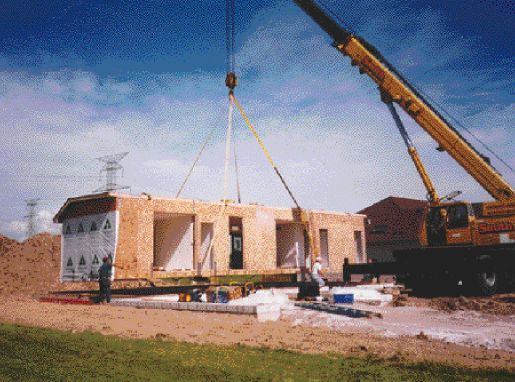
Each module arrives on the building site on a steel carrier towed by a tractor-trailer rig. Pitched roof sections are folded down for shipment. Windows, doors, and most exterior trim are already installed, and the front and back walls are covered with vinyl siding enclosed in a protective wrap. The gable ends will be sided after the installation is complete. After the modules are delivered, two or more carriers can be stacked for the return trip to the factory. The rear module is craned onto the foundation first, with its roof still in the folded position. The set crew powder-fastens support posts to the basement slab and bolts them to the central LVL girder.
Cost and Quality
Modular construction allows me to take advantage of the manufacturer’s volume discounts on materials, and the accelerated build schedules help keep the price affordable for both buyer and me. When all the bills are paid, I’ve found that a modular costs about 10% less to build than a comparable stick-framed home. In addition to offering a variety of plans, each manufacturer also provides a range of options for good-quality fixtures, trim, cabinets, and other features.
Most of the modular companies I work with, for example, use Merillat cabinets, GE appliances, and windows from major manufacturers like Andersen and Pella that are better than the low-cost generic windows found in many stick-built houses in the same price range. Buying these items through a modular manufacturer gives me the benefit of volume discounts on name-brand products, so I don’t have to compete with stick builders on price and quality.
The bottom line is that modern modular houses are as good as or better than comparable stick-built houses. I often take potential buyers through a local development of about 70 homes, about a third of which are modulars. No one has yet been able to distinguish the modular homes from their stick-built neighbors.
In addition, the controlled environment of a manufacturing facility reduces quality-control problems and makes concern about variables like bad weather and finding good help a memory. Because the factory is always dry, there’s no chance that rain-soaked framing members will warp or plywood will swell or delaminate. As a result, I get straighter, better-looking walls and floors.
Business Advantages
While material prices for stick builders can change from one day to the next, modular manufacturers only increase their prices every two to four years. That price stability allows me to write very tight estimates. When I send a set of drawings to a manufacturer, I generally have a firm price in hand within a matter of days. After I enter the costs of site work and finish, I have an accurate cost figure that isn’t subject to unexpected change.
Less is more. Depending on the manufacturer, the time of year, and the complexity of the plan, the time between placing an order and taking delivery of the completed house runs from as little as two weeks to several months. Besides the advantages of shorter build schedules and the benefits of building in a manufacturing facility, this system has other benefits. I no longer have to deal with a framing, roofing, insulation, or drywall sub because all that work is done by the manufacturer. As a result, I no longer have to spend hours researching materials invoices to make sure they’re accurate. I have fewer phone calls to make, fewer 1099 forms to prepare, and fewer insurance certificates to collect for the annual insurance audit.
All this translates into much less time spent on administration. As an example, the last custom home I built required me to write 149 checks, while the last modular home I built required only 33. Because the projects are completed much faster, I also enjoy reduced insurance costs. My waste-removal costs are minimal, and the homeowner pays less interest while waiting for the house to be finished.
As demonstrated by these simplified construction schedules drawn from two of the author’s recent projects — one for a 2,000-square-foot stick-built house and one for a 1,600-square-foot modular — a modular job is measured in weeks, rather than months. While differences in size and cost between the two projects mean that this isn’t a true apples-to-apples comparison, the benefits of modular are apparent. Note that the exterior finish work, interior finish, and lot finish begin simultaneously when the house is delivered to the site, midway through the third week, rather than spread over a span of 13 weeks.