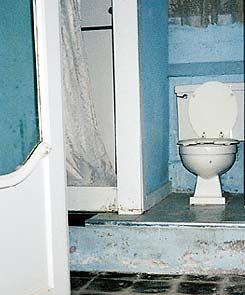
Adding a bathroom to a finished basement greatly improves the livability of the space, though at first glance it appears to have gravity working against it. After all, in most basements the main drainpipe exiting the house is closer to the ceiling than to the slab below. Actually, this is an easy opportunity to triumph over client misgivings and Newton’s apple. There are two ways to connect a toilet to an existing overhead drain line: an in-floor ejector system or an above-floor system. The above-floor system uses a sealed pump tank, to which the bathroom fixture drains are connected. The tank can be concealed in an enclosure or closet, and requires little or no demolition of the concrete floor. On the down side, you’ll have to build a raised platform, about 6 inches high, to accommodate the waste pipe. This means that access to the toilet requires a step up. The platform may also impinge on headroom requirements.
Low-Profile Pumping
I prefer the in-floor system, and customers are usually happier with it because it provides a normal appearance and easy access to the toilet. In one recent job, I converted a raised-platform toilet to an in-floor installation (see Figure 1).
Figure 1. A basement toilet on a platform (top) installs easily but is awkward to use. Using an in-floor basin with a sewage grinder pump creates a normal appearance and doesn’t impinge on headroom (bottom). | |
| null |
In-floor installation requires some concrete demolition to install the sump basin and underfloor piping. The basin is a sealed unit, typically made of polyethylene, high-density polyethylene structural foam, or fiberglass, and contains a powerful grinder-ejector pump. These are rugged units that rarely require maintenance, although foreign objects may resist grinding and jam the works. Depending on the unit, the basin measures a minimum of 18 inches wide by 30 inches deep. It can be located anywhere in the basement floor, but it’s important to allow floor space for the basin and all of the related piping, with access for maintenance. I try to install the basin outside the bathroom, close to the point where it connects to the existing sewer line. This also eliminates anything unfamiliar in the look of the new bathroom.
More from Journal of Light Construction
-
Waterproof Gypsum Backerboard
1 MIN READ
-
Expansive Glass Wall
1 MIN READ
-
Interior Fire-Rated Plywood
1 MIN READ