Summer is here! Whether you live with heat all year or just get to have it for a few months, knowing how to manage the conditions around you is vital to staying safe. In my article “Working in Winter” (1/26), I talked about how we cannot control the weather we work in, but we can control how we prepare for it. In my region, summer temps can get into the 30s Celsius (high 90s Fahrenheit) with the added joy of elevated humidity. Yes, the 100-degree temperature swing from winter is fun. So, knowledge about what that kind of heat can do to a person who is doing physical labor is important to have.
What I want to go over in this article are the different physical results of heat and sun exposure and how to treat them or mitigate them. I also want to talk about clothing choices, work practices, and hydration. While many of you may know the first aid portions of this, I recommend spreading that knowledge to your whole crew. If the one person who has all the first aid skills is the one who needs the help it’s going to be a bad day.
How the Body Reacts To Heat
The human core body temperature is around 98.6 degrees F. That can vary slightly between individuals but in general that is where your body wants to be. When you start to get warmer than that, either from physical activity, the ambient temperature, or a combination of the two, your body will try to cool itself down in the following ways. You will start sweating and the evaporation of the moisture on your skin will release heat. Your heart rate will also increase, which helps pull heat from your core to the extremities. Connected to that, your blood vessels will dilate, resulting in increased blood flow. This, in turn, helps release heat by radiating it away from the core and aids in the sweating and evaporation process.
This all works well so long as nothing impedes the process, and so long as the exposure is not for long. The things that can get in the way of this are: high humidity that reduces the effect of sweating; restrictive clothing that constricts blood vessels and traps heat (creating a feedback loop where you keep getting hotter); and being poorly hydrated (if you don’t have enough fluids then your body can’t produce the sweat to cool you). In addition, poor cardiovascular health will make that increased heart rate difficult to maintain.
First, Get Out of Your Body’s Way
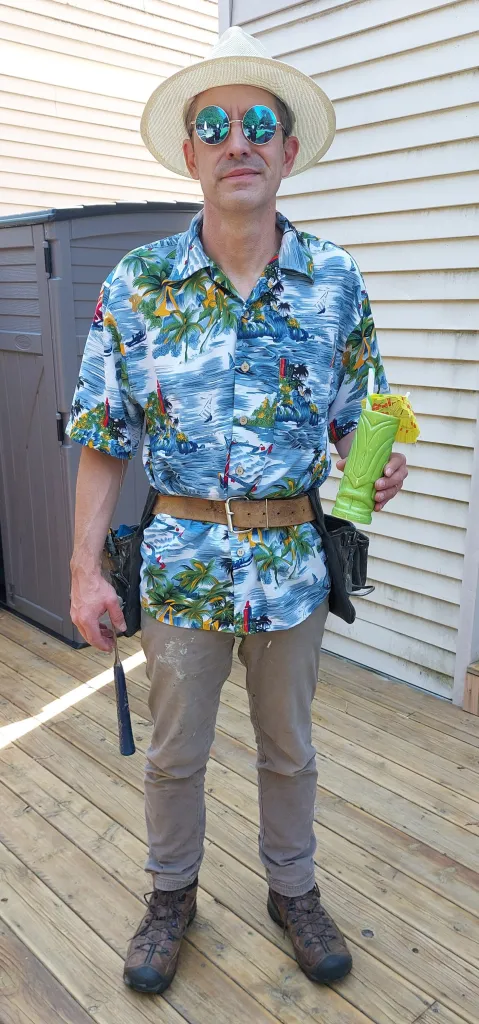
As a baseline, you need to wear loose, light-colored clothing and not too much of it. You want moisture to be pulled away from the skin without becoming trapped in the fabric. Quick-dry synthetic fabrics are good for this, and so are linens. You want light colors so that the sun’s radiation reflects away from you. Again, you also want clothes to be loose enough to move with you so they don’t constrict blood flow and can allow air to pass over your skin.
You also need to drink in order to sweat, and to consume the right types of drinks. To prevent dehydration, an average male needs 13 cups of liquid a day and a female 9 cups (according to The Institute of Medicine, which is the health arm of the National Academy of Sciences). If you are sweating and physically active, then you will need to drink more. Water is the easiest, but fruit juice and sports drinks can be part of that mix. (Energy drinks with high levels of caffeine and sugar are not recommended. High concentrations of caffeine stimulate urine production, and high sugar concentrations draw water from the body’s tissues. The effect of both increases dehydration.) The salts and other minerals in juice and sports drinks help replenish what you lose throughout the day. If you are thirsty, then you are already 1% to 2% dehydrated. If coffee and energy drinks are part of your extra fluid intake, then try to add a hydrating drink instead of a dehydrating one.
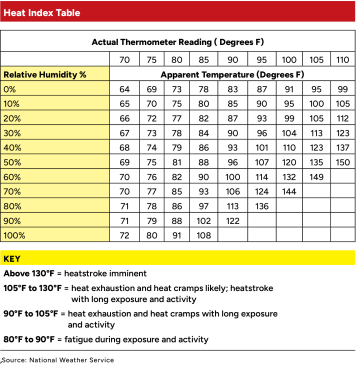
In terms of exposure time to heat, you need to listen to your body and take cool-down breaks. Watch your pace on hot days, doing heavier work in the cooler morning and reducing the heavy stuff as the temperature rises. Your body can’t cool down if it’s creating heat through activity.
For cardio health you need to think about your fitness. The less in shape you are, the more difficult it is for your body to cope with the stress of heat. There are some other no-brainers too, such as limiting time directly in the sun, increasing airflow around you, wearing a wide-brimmed hat, not drinking alcoholic beverages, and using sunscreen.
When That Fails…
Even if you or your coworkers have done everything right, the heat and sun can be too much. There are a few symptoms of heat and sun exposure that need to be watched for and actively treated. These include cramps, swelling, rashes, burns, and even life-threatening heatstroke. Starting with some of the less harmful ones and working our way up, let’s look at these symptoms and their treatments. Keep in mind that even a relatively minor affliction can escalate if not paid attention to and treated—for instance, experiencing cramps or dizziness while on a ladder can be dangerous.
The following first aid advice is taken from St. John Ambulance’s “First Aid Reference Guide” (4th edition, 2019) and the “Wilderness First Aid Field Guide” (6th edition, 2022) by the Emergency Care and Safety Institute. This information should always be checked against the latest information available and with medical professionals.
Heat Edema
Good old swollen ankles and feet can happen to most people from standing all day, especially in the heat. And it can be common early in the heat season when your body is not yet acclimatized. Edema can get uncomfortable if it persists. Elevating the legs and even wearing support stockings can help.
Heat Rash
Here you have an itchy red rash on the skin, usually caused by all the sweating you are doing. If the weather is humid, then the chances of this rise significantly. Often the rash appears around the neck or on the insides of the legs, and it doesn’t become painful if treated early. To prevent heat rash, try to stay dry. I know that’s not easy to do, but wearing wicking clothing (quick-dry synthetics, not cotton) and changing your clothing will help. The treatment is to get the area to dry and allow it to breathe and cool down. If the rash persists, then topical creams could be called for.
Heat Cramps
This usually presents as painful cramping in the abdomen or back of the legs. This can start as muscle spasms and then progress to a full clenching of the area. It also may occur long after the heat exposure or physical activity.
The cause of this is the depletion of electrolytes in the body, so prevention means keeping your levels up on hot days and on average workdays as well. The treatment is stretching, resting in a cool area, and hydrating. Fluids with minerals, such as sports drinks and fruit juices, may help. Salt tablets are not recommended (see “A Note on Salt Tablets” below) but a ratio of ¼ teaspoon of salt to one quart of water is a standard first aid treatment to replenish sodium in the body. This should be consumed in small sips to reduce the chance of nausea or vomiting. Even with this strategy, cramps can last a few hours before subsiding. If the cramping does not subside, seek medical help.
A Note on Salt Tablets
According to the first aid books referenced above, as well as the Mayo Clinic and Johns Hopkins Medicine, salt tablets are best administered by medical professionals. The reasoning is that you are adding a highly concentrated dose of salts and other minerals to the body. This high dose can be dangerous if not accompanied by enough fluids. If care is not taken, you could be doing more harm than good.
Heat Syncope
This one usually is seen as a precursor to heat exhaustion or heatstroke but can be a stand-alone condition. Here the person will feel dizzy and may even have a fainting spell. This often happens right after physical exertion or heavy heat exposure. If you or one of your coworkers start to feel this way, get to a safe place quickly. I once had a coworker say they were feeling odd just before turning away from me and dropping like a stone. They had just helped lift a beam. If they had been in mid lift or at a height when they fainted, then the result would have been more than a bloody nose.
If someone has fainted, check for breathing and injuries, and escalate to getting medical care if they have trouble regaining consciousness. When they awaken, help them rest with their feet elevated, cool down with water, and if not nauseated get them hydrated as you would with heat cramps. (This strategy also applies to someone who is dizzy but hasn’t yet fainted.)
Sunburn
While this seems less severe than fainting, I (and others) consider it serious due to what can result over time. I know a roofer and a siding/window installer who both had parts of ears and noses removed due to skin cancer. According to their doctors this was a direct result of years of having unprotected skin exposed to the sun. As with most conditions, prevention is the best course of action. A sunburn is a radiant burn caused by the sun’s rays. As a burn, it has classifications similar to any other burn: first, second, and third degrees. Usually, the sunburns we see are red and swollen skin with some blisters—these fall in the first-degree or pushing-second-degree level.
The prevention is to keep exposure time down, cover as much of your skin as possible, and apply regular applications of sunscreen (once in the morning won’t do). The treatment is to cool the area with a damp cloth, which reduces the heat and soothes the pain, and to gently apply an ointment once the skin has dried. Do not break any blisters—this can cause infection and scarring—but instead let the area heal over time. Try to be extra diligent in covering the area as it heals so that you don’t do further damage. During and just after healing the skin is very sensitive to heat and the sun’s rays. If vomiting, nausea, or dizziness starts, then you are getting into our next condition.
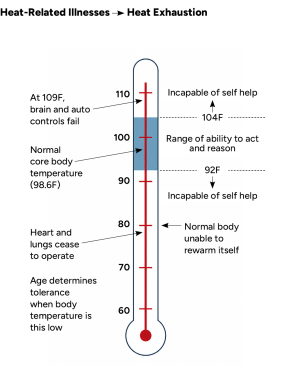
Heat Exhaustion and Heatstroke
Heat exhaustion and heatstroke (sometimes called sunstroke) are terms frequently used interchangeably. However, they are different. Heatstroke is the more dangerous, life-threatening condition, and will often evolve from untreated heat exhaustion.
These conditions result from dehydration, physical exertion, and heat exposure, which cause blood circulation to pull away from the major organs and to pool in the blood vessels close to the skin. With heat exhaustion, the symptoms are: excessive sweating, thirst, fatigue, nausea, headache, rapid pulse, and shortness of breath. It often feels like having a flu. If you or a coworker get to this stage, it needs to be taken seriously and treated immediately. You need to get the person to a cool place and keep their head and shoulders elevated with their knees bent. Remove any extra clothing. Give the person fluids if they can take them, but give them small sips to reduce the chance of vomiting. As noted above, salted water (¼ teaspoon to one quart of water) can be administered, also in small sips.
The person should not be left alone, or should be checked on frequently. They may seem stable, but symptoms could progress to fainting and/or vomiting, which can be dangerous. Recovery can take quite some time, so their workday is done at this point and they need to rest and slowly hydrate.
With heatstroke you will see the previous symptoms, but the person’s mental state will be altered. Look for confusion, unresponsiveness (blank stare), or agitation. The skin also will feel very hot but not usually wet like with heat exhaustion. Here, treatment is the same, but a call to get medical attention should be made.
More on Mitigation
We plan for site conditions, material requirements, and workflows, but weather conditions also need to be planned for. Some of the simple things my partners and I did included saving work in the cooler areas of the home (basement and first floor) for the hottest days. The third-floor trim would be worked on first thing in the morning or not at all on the hottest days. We started earlier or took a long break in the middle of day, rejoining the work in the evening. We made sure to have water and sports drinks onsite every day and created a schedule for it to be replenished. Taking a cool-down break was normalized—no judgment if you needed a minute. We also benefited from a sun shelter tent with a mist fan that was a standard setup for the crew who did our foundations.
I asked other JLC contributors what they do to help beat the heat and what follows are their replies.
John Carroll, Builder, Durham, N.C.
I spent the first 10 years of my career working on roofs, mostly in North Carolina. So, I definitely developed strategies for working in the heat.
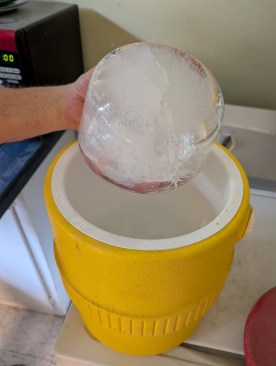
John Carroll
John freezes a pot of water and puts the block into his cooler for the day. A solid piece of ice like this lasts much longer than a few ice cubes.
Work as much as possible away from the sun. If you’re working on the side of a house, for instance, don’t get hung up on finishing that side before starting on another side. Instead, stop when the sun is beating down on that side and move to another side. Oftentimes, you can’t get completely out of the sun on a roof but you can go to a side where the sun’s rays hit at a more oblique angle. The south and east sides of a roof, for example, are brutally hot in the morning, but that ameliorates a bit in the afternoon when the sun is beating down on the west side. A rule of thumb for roofers or siders is to avoid working with the sun on your back.
Schedule your day to avoid the heat. On extremely hot days, I’ve arrived at daybreak and quit at 11:00 a.m. Sometimes, it pays to take a long break at midday, then return to work late in the afternoon. The afternoon is the time to work on the east and south sides. Drink plenty of water. Then drink some more. Water is essential. An old roofer’s trick is to rub some of that ice water on your wrists, too. It’s surprising how much it cools you down.
Mark Clement, Deck Builder and
Remodeler, Ambler, Pa.
I start with wearing a good wide- brimmed hat. You need to keep the sun off your head and face as much as possible. Even the hard hat I wear allows airflow and this goes a long way in keeping my head cool. I keep a change of shirts with me and when one gets soaked through I change it. I also spray myself down with a hose in between shirt changes.
I will set up a fan that blows across the deck I am building and another one just at my feet under my cut station. In a back yard with vinyl siding on two sides and a composite deck, the reflective heat is oppressive, so a bit of a breeze goes a long way.
Jake Bruton, Owner, Aarow
Building, Columbia, Mo.
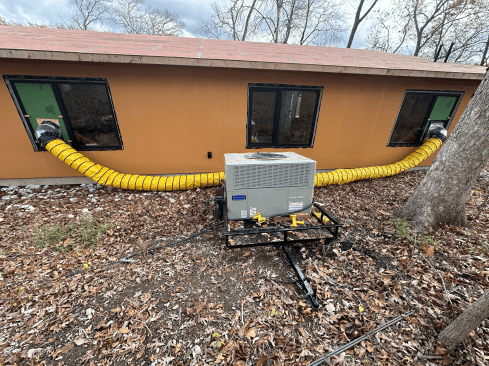
Jake Bruton
Jake’s onsite AC not only improves conditions for the crew but also helps productivity.
At my company we have a few ways to help our crews get through the summer months. On each of our work trailers we carry a pop-up tent for shade. This one took a while to become standard practice, but once one of our younger guys started putting it up the older crew members saw the value and made it a regular thing. We also carry box fans that the crews can set up on site. That can either be outside to give them a breeze or blowing up from the basement inside a home. In either case, it helps.
One of the bigger things we do is have air conditioning units mounted on landscape trailers. We put these on site and run temporary ductwork into the home (see photo). Since our homes are usually weathertight with ZIP sheathing, we can get the temperature in the house down from say the mid to high 90s to around 80 degrees F. This makes a big difference to our crews and helps bring in subs. When we can tell our subtrades that they will be working on an air-conditioned site they will generally prioritize our jobs. This has worked out well in keeping our jobs on time even during the hottest periods.
Common Sense
Most of what keeps us safe at work is straightforward, but I sometimes pushed the precautions aside when on a tight deadline. That is when, sometimes, bad things happen. The “sometimes” part is what makes us complacent. If you got a sunburn every time you walked outside without sunscreen you wouldn’t forget to slather up. Since you don’t feel the consequence every time, you start to think it does not apply to you. Take the time to think out your workdays when facing the summer heat. There’s no special badge for working on the hottest day of the year.
Keep the conversation going—sign up to our newsletter for exclusive content and updates. Sign up for free