Kitchen & Bath: Installing a Farmhouse Sink
The farmhouse sink has risen from the salvage yard to become an increasingly popular option in today’s kitchen. Also called an apron-front sink, the traditional farmhouse sink was hung on the wall at a height that suited Mrs. Greenjeans. But today, wall hanging is the exception, not the norm, making installation more of a challenge. Because many of these sinks are now custom made, and most have unusual installation requirements, planning for a farmhouse sink should begin early in the kitchen design stage.
Special cabinet requirements can come into play. For example, reinforcement may be necessary under a vitreous china or fireclay sink, which can easily weigh in the hundreds of pounds empty. A deep bowl is one of the appeals of these sinks, but there’s no single standard among the many designs and makers. The supporting cabinet must be either custom made or somehow adapted to permit rim alignment at the countertop. In some installations, filler strips are used to complete the apron’s integration with the cabinet front. And just to keep things interesting, the sink may install as an undermount, rim mount, tile-in, or even be surface mounted, vessel style. Additionally, the sink may be installed with its apron flush, recessed, or projecting from the cabinet front. Each method and every design variance carries its own peculiar details, making manufacturers’ prescriptive instructions scarce.
A farmhouse sink faucet is typically wall mounted or installed in the countertop behind the sink. Wall mounting may require a special wall buildout at the backsplash to keep the supply lines out of the exterior wall. The area at the back of the sink is also more exposed to drips and splashes under either a deck- or wall-mounted faucet, making watertightness imperative. Some makers offer sinks with integral backsplash and faucet panels, providing an all-in-one solution (see Figure 1).
Figure 1.A high integral backsplash conceals wall-mount faucet supply lines and simplifies waterproofing the sink area.
Materials
Apron sinks are manufactured of many different materials, including stainless steel, hammered copper, enameled cast iron, solid surfacing, quartz composite, granite, and fireclay. But the quintessential farmhouse sink is definitely the fireclay version, first manufactured in England around 100 years ago and made in the same manner today. The fireclay is slip-cast, or poured in liquefied form, into plaster molds, then dried, glazed, and kiln fired. The result is a material of notable hardness and durability. Due to its thick walls, hands-on fabrication, and material shrinkage during firing, actual sink size can vary by plus-or-minus 2% from nominal dimensions. This makes it advisable to wait until you have the unit in hand before cutting and fitting the countertop or cabinet front. It’s also why you can forget about requesting an installation template, as each unit varies slightly from the next.
Keep plumbing in mind when placing an order; manufacturers may provide special fittings essential to a farmhouse hookup. The inherent wall thickness of a fireclay sink — up to 2 inches in some models — can complicate a standard disposal installation. Some sink manufacturers offer flange adaptors or even special disposal units made to fit fireclay sink drains. Furthermore, the drain may be located toward the front of the sink. The sink’s rounded outside corners require it to sit forward to clear the cabinet, so the cabinet must be at least 24 inches deep, front to back, to enclose the disposal unit.
Granite, slate, and soapstone can be carved into beautiful farmhouse sinks, but you’ll definitely want some help with the installation and a cabinet capable of carrying a serious load. Some models weigh in at over 300 pounds (Figure 2).
Figure 2.A solid-stone apron-front sink can easily weigh 300 pounds and claim a considerable piece of the installation schedule.
Stainless steel. High-quality stainless steel, 18-gauge or heavier, with 18/8-chrome/nickel content (18% chrome for strength, 8% nickel for corrosion resistance), seems to be the standard specification in the farmhouse category. The apron front is often made of heavier, more dent-resistant material than the bowl; for example, the Cotswold sink features a 16-gauge apron and 18-gauge bowl (Figure 3).
Figure 3.Stainless steel shows no sign of losing its dominance in the sink department. Apron-front models typically feature 18-gauge basins and heavier 16-gauge aprons to help withstand frontal impact.
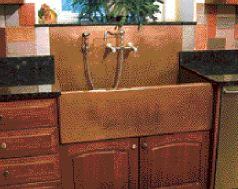
Copper means custom, and a custom copper sink has much going for it. Custom Sinks by Rachiele offers many unique features, including a patent-pending apron-front basin made to fit stock cabinetry. A shorter-than-typical apron is designed to fit over the face frame rail of a standard sink base cabinet (Figure 4). The sink basin drops behind the face frame, permitting the forward installation and deep basin characteristic of the farmhouse style. This is one good way to get the farmhouse look in a retrofit situation or when working with stock cabinets. Naturally, when working with a sheet-metal sink, whether copper or stainless steel, there’s no unusual concern about its weight or the need for extra structural support.
Figure 4.This one-of-a-kind custom sink design provides a retrofit or stock cabinet solution by fitting the apron over the top rail of the face frame and replacing the drawer face blank.
Solid surface. The 105-pound Blanco Silgranit sink, made of 80% granite and 20% resin, is a hybrid combo of the self-rimming, vessel, and farmhouse styles (Figure 5). Its 3 1/2-inch-high “apron” substantially raises the rim above standard counter height, which could play to the advantage of a tall user, or you could compensate by lowering the sink section of the countertop. This sink can also be adapted for undermounting, giving it plenty of versatility.
Figure 5.This sink approximates the farmhouse look in a drop-in format. The 3 1/2-inch-high rim height should be considered when establishing the height of the countertop. The granite composite material is said to be extremely stain and scratch resistant.
The American Standard Chandler apron-front sink (Figure 6) is made of solid Corian. Therefore, the sink might seem like a natural for an integral, undermounted installation in a solid-surface countertop. In fact, it’s made only for drop-in rim mounting and weighs a relatively light 66 pounds. A rectangular recess in its apron allows the installation of a decorative tile frieze.
Figure 6.Despite its solid-surface composition, this sink is designed for rim mounting only, making for a fairly conventional installation.
Installation
In the truly traditional “unfitted” farmhouse look, the sink either hangs on the wall or rests on a piece of furniture exclusively dedicated to the task (Figure 7).
Figure 7.An upscale look from the turn of the 19th century makes a comeback in this contemporary display.
Some makers have tie-ins with cabinet manufacturers and can provide period-look and contemporary bases for their sinks. Rohl will commission cabinetry from a small, local firm for some of its imported Shaw’s Original fireclay sinks. Working the other way around, Crown Point Cabinets will build its cabinet to suit any sink model. And Vanity Flair claims its cabinet will “accommodate most all farmhouse sinks” (Figure 8).
Figure 8.If the sink manufacturer doesn’t offer a proprietary cabinet, a custom cabinet manufacturer can build to suit the sink (left). Vanity Flair claims its furniture-style base will accommodate most farmhouse sinks (right).
The “ideal” height for the sink rim is between 4 and 9 inches below the elbow of the standing user, according to Dino Rachiele, an experienced kitchen designer and the founder of Custom Sinks by Rachiele. Rachiele has made an informal but rigorous study of the ergonomics of kitchen sink usage and offers the following guidelines: For users between 5 feet and 5 feet 3 inches tall, the “perfect” bowl depth is 8 1/2 inches because the bottom of the sink can thus be reached without uncomfortable stretching; from 5 foot 4 inches to 5 foot 5 inches, the best bowl depth is 9 inches; from 5 foot 5 inches to 5 foot 6 inches, a 9 1/2-inch bowl is most comfortable; and 5-foot-6-inch to 5-foot-11-inch users will feel at home with a 10-inch-deep bowl. Oddly, however, users 6 feet and taller should regress to a shallower, 9-inch-deep bowl to avoid bending at the waist and developing an aching back. These guidelines assume a standard, 36-inch countertop height. Although current kitchen design often uses varied countertop heights to ergonomic advantage, the presence of an adjacent dishwasher tends to anchor the sink counter at 3 feet. Naturally, your clients may have their own thoughts on what feels right and should be consulted.
There’s said to be another ergonomic advantage to a farmhouse sink: Because the work area is brought further forward than in a standard, countertop installation, the need to bend and reach is theoretically lessened. But make sure the valve location doesn’t force the user to lean forward to reach it, defeating the sink’s forward design advantage. Narrow front-to-back depths, wall-mounted valves, and long-necked spigots all contribute to the classic farmhouse look.
The way things used to be, today. The doors in a standard sink base cabinet are usually too tall to fit below the typical farmhouse basin. While it’s possible to modify a stock cabinet, it’s more common to order a custom cabinet for a specific sink. Kohler advises the construction of a sink cabinet capable of supporting 300 pounds for its fireclay sinks. Vertical cabinet panels of 3/4-inch cabinet-grade plywood with direct bearing on the floor should easily satisfy that requirement.
Drop-in, tile-in, or undermount? The most significant difference between a drop-in and an undermount farmhouse sink is the sequence of installation. A drop-in sink follows the finished countertop installation and is complicated only by the possible need to fit the cabinet face around the apron. Stainless-steel and copper sinks can be undermounted using clips, anchors, sealant, or a combination to secure the rim to the countertop’s underside. A tile-in sink (typically cast iron or ceramic) is installed after the countertop substrate (exterior-grade plywood and tile-appropriate backerboard) with its rim raised by the thickness of the tile and backerboard. Kohler emphasizes that the rim and weight of its fireclay sinks must not bear on the tile backerboard. Any undermounted fireclay, stone, iron, or vitreous china sink should be installed in, and be entirely supported by, the cabinet before setting the countertop. The sink rim must be absolutely trued to the top of the cabinet to ensure complete contact with the countertop’s underside. A bead of sealant — silicone is best — between the rim and the countertop is the only assurance against a leaky installation. Masking tape applied to the countertop edge and inner face of the sink bowl will keep the squeeze-out under control while you tool the sealant. Let it form a skin before you pull the tape.
The weight of a stone or fireclay sink and the lack of access to the underside can make height adjustments somewhat dicey. Fireclay sinks in particular are known to be slightly irregular, making it difficult to prepare precise support. Veteran Seattle installer Dave Starr has developed a neat trick for fine-tuning the installation of a heavy farmhouse unit. Before setting the sink, Starr installs a tee-nut under each corner in the cabinet support panel, drilling completely through the panel to allow screw insertion from underneath (Figure 9). With the sink set on the support panel, he then uses the screws to precisely adjust the height of each corner, flush with the top of the cabinet. A generous blob of silicone at each screw helps hold the sink in position.
Figure 9.Tee-nuts provide adjustability beneath a slightly irregular ceramic or fireclay sink slated for undermounting. A generous dot of sealant at each screw location and a bead around the rim help secure the sink in place.
|
Sources of Supply
|
American Standard 800/442-1902 Blanco 800/451-5782 Crown Point Cabinetry 800/999-4994 Custom Sinks by Rachiele 800/881-9044 Franke 800/626-5771 Herbeau Creations 239/417-5368 Just Manufacturing 847/678-5150 |
Medicine Cabinets
Mid-Range Luxury.
In heights of 24 or 34 inches, the 4-inch-deep Gallery Collection features stainless-steel bodies (Deluxe model), 1/4-inch beveled glass mirrors, Euro hinges, and 1/4-inch adjustable glass shelves. Mirrored door backs maintain the view while the cabinet’s open. The conventional 14-inch width makes this line a good choice for swap-out upgrade installations. Cabinets may be surface-installed or recessed, with decorative wood or mirrored surround kits available to enhance the look of either method. The Deluxe model is also offered in a 6-inch depth for a few dollars more. List prices start at $300 for the Classic model in white enamel on steel and go up to $550 for a 6-inch-deep Deluxe in stainless steel. Real wood accessory frames are also available for recessed or surface-mount applications, finished or unfinished, at $150 to $300 for recessed and $350 to $700 for surface mounting.
Broan-Nutone, 800/558-1711, www.broan.com.
Assortment of Options.
Beginning with a standard, 23 1/4-inch-wide two-door mirror cabinet, the Multibox system can be easily expanded to 47 1/4 inches wide by hooking on a couple of 11-inch side units. Integrated, color-corrected fluorescent strips not only provide grooming light but rotate with the door to light the cabinet interior. Side units may be ordered closed and mirrored, or open and fitted with two to eight optional white plastic pullout storage boxes. White, aluminum, and many hardwood finishes can be specified. Cabinet depth is a generous 7 inches; however, the cabinet is intended only for surface mounting. The basic unit costs $1,195; side units cost $450 to $515, depending on configuration and finish selected.
Duravit USA, 888/387-2848, www.duravit.com.
French for Metal.
Rust-free aluminum framing, mirrored interiors, rubber door gaskets, swing-out magnifying mirrors, and adjustable glass shelves are all standard in the Metallique Collection line. Cabinets are available in 20- or 24-inch widths and 30- or 40-inch heights and have a 4-inch interior depth. An optional interior safety lock-box pilfer-proofs prescription medicines or jewelry. Cabinet frames are available in polished chrome or brushed nickel finishes to complement other bathroom fittings. Suggested retail prices start at $690 and run to $1,843, depending on options and finish.
Robern, 800/877-2376, www.robern.com.