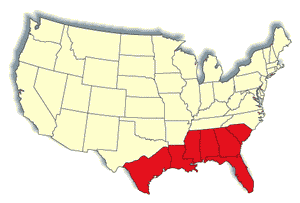
To build long-lasting, energy-efficient, healthy houses in the Florida peninsula and Gulf Coast regions of the United States, builders must take into account the unique climatic conditions of the area. Code guidelines are not always helpful, since the CABO One & Two Family Dwelling Code and the Model Energy Code are mostly written for heating climates and advocate construction practices that often are the opposite of what should be done in cooling climates. In the summertime along the Gulf Coast and Florida, the outside air is hot and moisture-laden, so most homes are air conditioned (see Figure 1).
Figure 1. Moisture control practices for hot, humid climates (shaded area) are almost the exact opposite of recommended building practices for cold climates, because moisture is more likely to enter wall cavities from outside than from inside. Under these conditions, code-approved building practices such as ventilated crawlspaces or the use of vapor diffusion retarders on the interior side of exterior walls can be disastrous. In this article, I’ll focus on the moisture-control techniques my company has learned during 18 years of building and designing homes in hot, humid Texas.
Concrete Slab Foundations
The soil is a constant source of moisture, so we use a sturdy vapor barrier such as 6-mil poly or visqueen beneath slabs to prevent ground-based moisture from migrating up through the concrete by capillary action or diffusion. We lap the joints liberally and use tape on any tears and around pipe penetrations. We also use a minimum 11/2-inch sand base under the slab to further reduce water problems (see “Sub-Slab Vapor Barriers,” 5/94). In addition, the poly helps reduce mineral efflorescence on the slab surface, a common cause of discoloration on stained and patterned concrete floors.
Unvented Crawlspaces
Despite what the code books say, in our geographical area I strongly recommend against ventilating crawlspaces unless I suspect there is an underground water source beneath the foundation. If you think about the goal — keeping the crawlspace dry and inhospitable to mold — the last thing you want is to encourage the infiltration of warm, moist air into a cool, dark space. This would lead to condensation on all crawlspace surfaces, making them vulnerable to decay. We do not specify vents for crawlspaces, and we make any access doors fit snugly. We also recommend carefully installing a 6-mil poly vapor diffusion retarder over the entire dirt floor. Spreading a few inches of gravel over the poly helps to keep it in place and protects it from damage. A sealed crawlspace also stays warmer on the few cold winter days we have here, minimizing the chance that warm, moist household air will create a problem when it finds a condensing surface within the crawlspace. With a sealed crawlspace, it is imperative that standing water be kept out. This means that the finish grade must slope away from the building at a minimum of 1/4 inch per foot. Avoid sites where the seasonal water table is above the elevation of the crawlspace.
Wall and Framing System
In the hot, humid South, by contrast to other areas of the nation, we cool our houses and buildings more than we heat them. Because the warm outside air usually has more moisture in it than cool inside air, moisture most often migrates from the outside of the structure to the inside. If you have a vapor diffusion retarder on the underside of the gypboard (a common detail in cold climates), or an impermeable vinyl wall covering over the gypboard, there is a good chance that warm, moist outside air migrating through the wall system will condense once it hits the relatively cool gypboard. This trapped moisture not only reduces the thermal performance of the wall insulation; it creates potential problems in the wall cavity — from unhealthy mold and mildew to structural wood decay. Contrary to code, do not use a vapor diffusion retarder on the interior of the wall system, because walls in the hot, humid South dry to the inside, not to the outside. Especially avoid placing a sheet of poly under the gypboard, or covering the gypboard with vinyl wall-paper. The only place where we use poly is on the interior side of walls around tub and shower enclosures that do not abut an outside wall. In these localized areas, we feel it’s prudent to protect the partition wall cavity from the high humidity generated in the bathroom.
Exterior sealing.
Houses in humid cooling climates do need to be sealed on the exterior, but careful detailing is critical. I am wary of tightly sealed exterior cladding systems, such as synthetic stucco, that are applied over impermeable rigid foam sheathings. These stucco systems are never perfect, and rain water eventually penetrates through cracks around windows and doors. Even when the foam is well taped or covered with housewrap or building paper, the surface is often accidentally punctured during installation, allowing rain water and water vapor to penetrate the foam and eventually find its way into the walls. Whether a building is clad with stone, brick, traditional stucco, wood, or synthetic siding, we prefer to use plywood or OSB sheathing covered with 30-pound building paper and a layer of heat-reflecting foil. This provides a sturdy drainage plane behind the cladding that sheds water down and away from the wall cavity (Figure 2).
Drainage Plane Detail
Figure 2. For exterior sheathing, the author prefers to use plywood or OSB rather than rigid foam. A carefully lapped and tightly sealed layer of 30-pound building paper over the sheathing creates a drainage plane that directs water down and away from the wall. In addition, all cracks and wall penetrations are sealed on both sides using expanding foam and caulk. Where the exterior cladding stands away from the wall, as with masonry veneers, use weep holes and flexible “moist-top” flashing at the base to direct water out of the cavity. Use common sense when installing sidewall flashing and housewrap or building paper. Because water drains downward, always lap the uppermost layers of flashing or housewrap over lower layers (see “Making Walls Watertight,” 12/95). Finally, provide ample roof overhangs: They not only shade windows and walls, but they help keep rain water off as well. Infiltration control.
To create a barrier to airflow, seal all holes, cracks, and other penetrations through walls, ceilings, and floors after framing is complete, then again after the drywall work is done. Use expanding foam and a good-quality caulk to seal around window and door frames. I also insist on using foam-rubber or neoprene gaskets under all electrical switch and outlet plates mounted in exterior walls. At the joint between wall plates and the foundation, I find that using a continuous roll of foam sill sealer does a better job of sealing than simply caulking the joint. In our experience, concrete tends to reject the caulk over time.