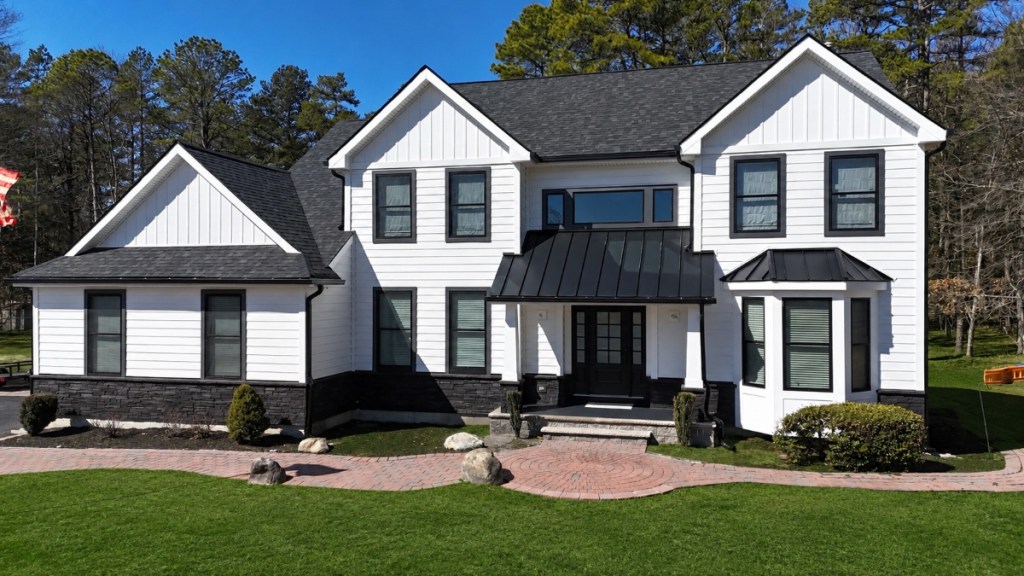
Steve LaPietra is a detail guy.
“Right down to the nail,” says the owner of Monmouth Vinyl in Howell, New Jersey.
He’s not exaggerating. LaPietra keeps 500 pounds of double hot-dipped galvanized Maze vinyl siding nails on hand every month—distributor-level inventory for a single contractor, but, he says, necessary. Though they cost roughly twice as much as standard nails, he considers these hard-to-come-by nails one more way to control the details that determine how a job looks years after the ladders come down.
That mindset has shaped Monmouth Vinyl’s reputation over 52 years in business. The company completes roughly 60 projects a year, and LaPietra now works alongside his son, Joseph, and daughter, Jenna. But the company’s identity was built around a particular idea: Vinyl siding does not have to flatten the character out of a house.

“As a siding contractor, we cut our teeth on siding,” LaPietra says. “The thing we’re most noted for is the details.”
It didn’t always used to be that way. For years, vinyl siding was not especially sympathetic to older homes with distinctive trim, deeper shadow lines, or historical exterior details. Homeowners who wanted maintenance freedom often had to accept a simpler look.
That began to change in the early to mid-1980s, when manufacturers introduced more detailed vinyl components—crown moldings, beaded soffits, window lineals, corner posts with cove moldings, and other profiles that made it possible to get closer to the original design.
Monmouth Vinyl gravitated toward those products immediately. The work was more demanding, but it fit the way LaPietra wanted to build. Every house had its own quirks, and every detail had to be thought through rather than covered over.
“A lot of customers don’t want to change the look of the house,” he says. “They just want to make it maintenance-free. Now we can do both things—make it maintenance-free and preserve the details.”
For LaPietra, one of the clearest signs of that care is a small piece of trim many homeowners would never notice: undersill.
“One of the staples of vinyl siding installation is finish trim,” he says. But LaPietra says many installers now reach for J-channel in places where undersill trim would do the better job, especially at horizontal cuts and under soffits.
The difference matters. J-channel has depth, which gives the panel more room to move. That can make the installation easier, but it can also leave a cut edge less secure. Over time, LaPietra says, that movement can show up as waviness, bubbling, or buckling as the vinyl expands and contracts.
Undersill trim holds those cut edges tighter, helping the vinyl stay flat and clean.
“With the new wave of installers that have arrived, they ignore the undersill trim,” he says.
Part of the problem is availability. LaPietra says many distributors no longer stock undersill in the quantities or colors contractors need because so few installers order it. White undersill can still be found, which helps under soffits, but matching colors can be harder to get.
“We’re the last of a dying breed,” he says. “With great difficulty, we’re still able to get our hands on some.”
The same thinking applies to fastening. LaPietra says he often sees vinyl siding nailed every 24 inches, 30 inches, or even farther apart. In his view, that is asking the panel to do too much. Vinyl needs to move, but it also needs to be held consistently enough to retain its shape through expansion and contraction cycles.
His preferred spacing is tighter—typically every 16 to 18 inches with his prized double-dipped Maze nails from Illinois.
“We’ve researched and found the best thing to use,” he says.
That level of care is not always easy to explain in a sales call. LaPietra says homeowners can only absorb so many technical details before their “eyes glaze over.” So instead of reciting every specification, he focuses on a few visible areas of the house and explains how his crew will handle them differently.
The rest of the proof can be seen on the dozens of other jobs he’s completed in the area.
“The craftsmanship is on the street, not in the showroom,” LaPietra says.