Kitchen & Bath: Turning the Kitchen and Bath Green
In steadily increasing numbers, consumers are seeking out renewable materials for their new homes and improvement projects. Not coincidentally, environmentally oriented building material suppliers are more than holding their own. According to the CEO of one ecology-minded building materials supplier in the Northwest, business is growing spectacularly and despite being defined more or less on the fly.
After visiting Seattle’s Environmental Home Center and noting a predominant selection of kitchen- and bath-oriented materials, I decided to catalog some of the products that are apparently selling so well there and elsewhere.
Bamboo
Bamboo lumber is harvested from an inexhaustible supply and looks like a real comer, emerging in OSB, engineered LBL (laminated bamboo lumber), particleboard, and various laminated flooring and sheet goods. The latter two are well adapted to kitchen use.
Bamboo surpasses other common hardwoods like oak and maple in hardness and can be worked, glued, and finished much like any solid wood or plywood, with a few cautions. Naturally occurring sugars in the bamboo darken, or caramelize, when heated; friction from router bits, shapers, and saw blades can discolor the material. Some experimentation with feed rates, blade types, and cutter shapes may be necessary to avoid unwanted effects. To prevent splitting, be sure to predrill for all screws.
Bamboo can be stained and finished with water-based and oil-based finishes, although it’s always best to test results on a scrap before committing.
Applications: Flooring, countertops, edging, hardwood substitute
Cork
Natural cork is sustainably harvested from the bark of the cork oak tree, Quercus suber, in Portugal, Spain, and other Mediterranean countries. The cork oak is not harmed by harvesting, which may be done every 9 years of the trees’ 100-year life expectancy. Harvesters strip the thick bark in long, wide slabs and stamp out wine corks first. The cork scrap is then ground and fused together under high heat and pressure into slabs that can be cut into floor tiles.
Surprisingly vivid colors are available in the cork line, permitting geometric patterns and creative inlaid designs. Tiles are usually purchased prefinished with either matte polyurethane or the traditional finish for cork floors, natural carnauba wax.
Solid cork tile creates a completely natural flooring that’s “warm” to the touch and resilient underfoot. Because cork consists of millions of tiny closed cells filled with air, it doesn’t absorb moisture, making it suitable even for bathroom applications. But for bathroom installations, it’s best to order unfinished tiles and apply the finish on site, since a site-applied finish will help seal the seams.
Applications: Flooring, countertops, decorative panels
Flapper-Free Flush
If there’s beauty in simplicity, the Niagara Flapperless (Niagara Conservation, 800/831-8383, www.niagaraconservation.com) is one beautiful toilet. The Niagara has no chain, lever, or flapper to empty the tank into the bowl. Instead, a conventional lever flush flips a water tub inside the tank, dumping its 1.6-gallon contents into the bowl in a sudden surge said to be more powerful than a 3.5-gallon flush. There are no submerged parts to corrode or wear out, no leaking flapper valve, a guaranteed 1.6-gallon flush every time, and, because the tub is suspended inside the ordinary-looking ceramic tank, there’s no tank sweat. All this ingenuity can be had cheap, too; the round-bowl model costs $165 and the elongated model, $180, including shipping.
Applications: Every bathroom in the country
Glass Tile
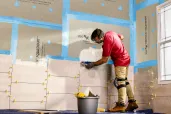
“Sintered” glass tile requires far less energy to produce than standard glass, which must be melted to a fully liquid state. Recycled glass is crushed to a sandlike texture, then heated only until the glass particles soften and fuse together. The addition of various metallic oxides to the mixture produces brilliantly colored tiles, impervious to water and suitable for wall and countertop applications. Not all glass tile is sintered, nor is all recycled glass tile transparent.
Opaque Terra Classic (Terra Green, 765/935-4760, www.terragreenceramics.com) ceramic tile (above) contains 55% recycled glass and is available in 16 “jewel-tone” colors. Transparent glass tile must be installed with its transparency in mind. High-polymer white thinset adhesive bonds firmly and shows the glass colors to best effect.
Applications: Walls, countertops, accent strips
Clear Natural Finish
Polyx-Oil (Osmo Holz und Color GmbH & Co., www.osmo.de) is a clear, satin-matte floor finish created from natural vegetable oils and waxes, made for wood and cork floors. It’s also used on wood trim, cabinets, and unglazed terra cotta tile. Polyx-Oil is said to be as durable as polyurethane but far easier to fix when scratched or worn.
Two thin coats is the standard, recommended application, with no need to sand between coats, as the finish won’t raise the wood grain. Coverage is said to be about 200 square feet per liter at a material cost of about $30.
Applications: Floors, cabinets, trim, woodwork
Green Paint
The ingredients in Safecoat Cabinet & Trim Enamel (American Formulating & Manufacturing, 619/239-0321, www.afmsafecoat.com) link through chemical bonding, unlike most water-based latex paints. This tight, chemical “weave” over the surface allegedly makes Safecoat a good choice for sealing materials like particleboard, which might otherwise “off-gas” into the room and pollute the air. Chemical linking also creates a durable and water-resistant surface, ideal for frequent cleaning.
This paint has a low VOC content, is said to produce almost no odor during application, and is odor free once cured. A high solids content promises good coverage and a durable, scratch-resistant finish.
New wallboard or drywall should first be coated with Safecoat New Wallboard Primecoat HPV. Safecoat Enamel dries to the touch in about an hour, with a recommended wait of four hours between coats. Tools and equipment clean up with water. At an average $35 per gallon, Safecoat’s price is comparable to that of other top-quality paints. A gallon is said to cover up to 350 square feet.
Applications: Cabinets, trim, woodwork
Linoleum
Vinyl flooring, with its vast selection of prints, patterns, and price points, overtook linoleum in the 1960s and early 1970s. The last domestic linoleum factory closed in 1975; today, the remaining producers — all three of them — are in Europe.
Linoleum is still made much as it was when invented 150 years ago, from linseed oil, pigments, pine rosin, and cork and pine flours. The mix is heated and rolled into sheets on a fabric backing, then hung to cure.
Accidental burns can be rubbed away with a nylon pad or steel wool — its solid composition goes all the way through to the natural jute backing material, enabling it to endure decades-long use. Long service life reduces waste and the need to produce replacement flooring. And unlike vinyl flooring, linoleum is completely biodegradable.
A wide range of color options helps account for the resurgence of interest in linoleum. It comes at a semipremium price compared to vinyl, around $4 per square foot.
Synthetic latex adhesive, such as Roberts 2072 Premium Linoleum Adhesive (Roberts Consolidated Industries, 800/423-6545, www.robertsconsolidated.com), is almost equally benign, with a zero VOC content; wet adhesive can be cleaned with warm, soapy water. Note: As with any product you provide or install, “green” or otherwise, avoid making specific, health-related promises, verbal or written, to allergically sensitive or other clients.
Applications: Flooring, countertops
Plantation Hardwood
Careful breeding produces more than champion racehorses; a fast-growing natural hybrid of Eucalyptus grandis and E. urophylla is now successfully plantation grown and harvested in commercially viable quantities from a fully sustainable and renewable resource.
The resulting tropical hardwood lumber is called Lyptus (Weyerhaeuser, 800/ 525-5440, www.weyerhaeuser.com) and is said to compare favorably with oak and beech while resembling cherry and mahogany in its color and fine grain (above). Custom Cupboards (316/529-3431, www.customcupboards.com) currently offers a line of cabinets featuring Lyptus.
Neil Kelly (503/288-6345, www.neilkellycabinets.com) has developed a popular Naturals Collection, a line of cabinets with facings made from lumber certified by the FSC (Forest Stewardship Council) and recycled and reclaimed woods (above). The frameless cabinets can be ordered in melamine-coated wheatboard particleboard, a panel material made from post-harvest wheat straw.
Applications: Kitchens, bathrooms
Recycled Rubber Flooring
Sure, old radial tires look great weighting down a flat membrane roof. Unfortunately, there just aren’t enough flat roofs around to match the supply. Durable surfacing made from old tires (minus the reinforcing scrim) is as strong and resilient as the original tire rubber.
Slip-resistant recycled rubber flooring can withstand temperature extremes and is recommended for indoor and outdoor use. Its low-VOC emissions meet U.S. indoor air quality specifications and guidelines. Pigments provide a rainbow of color choices. Prices vary by style, thickness, and manufacturer.
Applications: Flooring
Solid-Surfacing Alternative
Richlite (Rainier Richlite, 888/383-5533, www.richlite.com) is a low-pressure phenolic, made of paper infused with phenolic plastic. Much of this completely homogenous, solid-surface-like product is derived from renewable, managed forests. A decorative edge can be routed into low-pressure phenolic, and inlays, undermount sinks, and grooved drain boards are all equally feasible. The heat-resistant material can be purchased in thicknesses of up to 3 inches.
Richlite offers the twin advantages of durability and hygiene. Not hard enough to dull knives, it also isn’t nicked by them. Thus, it contains no crevices that can harbor bacteria.
Richlite is worked similarly to wood, and, like wood, the material is often described as smooth and warm to the touch, not plastic or cold and stony feeling.
Although it can’t be seamed invisibly, careful machining and gluing with epoxy produces an inconspicuous joint. Richlite is currently available in six muted and mottled earth-tone colors — the black resembles natural slate in appearance.
Richlite is said to be priced between decorative laminate and conventional solid surface, at suggested retail prices of $24 per square foot for 1-inch-thick material, and $30 per square foot for 1 1/4-inch.
Applications: Countertops, worktops, raised panels, inlays, etc.
Straw Board
Wheatboard is said to be a lighter-weight, more moisture-resistant product than its wood-based counterpart, while exceeding industry standards for the highest-grade particleboard. Primeboard (701/642-1152, www.primeboard.com) currently produces its panels from wheat chaff bonded with methyl-diphenyl-isocyanate (MDI), a synthetic polymer resin, which accounts for 3.5% of the panel’s weight.
MDI contains no formaldehyde and emits no harmful fumes. The MDI resin is not water soluble and is resistant to water damage.
Applications: Cabinet panels, shelving, countertop underlayment
General Sources of SupplyEco-Products 303/449-1876 Eco-Wise 512/326-4474 Environmental Building Supplies 503/222-3881 Environmental Home Center 800/281-9785 www.environmentalhomecenter.com LivinGreen 805/966-1319 |