The most common complaint I hear from my fellow remodeling contractors and custom home builders has to do with getting that last payment. Many who have come up on the short end chalk it up to the cost of doing business, relying on luck and their ability to judge character to see them through. But I think there’s already too much uncertainty in the construction process, so I have developed procedures that increase the odds that I’ll get paid everything I’m owed without a hassle.
Professional Attitude
How your relationship with the client starts determines how it ends. It’s essential to maintain a professional attitude toward both the clients and the work. Many hands-on contractors like to take a personal approach with clients, but there’s a difference between being friendly and treating clients like friends. Professionals aren’t asked to do favors, but friends are, so clients who perceive us as friends often expect us to do little “extras” free of charge. We’ve all heard clients say, “While you’re here, would you mind patching that hole in the drywall?” only to have them later refuse to pay for the time and materials we spent making the repair. The building process can be stressful for clients, and part of your job is to help them through it. But that doesn’t mean you should give your work away for free. All of the systems I use reinforce my image as a responsible business person. They show the client that I take my work seriously and keep my commitments, and that I expect the same from them.
Contract Scope of Work
If you want to control the outcome of your projects, you need a good contract. I’m not talking about printed proposal forms you can order out of a catalogue – they are way too vague for anything but the smallest jobs or handyman work. I mean a real contract that can be customized for each job. Since clients often refuse to pay the final bill because they feel they were either shortchanged or overcharged at some earlier point in the process, use the contract to define the scope of the work and to explain exactly how unexpected work will be handled. Exclusions. Your contract should not only explain the work you plan to do, it should also specifically exclude work that you do not intend to perform (Figure 1).
ExclusionsDue to the nature of this construction, there will be some damage to the landscaping. Dumpsters and heavy equipment shall be necessary and may cause damage to the driveway blacktop and lawn. As long as Builder shall exercise reasonable care, it shall not be liable for any damage to the above-mentioned landscaping, lawn, or driveway. Builder shall cut, prune, or remove any trees or shrubs as necessary to perform its work and will only be required to backfill any excavation. Any additional work shall be at an additional cost, as agreed upon by an Additional Work/Change Order, signed by both parties. Hidden DefectsIn the event that there are any conditions not apparent or disclosed, or changes or deviations in the Construction by Owner which are not required by the drawings and specifications herein mentioned, which require additional work and/or material by Builder, an Additional Work/Change Order shall be signed by Owner and Builder. If said work requires additional time, the completion date shall be extended accordingly. |
Figure 1.
To avoid misunderstandings that may hold up the final payment, the author’s contract lists work that is excluded from the project, and specifically provides for Additional Work/Change Orders to handle deviations caused by hidden conditions. For example, if you are remodeling the kitchen, include contract language that excludes any work in any other room of the house. Then, when the client asks you to patch some drywall in the entry or to touch up the paint on the bathroom ceiling, it’s clear that this is extra work that will raise the cost of the project.
Hidden defects.
In remodeling work, extra costs are often the result of conditions you weren’t aware of when you quoted the job. Hidden plumbing stacks, illegal wiring, rotted structural members, and other problems are sometimes revealed only after demolition begins. Your contract should clearly state that the expense of dealing with these kinds of concealed problems is not included in the price and constitutes an additional cost. Owner responsibilities.
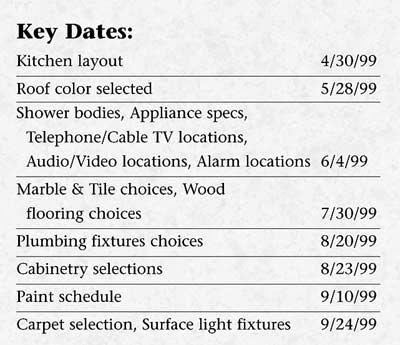
Often, the owner’s failure to make choices or supply material or labor on time can cost you money. For example, say you agreed that the client will supply the plumbing fixtures, and that they must be delivered on June 1. But the client’s brother-in-law couldn’t borrow his uncle’s truck that day and nobody told you, so the plumber and your foreman are there waiting, but the fixtures never arrive. Not only are you out your foreman’s wages and the amount the plumber will bill you for his time, but you now have to juggle the whole job to get things back on track. If you screwed up, you would expect to be held accountable, and so should the client. Make sure your contract clearly lists any responsibilities the client has to supply materials or perform work that will affect your part of the project. The contract should also explain that the client is liable for any additional costs incurred because of delays or other problems due to the client’s failure to meet those responsibilities (Figure 2).
Figure 2. To avoid delays, the author’s project schedule includes “Key Dates” for material selections and other critical decisions required from the owner. A clause in the contract stipulates that if a missed deadline results in additional costs, the owner will reimburse the builder. Change orders. It’s not enough to include contract language to define contingencies – you also need to draw up a change order every time you do additional work or something unforeseen affects the original scope of the project. Include the cost of the change, the revised contract price, and any additional days you need to add to the completion date (Figure 3).
Figure 3.
Along with a detailed description of the work and its cost, the author’s change order form states the number of days the completion time will be extended. Payment is due when work for the extras or changes is complete. Make sure the client signs that change order – it’s hard to claim a faulty memory later on when you can show them their signature on a document. Never let change order invoices accumulate till the end of the job. I bill separately for change orders as soon as they are completed. This practice ensures that there are no surprise expenses for the owners at the end of the job, and it also prevents me from forgetting to collect for a change order.
Payment Schedule
The payment schedule can make or break the job, but sometimes traditional methods don’t work. In the old days, we got one-third on deposit, one-third when we started work, and the balance upon completion. I don’t want to think about how many thirds I never saw. Dividing the contract amount into equal weekly or monthly payments doesn’t always work either, because there is no predictable relationship between time and the value of the work performed. For example, exterior doors and windows are expensive, but don’t take very long to install. Unless the timing is just right, a monthly billing system could mean you have to pay the window supplier nearly 30 days before your client pays you. Even a weekly billing schedule could cause cash flow problems if the timing was off. Phase completion. I have an easier way. I submit an invoice for payment when a predetermined phase of work is complete. This system is a little more complicated than it sounds because on a typical custom home, I may list 20 to 30 phases (Figure 4).
Owner agrees to pay Builder for all of the Construction the sum of: Four hundred twenty-two thousand eight hundred dollars $422,800.00 (hereinafter referred to as the “Contract Price”), to be paid as follows: 1. $10,000 deposit upon signing. 2. $20,000 upon start of work. 3. $15,000 upon completion of demolition. 4. $10,000 upon completion of concrete. 5. $15,000 upon completion of 1st floor exterior wall framing. 6. $15,000 upon completion of 2nd floor deck framing. 7. $15,000 upon completion of 2nd floor wall framing. 8. $20,000 upon completion of roof framing and sheathing. 9. $10,000 upon completion of roof. 10. $15,000 upon delivery of windows and exterior doors. 11. $10,000 upon partial completion of exterior wood siding. 12. $15,000 upon completion of exterior wood siding and trim. 13. $15,000 upon completion of plumbing rough-in. 14. $10,000 upon substantial completion of AC ductwork. 15. $10,000 upon completion of electrical rough-in. 16. $10,000 upon completion of heating system. 17. $20,000 upon completion of sheetrock and compound. 18. $15,000 upon AC system working. 19. $10,000 upon installation of oak flooring. 20. $10,000 upon delivery of marble and tiles. 21. $10,000 upon substantial installation of tiles. 22. $15,000 upon delivery of plumbing fixtures. 23. $10,000 upon installation of interior doors. 24. $15,000 upon substantial completion of wood molding and trim. 25. $10,000 upon installation of stairs and railings. 26. $10,000 upon installation of closet systems. 27. $12,800 upon installation of granite and marble tops. 28. $10,000 upon installation of plumbing fixtures. 29. $10,000 upon completion of wood deck and front stoop. 30. $15,000 upon substantial completion of painting. 31. $10,000 upon finishing of oak flooring. 32. $10,000 upon substantial completion of electrical trim, and substantial completion of all the Construction. 33. $15,000 upon completion of punch list, and all items Builder is responsible to perform to obtain a Certificate of Occupancy. Although the sums set forth for each of the items are specific, the order of completion of such items is only a guide. An invoice for any work completed or substantially completed work shall be delivered to or faxed to Owner. Owner’s fax number is 212/555-5555. Owner shall make all payments within seven days of receipt of invoice. Failure to make such payment shall be deemed a breach of this contract by Owner. |
Figure 4.Basing progress payments on 30 or more phases makes for good cash flow and reduces the outstanding balance at the end of the job. The payment schedule also establishes job milestones that the client can easily verify. Many of my colleagues think this excessive, but none of my clients has ever objected to handing over a check for the completion of a phase that also happens to be a milestone in the project. Clients don’t mind making more payments if they’re smaller, and they find security in being able to verify that the work is done. Getting paid at completion of each phase also makes it possible for me to pay my subs faster. For example, I divide the electrical work into two phases, rough-in and finish. My subs know that when the rough wiring is complete, they won’t have to carry their costs till all the switches and outlets are installed. And because I don’t make subs wait 30 or 60 days, I get excellent service. The same is true of my material suppliers. By dividing the job into smaller pieces, I can pay for materials sooner. This helps me negotiate better pricing, because a supplier who can collect quickly can turn over his inventory more times and increase profit, even at a reduced margin. Timely billing. If you want the payment, however, you have to send out an invoice. You might be surprised how many tradesmen don’t have time to send out the bill. Even honest clients who are surprised by one big bill at the end of the job are more likely to balk at paying. In their shock, they’ll scramble to find some mistake in your math or, worse, they’ll desperately look for some problem with the work – anything to cut that final bill down to size. No one can pay for something they have not been billed for. When a phase is complete, I write up an invoice within 24 hours. Also, I hand-deliver or fax all invoices. I find no shame in asking for my money, and I expect timely payment. Typically, my payment schedule specifies that the homeowner has seven days to pay an invoice. If the owner has designated an agent or representative (usually the architect), that person has 48 hours to visit the site and verify that the phase is complete and payment is due. Otherwise, the work is considered done and payment deemed due. Of course, I have a non-timely payment clause in my contract, and I have had to stop work on several occasions. This was upsetting to the clients at the time, but they soon realized that I expected them to honor their side of our agreement. Small deposits. On a large job, I ask for a deposit of $10,000. On a $350,000 project, that’s only about 3%, but it’s enough to get the job going. Remember, this business is service-oriented, not product-oriented. The only time you should lay out your own money is when you’re building on spec. In return, you get total control, so you don’t have to wait for design decisions or color selections to get the work done. But when you’re working for the homeowner, you should be working with their money. The deposit covers startup expenses and helps you pay the first set of bills on time. Subsequent payments “replace” the deposit, which makes for steady cash flow, and takes a little pressure off you.
Punch List
When the project is ready for the owners to move in, it’s “substantially complete” – the paint is dry, the switch and outlet covers are installed, and the carpet is in. At that point, all that stands between me and the final payment is the punch list. Some may take issue with this practice, but I “seed” the punch list by touring the job with the foreman beforehand. I am a firm believer in leaving a few items for the client to find during the real punch list walk-through. In my experience, it’s human nature to want to discover something left undone during the final walk-through, so I make it easy by “forgetting” a door stop or a switch plate or a cabinet pull – obvious but simple to fix. When the client finds these obvious omissions during the real punch list walk-through, they don’t look very hard for other problems. In fact, if they overlook one of the seed items, I point it out to them. I’m not trying to shirk my responsibility to take care of any incomplete details, but I am trying to avoid having thousands of dollars held back on account of a 98¢ door stop. Because I only want to be responsible for one punch list, I make sure we walk through every room of the house. I even offer to go into the attic and crawlspace if the clients will join me, but no one has ever taken me up on this. When we’re done, I have the client sign and date the punch list, and I leave them a copy. Typically, we return over the next few days to take care of everything on the list.
The Final Payment I remember when the “standard” final payment was 10%, but I think that’s too much. Even on a $50,000 job, 10% is probably more than the contractor’s net, but it’s way too much money on bigger jobs. In my system, the final payment is small – usually no more than 3-1/2%. That’s because the incremental payments received during construction at the completion of each phase cover most of the project cost. There are no surprise change order costs either, because additional expenses were collected at the time the work was done.