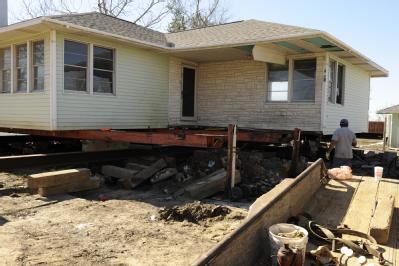
A Sabine Pass, Texas, house gets a ten-foot elevation retrofit in February. Rebuilding efforts in Texas are complicated by a fiscal crisis in the state’s homeowners’ insurance program for coastal residents. Photo by Mike Moore/FEMA
As hurricane season approaches, the politics of coastal windstorm insurance is heating up in vulnerable states. Alabama and Texas are the latest states to see coastal insurance issues rise to the top of the legislative agenda. But in both states, resolving the views of coastal residents and inland residents is proving a complicated task. In Alabama, coastal residents and their representatives are complaining of high premiums and a lack of coverage. In coastal Alabama, state insurance commissioner Jim Ridling recently reported, insurers charge coastal homeowners more, not just for storm coverage, but for unrelated risks such as fire. The Press-Register covers that story (” Home insurers socking coast: It’s not just the hurricane coverage that’s costly,” by Jeff Amy). Alabama legislators have responded with bills that would require discounts on policies for homes that were built in compliance with the 2006 International Residential Code (IRC), which has tougher provisions for wind-resistant construction than did older Alabama standards (see ” Coastal insurance bills advance in Alabama Legislature,” by Bryan Lyman). Even deeper discounts would apply if a house complied with the ” Fortified for Safe Living” standard, an above-code construction specification published by the Institute for Business and Home Safety. The bill passed a state House and Senate joint committee without controversy. However, procedural tactics could stall further progress in the full House and Senate. In Texas, the Houston Chronicle reports, lawmakers are struggling with an impending insurance crisis (see ” Lawmakers debate windstorm insurance,” by Kelley Shannon/Associated Press). With private insurers backing away from the coastal market, the Texas Windstorm Insurance Association (TWIA) — the state’s fallback insurer for homeowners who can’t find other insurance — is short of cash. If another storm like Ike were to strike Texas this year, the association could run out of funds to cover the damage. That would leave homeowners in deep trouble in fourteen Texas coastal counties where the TWIA is the only game in town. Texas’ fourteen coastal counties — from Cameron in the south to Jefferson in the north — depend for hurricane coverage on the Texas Windstorm Insurance Association, an organization that state Representative John Smithee describes as “broke.” The problems are complex, and proposals on the table include a variety of approaches — from replenishing the TWIA’s reserves, to encouraging private companies to re-enter the market, to capping insurance coverage for all properties on the coast (and even excluding second homes from coverage altogether). That last idea, floated by Amarillo Representative John Smithee, generated a storm of resistance from coastal legislators. Quoted in the Beaumont Enterprise, Representative Allan Ritter, from Nederland, Tex. (near Port Arthur), said “As written, [Smithee’s] bill – from Brownsville to Beaumont – would be economically devastating to the entire coastal region.” (See ” House bill blows away windstorm insurance coverage along Texas coast,” by Dan Wallach. As tough as the issues are, Texas lawmakers have scant time to reach a solution. As a part-time body, their legislative session ends June 1 — the official first day of hurricane season.