by Aaron Hoover
When the tiny Katrina Cottage debuted at the International Builders Show in January 2006, it was hailed as a well-designed, inexpensive, aesthetic solution to the housing shortage on the ravaged Gulf Coast.
More than two years later, the cottage — the smallest version of which is just 308 square feet — has fulfilled some of its early promise. But it has also hit some roadblocks.
Tapping millions in federal recovery dollars, Mississippi authorities are building and placing thousands of simplified versions of the cottage, known in that state as “MEMA cottages” after the state Mississippi Emergency Management Agency. But while the agency has erected more than 1,800 cottages to date, it is encountering stiff resistance from the very coastal cities where housing needs are most urgent.
Raising Objections
Officials with Bay St. Louis (pre-Katrina population: 8,200) have been particularly vocal in their opposition. They say the MEMA cottages bring down property values, hold little taxable value, and pose a physical threat to larger traditional homes should the region face another massive storm surge — and that’s just the start.
“They are trailers. All they did was put HardiPlank on the outside, and where the tongue was usually located, they put a porch over the tongue,” says James Thriffiley, an eight-term veteran of the Bay St. Louis City Council. “It’s not promoting development, and it’s not promoting employment” because local construction workers are not needed to erect the cottages, unlike the case with stick-built homes.
The council initially allowed the cottages only in parks occupied by emergency trailers, Thriffiley said. Responding to pressure from the state, the town later permitted them elsewhere — but restricted them to people who owned a home destroyed by Katrina, owned the land where the cottage would be placed, and had plans to rebuild permanent homes. The rules have kept the number of cottages in the city to less than 100.
“We didn’t want to become a whole town of FEMA cottages,” says council member Bill Taylor.
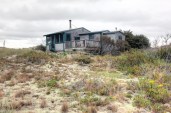
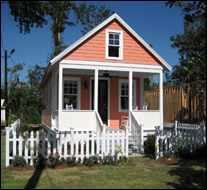
In which “house” would you rather live? The Katrina Cottage (top), designed as a practical alternative to the typical FEMA trailer (bottom) for victims of Hurricane Katrina, may be too nice. Though the cottages were designed as quick shelter for residents fixing up their damaged homes, some community planners are resisting the possibility that residents could convert the tiny homes into permanent dwellings.
Raising Foundations
At the heart of the objections is the unanswered question of whether the cottages — which are not required to meet federal flood requirements when placed and are usually not elevated — are intended to remain temporary or to become permanent.
While city officials want the cottages to remain for as short a period as possible, MEMA authorities have said the cottages could serve as long-term residences. That’s also a theme sounded by the cottage’s designer, Marianne Cusato, who has called the cottages “permanent emergency housing.”
The Mississippi agency had wanted to allow tenants to buy the cottages, then convert them to permanent homes by elevating them to meet flood requirements, according to the Los Angeles Times. Not surprisingly, city officials have been icy to that idea. Thriffiley questions whether residents who need government assistance to procure a cottage could find the dollars to elevate it. And he says the city could lose vital federal flood compliance certification if the cottages remain at ground level.
Mary Cormerio is professor and chairman of the University of California – Berkeley’s department of architecture and the author of Disaster Hits Home: New Policy for Urban Recovery. She says the Katrina Cottage might have received a more welcome reception from authorities if it had been designed and marketed as a structure that was easily expandable into a more traditional, expansive, permanent home. While that idea may seem foreign to American ears, she said, it is routine in other countries where, for example, illegal shantytowns are converted into legal legitimate neighborhoods.
“The fundamental problem with these cottages is that in the effort to be a quick, temporary solution, they are not easy to adapt or expand on,” she says.
But even if that design possibility existed, she notes, the government would need to make available dollars or assistance aimed at helping people convert the homes from temporary to permanent — including meeting flood requirements. That’s not the tradition in a system where public money tied to emergency housing is readily available, but funds become far scarcer in normal times.
For those who protest the cottages, she says, “I think the fear is that they will just become another slum, because there is no policy for transition, financial or physical.” — Aaron Hoover