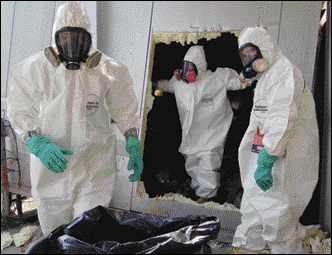
Working in the New Orleans toxic soup
As head of a crew tearing out carpet, furnishings, and drywall from New Orleans homes and businesses, Devon Seymour has seen the worst of Katrina’s aftermath.
But for Seymour, the dried muck, rampant mold, and other crud he and his three workers encounter aren’t as onerous as an invisible scourge: the smell. At one Burger King where boxes of burgers lay rotting in powerless, stifling freezers, it was so bad that he and the others could barely finish the tear-out.
After cutting into a cafeteria meat locker, a HazMat team removes rotten meat from an elementary school freezer that lost power during Hurricane Katrina.
“Even with the respirator, I actually threw up at least one time there,” says Seymour, who relocated from Miami to New Orleans after the storm. “We lost a couple of guys easy on that project because the stench was just unbearable.”
As the floodwaters from Hurricane Katrina’s August landfall seeped out of New Orleans, several organizations raised concerns about toxins, mold, and other hazards left behind. Although the concern centered on returning residents, those engaged in demolition and renovation arguably faced the greatest risk. But as of late December, little was known about the extent of that risk and what sort of health problems it might have already caused or would cause in the future. And what information did exist was frequently the subject of disagreement between environmental and health advocates on one side and federal and state officials on the other.
Meanwhile, the U.S. Occupational Safety and Health Administration, among other agencies, had publicized safety measures for workers in New Orleans. But it is far from clear that contractors or employees know or follow them consistently.
“No one has given us guidelines,” says Jack DeGeorge, co-owner of All American Builders and Remodelers. He requires his dozen workers to wear rubber gloves, boots, and respirators when common sense seems to warrant it, but says he thinks any danger is overblown.
Within weeks of the storm, the National Resources Defense Council (NRDC) was warning of a “toxic chaos” in New Orleans either being ignored or minimized by the Environmental Protection Agency (EPA) and Louisiana Department of Environmental Quality (DEQ). The NRDC says its sampling of the sediment left on streets and sidewalks revealed dangerous levels of arsenic as well as carcinogenic hydrocarbons and organic chemicals. By contrast, the EPA and DEQ maintained that — with the notable exception of a St. Bernard Parish neighborhood near the Murphy Oil spill — arsenic and other toxin levels were typical for older cities and similar to those that existed pre-Katrina.
“… If people avoid obvious signs of hazardous material, practice good personal hygiene, and use common sense, exposure to the environment should not cause any long-term health effects,” concludes a December 9 press release by a multi-agency task force said to reflect conditions of more than 1,000 outdoor environmental samples.
But indoor toxins — those that workers are more likely than others to repeatedly encounter — may be more problematic. The EPA didn’t test indoors, arguing that private homes were not within its jurisdiction. The NRDC did its own limited tests for mold, measuring spore counts in eight homes, including some untouched since the flood and others partially or fully “remediated” with, for example, carpet
and drywall removed.
In the untouched and partially remediated homes, the NRDC found average counts of 650,000 and 350,000 spores per cubic meter, respectively. That’s way above the “very high” standard of 50,000 spores per cubic meter as determined by the National Allergy Bureau, says Patrice Simms, a NRDC lawyer. Fully remediated homes, meanwhile, had counts of at least 60,000, also high but comparable to outside air in New Orleans, Simms says. But as bad as the numbers sound, “there is no regulatory framework for mold, so there are no standards per se,” Simms explains.
He adds that although the NRDC didn’t test sediment in homes, toxins in outdoor sediment would also be present indoors. “Anybody involved with the remediation of these buildings is going to be coming into contact with those toxins,” Simms notes.
With thousands of workers doing demolition and reconstruction since October, it might seem that toxin- or mold-induced health problems would already be obvious. But despite reports of a ubiquitous “Katrina cough” among both workers and residents, authorities have yet to tally the most common injuries sustained by construction workers, much less any pattern of sicknesses or health problems.
“We do not have numbers on the respiratory tract irritation,” says Louisiana state epidemiologist Raoult Ratard in a brief e-mail. “It is all mixed with people who have colds and other respiratory infections.”
Seymour, DeGeorge, and others involved with the cleanup on a daily basis seem to report only minor problems. “The ones who had the Katrina cough had that cleared up by antibiotics,” says Dennis Roubion, president of Roubion Construction, a New Orleans-based firm of about 50 workers.
Roubion adds that he had just paid his annual workers’ comp bill — and that the amount didn’t differ from last year’s prestorm bill. — Aaron Hoover
Gulf Renaissance
A vision to pull devastated coastal towns out of the current dark age
The Great Chicago Fire of 1871 destroyed a third of the city, but the disaster literally cleared the way for the wide boulevards, parks, and skyscrapers Chicago is known for today.
Mississippi officials hope for a similar transformation of 120 miles of shoreline left in tatters by Hurricane Katrina. Just as adherents of an architectural movement called the City Beautiful remade the windy city, Mississippi’s planners are turning to one called New Urbanism. They’ve recruited the movement’s father, Miami architect Andrés Duany, to spearhead an extensive statewide planning effort for reconstruction of 11 coastal cities damaged by Katrina.
Bright optimism. New Urbanism, which emphasizes pedestrian-friendly neighborhoods with mixed living and retail space, shuns sprawl and big-box strips. For Duany, Katrina’s aftermath presents an opportunity to realize the vision on an otherwise unthinkable regional scale. Says Duany of the cities, “There’s a tendency for the ones that are less destroyed to be more optimistic, and I think it should be the reverse. Those that are most destroyed should be most hopeful.”
The task, of course, will not be easy. For starters, there’s no regional consensus on the New Urbanism approach, much less the particulars — despite, or perhaps because of, an extensive effort by the group pushing it, the Governor’s Commission on Recovery, Rebuilding, and Renewal. Last fall in Biloxi, the commission held a six-day meeting, the Mississippi Renewal Forum, to iron out the main ideas. With major support from the Congress for the New Urbanism, well over 100 planners, architects, and designers attended. Specialists later fanned out to work with residents to craft city-specific plans.
Gulfport City Council President Barbara Nalley loves the results. With a prestorm population of 71,000, the largest of Mississippi’s Gulf Coast cities reported damage to at least 80% of its commercial and residential buildings. Nalley likes, for example, the commission’s proposed extension of Gulfport downtown to the harbor area south of Interstate 90, including a “seaside promenade worthy of Monte Carlo.”
“We were going to revitalize our harbor and port area anyway before the storm,” she says. “What they’ve presented to us are even better ideas than what we had in mind.”
Some skepticism. Others aren’t as swept away. Richard Notter, an alderman on the Long Beach board, says he likes some specifics of the plan but is wary of its approach. “They talk about walkable areas, and that’s wonderful in the Northeast,” he says, “but in the South it’s very, very hot and people don’t want to walk around outside.”
New Urbanism, modeled after the downtowns of yesteryear, is often identified with historic architectural styles. To evangelize the look, the commission put together A Pattern Book for Gulf Coast Neighborhoods. The book gives advice on how, facing the chore of rebuilding nearly 70,000 destroyed homes statewide, homeowners can recreate their new homes in Mississippi’s traditional architectural styles. But Notter has no plans to force aesthetic guidelines on his devastated constituents. “In the South, we’re really more in touch with property rights,” he says.
Or as Pass Christian native Billy Bourdin, 77, the second-generation owner of Bourdin Brothers Plumbing and Heating, puts it, “I think they ought to let us go back and do what the hell we want.”
Looming forces. Ultimately, the question of whether the New Urbanism plans become a reality will probably depend on how they stack up with other major forces shaping the reconstruction. Looming large are new Federal Emergency Management Agency (FEMA) advisory flood maps for all three of Mississippi’s coastal counties. The maps comprise the largest proposed expansion of flood zones in the National Flood Insurance Program’s 37-year history, says Todd Davison, FEMA’s regional manager for mitigation. Extending as far as 22 miles inland, the maps could prompt thousands of residents either to rebuild formerly ground-level homes on pilings or further elevate homes already in the air before Katrina.
By reaching back to the rich architectural heritage of the devastated Gulf Coast, architect and community planner Andrés Duany hopes to avoid reconstructing what he claims to be unexceptional, even tawdry, development of the last 30 years.
Davison notes that the maps — which different cities have already moved to reject, approve, or modify — and New Urbanism are not mutually exclusive. But, he says, “I think the element of risk is going to have to define land-use regulations.”
Numerous other major forces stand to influence the reconstruction as well. One widely endorsed governor’s commission proposal suggests moving the east-west CSX Transportation railroad north so that it no longer bisects coastal communities. But as CSX repaired bridges and crossings, there was no sign that was going to happen. “They still own the tracks, and they are planning to run trains down those tracks,” says Notter.
Duany is pragmatic, saying many of the architects and planners who count as its most influential supporters already have enough on their hands rebuilding their homes and cities. Some communities will run with the plans; others won’t, he predicts. “There are hundreds of thousands of buildings down,” he says. “And the very best people are very busy. So yeah, it’s going to be difficult.” — A.H.
Currents
Insurance Rates to Climb
After suffering losses totaling an estimated $60 billion due to Hurricanes Katrina, Rita, and Wilma this past year, insurance companies are expected to raise premiums in devastated areas. Allstate and State Farm have already won approvals for home insurance rate increases in Florida averaging roughly 9%. These average rate increases mean that some homeowners may see premium hikes of more than 40%, according to November reports in the Insurance Journal. Allstate is now in arbitration seeking an even higher increase of 18% in Florida and has indicated it would seek rate increases in other states devastated by last year’s storms. Insurance analysts say the rate increases follow not so much from the cost of claims as from the rising cost of reinsurance (the insurance for insurance companies). Last year, reinsurance infused more than $20 billion in capital for U.S. insurance companies to use for handling the claims. This money may have actually put the property-casualty industry as a whole in the black for 2005, despite its heavy losses. But, according to reports in CNN/Money, analysts admit that insurers have a “psychological advantage” that favors raising premium pricing.
It’s Not Over ’til It’s Over
Finishing off one of the most active hurricane seasons in history, Tropical Storm Zeta — the 27th major storm for the year — formed in the eastern Atlantic in late December. Zeta is the sixth letter of the Greek alphabet, which has been used to identify storms since forecasters ran out of names on this year’s official list of 21. The number of names selected for the storms for this past year was based on the most active previous year, 1933, when there were 21 storms. The year 2005 marks the first time there have been more than 21 named storms in 154 years of record-keeping.