Interview by Jim Gialamas
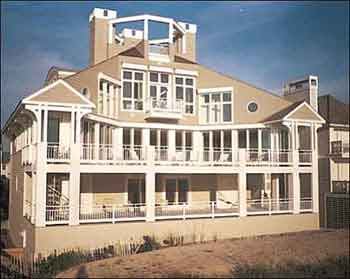
The expanse of windows in this elegant new home by Boardwalk Builders relies on a steel moment frame embedded in the framing to handle lateral wind loads.Patty McDaniel and her crew (below) pose at a job site near Rehoboth Beach.
Patty McDaniel founded Boardwalk Builders in Rehoboth Beach, Del., almost two decades after building a custom home for her father on the Delaware Shore. Since then, the MIT graduate has watched her remodeling business evolve from a small partnership to an award-winning enterprise with $2.8 million in sales in 2004 and 17 regular employees. With this broad range of experience on her toolbelt, McDaniel discusses her observations on how the industry has changed, building-code revisions she’s keeping on her radar screen, and the importance of the occasional “dope slap” for contractors who want to take their businesses to the next level.
What is the market like in Rehoboth Beach?
We do most of our work concentrated right on the town of Rehoboth, with the communities of Dewey Beach, Henlopen Acres, and North Shores that are attached. That’s a fairly small geographic area. Last year in the city of Rehoboth, which is about six blocks by twenty blocks, we were working on twenty houses. Most of our clients are working on their second home or a retirement home. That implies a fairly privileged class of people. They’re here to relax and enjoy the beach.
What distinguishes Rehoboth Beach from other coastal markets?
We’re mostly working with old housing stock. Maybe one job every year, or every couple of years, we build a new house, but the last two years have been all remodeling.
In this market, some builders don’t want to do remodeling. New construction is very straightforward and clean cut, and you know what you’re getting into. Remodeling is messier, with more unknowns.
Is it safe to say that you prefer remodeling to new construction?
That’s like asking me if I like apples or oranges; I like both. I would say that we have a competitive advantage because we’re just smarter about remodeling. Also, just the fact that you’re willing to do remodeling gives you a competitive advantage.
You started at MIT?
I got my undergraduate degree at MIT. I was in the School of Architecture and Planning. I have a BS in urban planning.
How did you advance from MIT to contracting in Rehoboth?
I grew up in Wilmington. I had spent some summers at the beach when I was really small. I ended up back in Rehoboth because my dad lured me home. I told him that if he ever wanted to build a house at the beach, I’d come home. I had graduated, and was doing the Bohemian thing in Cambridge. I ended up coming to Rehoboth and stayed.
Sounds like a great offer!
It was a cool thing to do. And it was very clever of my dad. I thought I was going to outplay that hand, but I was wrong. We built that house, and then we built another house and sold it. Then I started the business with a partner in 1986, and I bought him out after nine years.
This new house in the ocean block of Rehoboth Beach was designed in tribute to the existing cottage. The property has been owned by the same family for decades.
On your web site, you describe the benefits of working with Boardwalk Builders. Which ones are the most important, in your opinion?
Knowledge and integrity. Everything else builds on them. If you do a bad job communicating, you can always come back from that if you know what you’re doing. But you can’t come back from not knowing what you’re doing without the integrity to fix it. Those are the baselines: You can communicate all you want, but if you’re not trustworthy, it’s not going to get you anywhere. To me, a coastal market has always been a second-home market. So a lot of your clients aren’t present. There’s a bigger emphasis on trust.
How do you communicate with homeowners who live elsewhere?
There are a lot of remodelers across the country who use “message centers” when they’re working in someone’s house. They’ll establish a central place to post notes for homeowners and for the crew. Our clients aren’t here, so we use e-mail as our message center. We only started using it two years ago. Before that, we were calling people all the time.
How do you format the e-mail?
There are four basic parts to it: What we did last week, what we’d like to do in the coming week, any questions we have, and the outstanding issues. An “outstanding issue” might be that they’re waiting on us to price a change order. A “question” might be about a selection. Our e-mail system has become routine now, and our clients love it.
Have you noticed any change in coastal construction codes since you’ve been in the business?
When we first started, there really wasn’t any enforced building code. We built a lot of homes on pilings in our early years, always with engineer plans. The wind standard, SSTD 10-99, came into being after Hurricane Andrew in Florida, and it has evolved over the years. [See “Structural Integrity 101,” page 42.] In the ’90s, it got real intense with bolt downs, shear walls, and all sorts of things. Now the International Building Code incorporates wind standards and impact-resistant glass. That’s the big change. So far we haven’t done any projects with impact-resistant glass. Most of our piling homes have had storm shutters, but the little houses in town haven’t. You can comply by using impact-resistant glass, storm shutters, or designing the home as an unenclosed structure. The codes have specified that as long as you have plywood over the windows, you’re fine — that counts as shutters. But I’m not sure that’s going to last.
Is cost the issue?
Cost and the availability of the product. It also complicates the installation because the connection between the window and the wall becomes that much more important. Today, if the wind blows hard enough, the glass is going to shatter. But if the glass can’t shatter, and it has the same connection between the window and the wall, then the force transfers to the connection, and the effect could be that the entire unit blows out of the opening.
Where should coastal builders focus their attention for the future?
What I see happening in my marketplace involves fairly old housing stock, rapidly escalating real-estate prices, and a very tight labor market. The escalation of the real-estate prices drives people’s willingness to remodel. Today’s market will bring $1.8 million for a crummy little beach cottage. If the owners have had the house for any period of time, they’ve tripled or quadrupled their money. The tight labor market means that if you’re going to pay a lot for your labor and resources, then you’re going to deliver them efficiently, with a high level of service, because you’re going to charge a lot for your labor and resources.
How does that affect the industry?
If you’re paying 50¢ for a cup of coffee, you don’t have a very high expectation for how it’s delivered to you. If you’re paying $4 per cup, you want a pretty good cup of coffee and you want the staff to be friendly, the place to be clean, and the service to be quick. If I’m at the point where the labor charge to the carpenter someday gets to be $50 to $60 per hour, the need for him to be quick, clean, and good at what he’s doing becomes much more important. You’re not going to send slackers and charge top rates, but you’re going to need to charge top rates to stay in business. You need to deliver a highly trained, customer-friendly staff, or people aren’t going to be willing to pay you. That’s the trend in the remodeling industry, and that’s going to drive the business toward bigger companies. It’s already hard to make it in the construction industry as a single person working, selling, and doing it all yourself. Our grandfathers could do it. Our fathers could do it. And there are people my age who might just barely retire before they have to quit doing it, but they’re scratching out a living.
Structural Integrity 101Hurricanes strike the Gulf and Atlantic coastal states on the average of one or more times per year, with a single storm capable of producing billions of dollars in damage. An average of 900 tornadoes is reported in the United States annually. Currently, wind damage to constructed facilities exceeds $3 billion yearly and this figure is expected to rise with accelerated coastal development and the migration of people to the hurricane-prone coastlines. Much of this damage can be attributed to the inadequate resistance of nonengineered buildings to high winds. … If property damage is to be mitigated in the high-wind regions of this country, increased engineering attention must be given to residential construction. It is the express purpose of [SSTD 10-99] to provide design and construction details for improving the structural performance of single and multifamily dwellings. The prescriptive requirements contained herein are based on the latest engineering knowledge reflected in Section 1606 of the Standard Building Code and are intended to provide minimum requirements to ensure structural integrity within the limitations in building geometry, materials, and wind climate specified. Source: From the preface of SSTD 10-99, Standard for Hurricane Resistant Residential Construction. Available from the International Code Congress (www.iccsafe.org). |
A substantial remodel transformed this 1940s Rehoboth Beach ranch home into a modern cottage that combines the original elements with Nantucket cottage styling.
What has been most important for you in building a successful business?
I would say that a tremendous amount of educating of “me” has gone on in the last eight, ten, nineteen years. I just didn’t wake up one day and start a company and know everything I needed to know. The things that have been really important to me have been the JLC LIVE residential construction conferences and then moving on from the conferences to the peer groups — where other people help make you smarter. There are a couple of organizations out there that host peer groups. The National Association of Home Builders puts together groups of similar businesses that are geographically diverse. Remodelers Advantage and Business Networks have been at JLC LIVE conferences for a long time.
Why peer groups?
There isn’t anybody in a small company to tell you you’re not seeing things clearly. If you get into a peer group, then you’re able to talk to other people who have similar issues. They’re able to give you the “dope slap” when you need it. If you and I are sitting down, and you’re thinking, “God, Patty’s got a stupid idea,” you may not say it to me, for all sorts of reasons; and even if you do, you’re liable to brush it off. But if I’m sitting in a room with 15 to 20 people, and they’re all looking at me saying it’s a stupid idea, and they’re not worried about losing my friendship or their jobs or my business, then they’re more likely to tell me I have a stupid idea. That’s really, really important if you’re ready to take it to the next level.~