In recent editions, Coastal Connection has discussed recommendations for roof covering reinforcement and for opening protection found in the Institute for Business and Home Safety’s report “Hurricane Ike: Nature’s Force vs. Structural Strength“. In this issue, we take up the IBHS report’s “third tier” of recommended upgrades: measures to strengthen the framing elements and connections that hold the entire house structure to its foundation, resisting the uplift forces of hurricane-strength winds. IBHS has made these measures a third priority, not because they’re less important, but because they’re harder to accomplish with a limited budget, the Hurricane Ike report explains: “The third tier is the hardest and most expensive since it involves strengthening the connections of the roof to the walls and the walls to the foundations. These retrofits typically will involve significant disruption to the home and its occupants and can be most economical and practical when they are part of a major remodeling job or when rebuilding after a flood or hurricane has damaged the exterior walls.” One difficulty is that the uplift path can be tricky to analyze, and specifying effective improvements can involve specialized knowledge. IBHS recommends hiring an engineer to specify connection details for remodeled parts of the house, or to determine what connection upgrades are appropriate for existing framing.
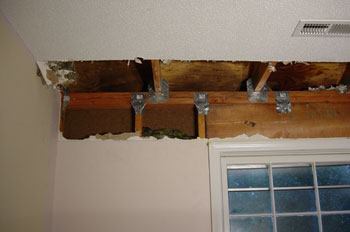
Examples of suggested load-path upgrades include adding steel connectors at the wall-to-roof framing juncture (top), as well as strengthening connections at the base of load-bearing walls. Masonry walls can be strengthened by adding steel reinforcement (bottom). Photos courtesy of IBHS. The State of Florida has adopted code provisions that require roof connection upgrades to be included in some re-roofing jobs. Advice on assessing roof-to-wall connections is posted at this ” Hurricane Retrofit Guide” website. And for more information, take a look at Coastal Contractor’s November, 2008, story, ” Strengthening Roof-to-Wall Connections,” by Richard Reynolds.