by Jim Craig
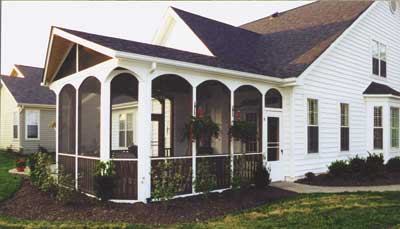
My company specializes in decks and porches. We keep ten two- to three-person crews in the field and build more than 90 screened porches every year. To compete against the many superb craftsmen in my area, we’ve had to develop methods and construction details that enable us to work efficiently and make a profit but still produce a porch that says quality.
Premium Materials
For starters, I always use top-quality materials, for a couple of reasons. First, using premium materials reduces the risk of callbacks and warranty issues. Second, it tells my customers that I’m concerned about the longevity of my product. And because the materials cost more and have a reputation for quality, the markup yields a greater profit percentage than more conventional materials would. . We use Madison Wood Preservers’ (540/948-6801; www.madwood.com) pressure-treated southern pine for all of the structural floor and enclosure framing, and for the newel posts and railing systems. Madison includes a water repellent in the treatment process to retard moisture absorption and to resist the effects of weathering. Primed trim. We use pre-primed pine for all of our painted trim. This lumber is coated on all sides with an oil-based primer, and all minor defects and knots are filled and sealed with an exterior-grade filler to prevent sap streaking and bleeding. We apply two topcoats of latex trim paint in the field. Trex. We use this wood-plastic composite lumber for the deck surfaces outside our screened porches, as well as for rail caps. It’s good looking, machines easily, and cuts down on maintenance chores. Trex decking (800/289-8739; www.trex.com) is available in 5/4 and 2-by profiles; we prefer the more substantial look of the 2-by stock.
Flooring to Keep Bugs Out
Many builders screen the underside of the porch deck or install a screened skirt panel around the porch perimeter to keep insects out. We prefer to use Madison’s C-select 2×6 tongue-and-groove boards for a solid, gap-free porch floor (see Figure 1). The product we use is kiln dried after treatment, which eliminates the warping, twisting, and splitting common with ordinary wet PT lumber.
Figure 1.The author installs 2×6 pressure-treated T&G decking to prevent insects from entering between the floorboards of a screened porch. The decking is blind-nailed through the tongue to conceal the fasteners. |
The boards are reversible, with a square-edge finish on one side and a V-groove edge on the other. We typically install the boards diagonally across the joists, V-groove up, and blind-nail the boards through the tongue to conceal the fasteners. There’s a good reason I run my decking diagonally. Whenever you run decking perpendicular to the joists, you end up with scattered butt joints, which degrade the deck’s appearance. By running the decking in opposing diagonals from a central point, you can cover a large surface with no end-butts. It’s a clean, stylish look. If a sundeck surrounds the porch, the two structures will share a common floor frame. I use gapped 2×6 Trex decking for the outside portion. To back the seam where the Trex meets the T&G decking, we install 2×6 PT blocking on the flat between joists, flush with the top edge (Figure 2).
Figure 2. Two-by blocking, installed on the flat between joists, supports the transition between the diagonally installed porch and Trex sundeck surfaces. | |