Kitchen & Bath: Laminate Countertop Edge Options
If you’re not installing one of those red-hot countertop materials like solid-surfacing, stone, or butcher block, chances are you’re working with high-pressure plastic laminate — still the dominant countertop material. No matter which material you or your client chooses, every countertop has an edge that can and should be turned to advantage.
A square edge is a workmanlike option, but it’s not the best or only possibility. Square edges are sharp and unforgiving, easily damaged by impact, and generally don’t say much about craftsmanship or design. If you’re working with solid-surfacing or stone, you’re limited only by your router bit collection. But if you’re dealing with laminate, you need something more.
The Thin Brown Line
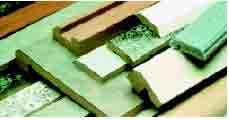
Those who choose plastic laminate for its economy, endless color and pattern options, and easy maintenance want to see it as seam-free as possible. Clients often complain about the dark line at the edge of a common plastic laminate top. Fabricators have developed a number of clever techniques for disguising that line, the simplest of which involves capping the edge with an applied hardwood face band. A wood edge can easily be shaped and rounded. You can buy ready-made wood edging in a number of profiles, including bullnose, bevel, or face-routed to receive a solid-surface, metal, or wallpaper accent stripe (see Figure 1). Not everyone likes the wood look, however.
Beveled laminate edging effectively eliminates the dark stripe and upgrades the appearance of a laminate top, but it’s somewhat demanding to apply. If the alignment is even slightly off after the glue dries, you’re left with a knife- sharp edge and no happy means of adjustment. The margin of error is somewhere around 2/1,000 inch. Sand the edge a little too much and you’re back to the dark line you wanted to lose in the first place. Beveled laminate edges are available with and without an interlocking tongue for alignment. If you’re totally confident in your router skills, a tongued strip and grooved counter edge provide a strong, self-aligning match. But all it takes is a piece of sawdust under the router base, a micro dip in the surface, or a wobbly wrist to mess you up. A smooth-backed strip is plenty secure if you thoroughly coat the mating surface with a good yellow wood glue (aliphatic resin) and temporarily secure the strip to the countertop with banding tape. You can feel the edge as you go, and you’ll have several minutes to adjust the alignment before the glue starts to set. If necessary (and if you’ve got the 2/1,000 touch), you can perform miniscule touch-ups with 220-grit sandpaper.
Figure 1.Among the pile of options offered by Kuehn Bevel is the wood edge, with a recessed face ready to receive any number of accents, including solid-surface strip, metal strip, or wallpaper.
Hybrid Edge
My favorite laminate edge treatment (for the imperfect world we live in) is the Gem-Loc. This edge combines a laminate face with rounded, solid-surface corners, creating a softer transition than a beveled edge (Figure 2). The Gem-Loc is available with and without an installation tongue; an important difference is that you deliberately install the strip a few thousandths proud of the countertop surface, then file it perfectly flush. The manufacturer stocks over 130 solid-surface colors in four major brands — Corian, Surell, Gibraltar, and Fountainhead — and all standard laminate colors in Formica, Wilsonart, Pionite, and Nevamar. The possible color combinations are claimed to be in the vicinity of 113,500. You can also have a custom edge quoted, using nonstock laminates and solid-surface colors of your specification. Backsplash cap is available, but not the backsplash itself. The company will ship any order, small or large, to most locations for a flat $34 fee within about a week.
Figure 2.Gem-Loc counter edges are available in thousands of combinations of laminate and solid-surfacing colors. The rounded edge is designed for simple, seamless application.
Kuehn Bevel and Wilsonart both offer bevel laminate, solid-surface, and wood edging options. Kuehn’s 7/16-inch-thick solid-surface edge is available in eight 19/16-inch-wide profiles in 12-foot lengths (Figure 3). The edge has a continuous 5/32 x 1/4-inch groove in the back to receive an “O”-size joining biscuit. It must be bonded to the countertop using a special adhesive equivalent to E-6000 (Eclectic Products, 995 S. A St., Springfield, OR 97477; 800/767-4667), a clear, silicone-based product. The bonding procedure is otherwise similar to that for the other edge types — that is, cut, glue, position, and tape.
Kuehn offers the sage advice that you should seal the underside of the countertop above and near the dishwasher with a waterproof sealer — polyurethane or thinly spread silicone caulk, for example — to avoid steam or moisture damage to the edge and substrate.
Figure 3.Solid-surface edging offers a durable, attractive treatment with near-foolproof application and custom corner profile capability. This option is adaptable to most countertop materials, including high-pressure laminate.
Preparation
To prepare the countertop for edging, first laminate the top, then rout the edges true using a straight carbide cutter guided along a straightedge. This will start you off with a factory-grade edge, essential for near-seamless edging results. And it’s best to trial-fit and fine-tune all the edging pieces first, temporarily holding them in place with tape, before committing to the adhesive.
Countertop Edge Manufacturers |
Kuehn Bevel, Inc. Randolph, N.J. 800/862-3835 Loti Corporation Tualatin, Ore. 877/436-3343 Gem-Loc Wilsonart International Temple, Texas 800/433-3222 |
Dave Holbrook is an associate editor at The Journal of Light Construction.