- Q. Occasionally when we’re hanging a drop ceiling in a commercial building, we encounter a change in ceiling elevation. What’s the easiest way to deal with this transition?
A.Cliff Carl responds: In commercial work, drop ceilings are hung from structural systems that are often located well above the finished ceiling height. To create the vertical transition necessary to separate ceilings at two different elevations, we hang a metal stud wall from the structure above that provides backing for a drywall finish (see illustration, below). We install diagonal “kickers” to brace the wall once it’s in place. At the lower ceiling level we use a detail that allows us to finish off this vertical transition as the drop ceiling is hung. We build the metal stud wall so the bottom is 2 or 3 inches short of the finish ceiling height, and let the drywall hang 5 to 6 inches below the bottom track of the metal stud wall.
After the finish height of the lower ceiling has been established, we score and snap the extended drywall at this height, and using construction adhesive, apply a drywall J-bead to the exposed edge of the drywall. To support the lower ceiling and finish off the drywall edge, we fasten L-track (the wall angle for a suspended ceiling) to the J-bead using 3/8-inch tech screws. The J-bead and the drywall can then be painted to match the wall finish.
Drop-Ceiling Elevation Change
1 MIN READ
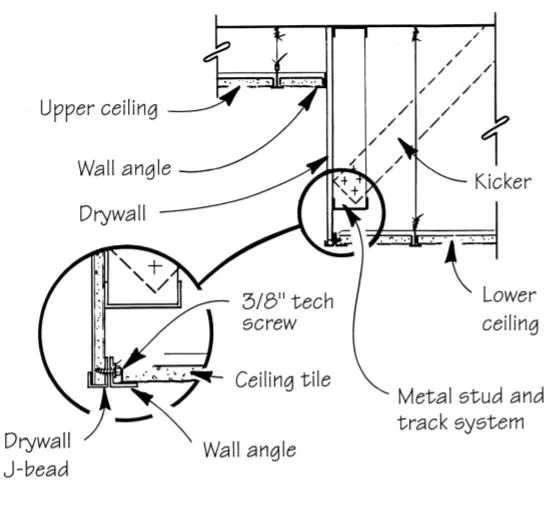
To provide a vertical transition for a commercial drop ceiling, the author hangs a light-gauge steel wall frame from the supporting structure above. The upper section of ceiling butts into the drywall face of this suspended wall, while a combination of J-bead and the L-track for the suspended ceiling finishes the edge of the drywall and supports the lower ceiling.