Although they’re still far from familiar, ground-source heat pumps have been installed for more than 30 years throughout the U.S. Also called geothermal heat pumps, they are recognized by the EPA and the DOE as the most efficient heating and cooling systems available today.
“Geothermal heat-pump technology offers a renewable energy solution that’s right for almost any home,” says Gemma Tiller, owner of Air Brokers Hvac, LLC, based in Branson, Mo. “Thermal energy is harvested from the earth and transferred into buildings by a heat pump that provides heating and cooling.” Despite misconceptions about climates that are too cold, geo-thermal technology can be used anywhere in the U.S. and Canada, Tiller says.
A ground-source unit works like a conventional heat pump to cool a home in the summer and heat it in the winter, but is far more efficient. Conventional heat pumps use outdoor air as the heat source and heat sink. Unlike soil, air provides no reservoir of heat, is a poor conductor, and is subject to extreme temperature fluctuations, all of which defeat system efficiency: When the most heat is needed, the outside air is coldest, and the converse is true for cooling.
According to Monte Jefferson, president of Home Energy, Inc., a geothermal installations firm based in Wendell, N.C., “The key difference between an air-source heat pump —which can’t heat a building efficiently when outdoor temperatures dip below 30°F — and ground-source is that the ground-source unit harvests the stable 50°F to 60°F heat of the earth, transferring this virtually endless supply of thermal energy into the home. In the summer, it transfers excess heat from inside to the earth.”
Pushing Efficiency Limits
After extensive research, homeowners John and Linda Cavanaugh decided to install a geothermal heating and cooling system in their new home in coastal New Hampshire. The type of system they chose — called direct exchange — is at the cutting edge of ground-source technology and is currently offered by two leading geothermal companies, ECR Technologies and American Geothermal.
The Cavanaughs have tracked their energy use for heating, cooling, and domestic water since February 2002 with a separate electric meter. Though their system, an ECR EarthLinked heat pump, cost approximately 50 percent more up-front than conventional heating would have, they calculate that this difference has already been paid back, thanks in part to a utility rebate that helped subsidize the installation.
A direct-exchange heat pump is notably different from the typical water-source geothermal system, which exchanges the earth’s thermal energy through water distributed in vast networks of plastic tubing. Direct-exchange technology accomplishes thermal transfer at much higher operational efficiencies because it eliminates one complete heat-exchange process. Also, because direct-exchange uses a much smaller “earth loop” (or “geo field”), it requires much less disruption of the property, making it ideal for retrofits.
Gemma Tiller has installed various types of geo systems, but she prefers direct-exchange technology because of the higher efficiency it delivers and the greater flexibility she can offer for installation of the earth loops. “The newer technology extracts heat with little disruption to the surrounding landscape and at such high operating efficiencies that it makes payback on the investment faster than ever before,” she says.
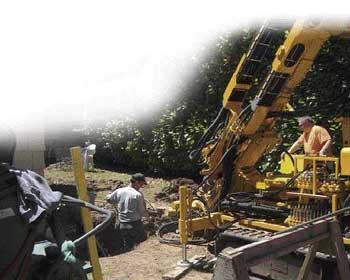
Installed costs are about the same for direct-exchange and water-source geo systems, though both are several thousand dollars more than a conventional air-to-air heat pump. With direct-exchange systems, however, small-diameter drilling for a geo field can achieve near “surgical” insertion of the ground loops, accomplishing the task quickly and with much less disturbance to the surrounding landscape than is the case with water-source systems.
How Direct Exchange Works
Most geothermal systems operate at ranges of 250 percent to 350 percent efficiency, notes Jody Hoffman of Hoffman Mechanical in Mechanicsburg, Pa., who has installed many types of geothermal heating and cooling systems over the last 20 years.
“That means these systems supply up to three-and-a-half units of heat for every unit of electrical energy required to operate it,” Hoffman says. Direct-exchange systems perform even better, “with system efficiencies up into the 400 percent range, conservatively. Add the available options for installation of the earth field, and direct-exchange is a great choice for many existing homes.”
Typical water-source geothermal systems rely on plastic piping to transfer a water-antifreeze solution through a plastic loop and an intermediate heat exchanger, where efficiency is lost.
By contrast, direct-exchange technology circulates refrigerant through highly conductive copper earth loops that are inserted into small-diameter boreholes of 50- to 100-foot depths, then embedded in sand or a protective thermal grout that enables direct transfer of energy with the earth.