It’s that time again: Every three years the National Electrical Code (NEC) undergoes major revision. The 1999 NEC includes several hundred changes that may have become the law in your jurisdiction. Many of these changes were editorial in nature, but some are important technical points. For the most part, you can leave it to your electrician to worry about the new rules, but in some cases these changes can directly affect your design, pricing, and how you go about your installations.
NM Cable Allowed Above Three Stories (336-4)
Non-metallic sheathed cable (the standard Romex found on all your job sites) is now allowed in all one-family and two-family dwellings of any height. It was previously restricted to buildings up to three stories. All buildings four stories or taller were required to be wired with another method, such as armored cable or conduit. Although one- and two-family dwellings are usually not more than three stories, taller structures are not unheard of. This new rule should grant some relief for builders of those rare four-story houses. The old rule also sometimes applies to basement or attic remodels. Some inspectors required the whole house to be rewired if an upstairs or downstairs addition pushed the house over the three-story limit. All other buildings besides dwellings fall under the old rule: No NM cable if the building exceeds three stories in height.
Island Receptacles Clarified (210-52)
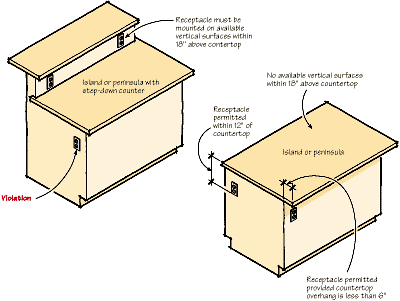
The NEC requires that at least one receptacle be installed on an island or peninsula. The question has always been, Where do you put it? The 1996 NEC was not very clear about this. Many inspectors required the receptacle to be mounted on top of the countertop using a tombstone-style receptacle, but most customers thought these were ugly. Under the ’99 NEC, a tombstone receptacle is no longer required. The code now clearly states that if no wall space or cabinet is available above the countertop within 18 inches, a receptacle can be mounted below the countertop within 12 inches — except where the countertop overhangs 6 inches or more (see Figure 1).
Figure 1. Island receptacles may be mounted on the cabinet side within 12 inches of the countertop, but not under overhangs of 6 inches or more (right). If any vertical space is available above the cabinet, as in a step-down counter, the receptacle must be mounted there (above).
Bathroom Circuits Expanded (210-11)
A change in the ’96 NEC required bathroom receptacles to be connected to a GFCI-protected 20-amp circuit that feeds only receptacles. The receptacles in all of the bathrooms in a house could be wired off one 20-amp circuit, but the circuit could not feed anything but bathroom receptacles. This meant that exhaust fans and lights installed in a shower (and which required GFCI protection to comply with their UL listing) could not be connected to the 20-amp GFCI receptacle circuit. Neither could jet tub motors or electric radiant heat. Under the ’99 NEC, this 20-amp branch circuit for bathroom receptacles can now feed fans, lighting, and other fixed equipment (Figure 2).
Figure 2. The GFCI receptacle circuits in bathrooms can now feed fans, lights, and other equipment — as long as the circuit serves only the one bathroom. However, two rules must be followed: The receptacle circuit cannot be used to feed any other rooms, and the total connected load of all of the fixed equipment except lighting cannot exceed 10 amps (210-23a). Be careful when applying this new rule. Changes elsewhere in the code could seem to conflict. Make sure your inspector reads it this way.
Access Panel for Jet Tubs (680-72)
Although access to the electrical equipment for a hydromassage bathtub has always been required, a change in the language spells this out clearly. Often homeowners balk at the thought of a removable access hatch in an elegant tile tub surround. With some planning, you can usually locate the panel inside a closet or in the ceiling of a closet on the floor below.