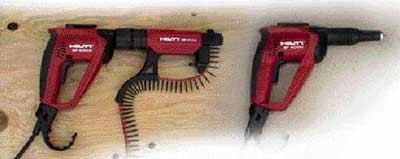
Screw guns are an integral part of any drywall contractor’s arsenal. Over the years, I’ve tried many makes and models of drywall guns, but I heard about Hilti’s only recently. I’m something of a tool fanatic, so when the folks at JLC asked me to test some Hilti drywall guns, I was eager to do it.
A box of tools arrived last fall and I hung drywall with them for about three months. The carton contained an SF4000 corded screw gun, an SF4000A cordless screw gun with a charger, an SF4000A BAP battery adapter, and two nickel metal hydride (niMH) batteries. It also contained an SMI 55 Plus magazine with an optional SME extension; the magazine fits both guns and is used to drive collated fasteners.
Corded Screw Gun
I like the SF4000 corded screw gun. It’s very light and comfortable to use, with a two-finger trigger, rubber grips, and a roomy hand opening. Cooling air enters through vents at the rear of the tool and exhausts through the housing that encloses the grip. This directs the air blast away from the tip so you don’t get hit with drywall dust when working near the floor.
A high-quality 15-foot rubber cord is standard, but the tool is also available with a 50-foot cord. The longer cord is a smart feature that eliminates the need to lift plugs when working up high. Depth of drive is easy to adjust; you just turn the cone on the nose of the gun. At 0 to 4,300 rpm, the SF4000 is faster than average but not as fast as my favorite Makita, which does 6,000 rpm.
One thing I don’t like about this tool is that the trigger lock and forward reverse switch are hard for me to reach without shifting my grip. This is aggravating, because there are times when I need to run the screw gun with one hand and hold up the board or hang on to the scaffolding with the other.
Cordless Screw Gun
Cordless drivers are popular in many trades, but they’re not a traditional drywall tool. The SF4000A is the first dedicated cordless drywall gun I’ve used. Like the corded version, it has a positive clutch that engages when pressure is applied to the tip. The tool I tested came with a one-hour charger and 3.0-amp-hour niMH batteries. It’s also available with less expensive 2.0 amp-hour nickel cadmium (nicad) cells. According to Hilti, the gun will drive 900 to 1,400 screws with a niMH battery and 600 to 1,000 with a nicad. At 0 to 4,000 rpm, it’s on a par with most corded models but is still slower than I would like.
The SF4000A has enough power to drive screws in both wood and steel studs. Like the corded model, it’s equipped with handy scaffolding and belt hooks. The tool is quiet and has a comfortable grip, but the trigger lock and forward/reverse switch are as hard to reach as they are on the corded model. Also, the weight of the battery makes this tool heavy and poorly balanced, a real wrist-buster.
Battery adapter. The battery-adapter accessory allows you to clip the battery to your belt and connect it to the base of the tool with a coiled wire. This reduces user fatigue by placing the weight on your hip. Unfortunately, the cord gets hung up on things, and I found this so annoying I could hardly bear to use it. What’s the point of going cordless if you have to use a cord?
Autofeed Attachment
Autofeed guns are the pneumatic nailers of the screw-fastening world. With collated fasteners, people who aren’t drywall pros can drive screws as quickly as the guys who hang board every day.
I’m equally proficient with loose and collated screws, but I prefer autofeed guns. Anyone can be productive if there are helpers to hold the board. But when you work alone, it’s much easier to use collated fasteners. I can grab the autofeed gun off my belt and push in a few screws while holding the board with my other hand. With a regular gun, I’d have one screw on the drill and a couple more in my teeth.
Autofeed guns are also better for fastening drywall to heavy-gauge steel studs. This application requires self-drilling, self-tapping screws, which momentarily spin in place before penetrating the stud. It takes a lot of force to drive these screws, and a tiny pause can cause the tip to slip off the screw and damage the board. With an autofeed model, I can lock the trigger on and drive a full strip of 50 screws without fear that the tip will slip.
The SMI 55 Plus autofeed attachment can be used with either Hilti gun. The magazine drives 1-inch to 21/4-inch screws — an acceptable range for single- or double-layer drywall applications. The screws come 50 to a strip and are interchangeable with the fasteners used in Grabber, Hitachi, Makita, Milwaukee, PAM, and Senco guns. The fasteners are attached to a floppy strip that is not compatible with QuikDrive, which takes a more rigid strip of screws.
I like how simple it is to remove and install the magazine and bit. With some models, it takes additional tools to perform these operations. On the Hiltis, all it takes is a firm push or pull.
Depth of drive is easily adjusted by turning a threaded sleeve at the base of the magazine. I used this feature a lot: I like to sink fasteners deeper at inside corners, since screws tend to stick up when the gun isn’t perpendicular to the board. This ease of adjustment is a must-have feature; some other tools require using a wrench to change the depth of drive with collated fasteners.
Type of collation. There are aspects of the Hilti attachment I don’t like. Loading the screws is awkward and time-consuming — although no more so than with any floppy-collation model. To reload, you must feed a new strip of screws through a pair of guides while pulling a release lever on the nosepiece. In this regard, it’s easier to use a QuikDrive attachment, because you can load it with one hand. That can save your bacon if you run out of screws before the board you’re holding is safely fastened.
On the other hand, floppy collation folds back freely, so it stays out of the way when you’re fastening three-way inside corners. With rigid strips, you need to cut off the spent portion of the strip to get into those areas. This is such a nuisance, it overshadows the advantage of being able to load strips quickly.
I had trouble with the particular autofeed attachment I tested. The strips had a tendency to jam and leave small remnants of plastic (from the collation) under screw heads. Periodically, I had to stop taping and remove these pieces. In terms of design, I wish there were a convenient place to put my other hand: It’s nice to share the load when you’re driving 2,000-plus screws per shift.
Subfloor/ceiling extension. The autofeed mechanism comes with an optional extension that allows you to fasten subfloors and ceilings without bending, climbing, or wearing stilts. The 2-foot extension works smoothly, and I recommend purchasing it if you buy Hilti’s autofeed magazine.
Pricing
A plastic case is standard with either gun. The corded model sells for $125. The cordless version comes with two batteries and is $350 with the 2.0-amp-hour cells and $459 with the 3.0-amp-hour cells. A belt-worn adapter goes for $48, a magazine for $112, and a floor and ceiling extension for $80.
No one makes a perfect autofeed system, so, in spite of my criticisms, I think the SMI 55 Plus has some possibilities. I would consider buying one if the feed mechanism were more reliable.
I also like the corded screw gun because it’s so light and comfortable to use. I’d buy one tomorrow if the trigger lock and forward/reverse switch were slightly better placed.
Brent Smithis a drywall contractor and remodeler in Rochester, Minn.


Old-School Steel.
Many pros have switched to plastic toolboxes and totes, but some tool users remain die-hard fans of steel. If you’re having trouble finding quality steel containers, consider Kennedy Manufacturing’s pro-duty classics. These steel boxes — with their distinctive brown-crinkle paint — are legendary for their durability and intelligent design. The K24 (top; $62) is a good choice for smaller specialty tools, such as those used for electrical and sheet-metal work. The super-sized K32X (bottom; $79) securely stores even your largest hand tools; a handle on the end makes it easy to pull out of the truck. Kennedy Manufacturing, 800/413-8665, www.kennedymfg.com

Versatile, Lightweight Storage.
Whenever I have more weather-sensitive tools and equipment than the cab of my pickup can accommodate, I toss Rubbermaid Action Packers into the truck bed to handle the overflow. These containers are weathertight and stackable, and allow you to unload and reload everything in a hurry when you need to pick up a few sheets of plywood or drywall on the way to the job site. They come in several sizes; the 48-gallon case shown costs $50. Rubbermaid, 888/895-2110, www.rubbermaid.com


Magnetic Order.
Tired of rummaging through your collection of boxes, buckets, bins, and bags to find the right chisel, screwdriver, or wrench? Cool magnetic organizers from Mechanic’s Time Savers make it easy to find whatever you need and easy to tell when something is missing. The company says the high-tech magnets on its Magna-Panel (below left) and Magna-Rail (below right) won’t magnetize your tools or damage sensitive electronic equipment. Prices start at $20 for Magna-Rails and $35 for Magna-Panels. Also worth checking out are sturdy magnetic organizers for hex-shaped driver bits and sockets ($10 to $27) and for smaller air tools ($40). Mechanic’s Time Savers, 800/824-1834, www.mechanicstimesavers.com

Van Plan.
There are hundreds of ways to outfit a work van; deciding on the best setup can be a head-scratching proposition. To help contractors and tradespeople design rack and storage systems for their vans, truck-box giant WeatherGuard has introduced Vehicle Solutions. This Web-based software helps match bins, drawers, racks, and cabinets to your particular vehicle and style of contracting. The program creates a 3-D view of your van’s interior, so you can see — and solve — any problems or inadequacies before the components are bolted in. When your design is complete, you can send it electronically to your local truck outfitter for a quote. I tried out the software on my well-equipped but imaginary Dodge Sprinter. It was fast, easy to use, and, best of all, free. WeatherGuard, 800/456-7865, www.weatherguard.com/vs
SAFETY GEAR

Matching Sets.
If your safety gear frequently vanishes into the same black hole that consumes your nail sets, carpenter pencils, and socks, check out the Safetypaq. This collection of personal-safety equipment comes in a sturdy plastic case that can be mounted where you can always find it — in the truck, in the job box, on the shop wall. The kit contains two pairs of safety glasses, one with clear lenses and one with tinted; a set of earplugs; and a pair of “high-dexterity” work gloves. Storage pouches protect the glasses and a small plastic receptacle keeps the earplugs clean. Give a set to each of your crew members to show them (and your insurance auditor) just how serious you are about safety. At $30 apiece, they cost considerably less than a trip to the ER. Dynapaq, 800/559-0491, www.dynapaq.com

Fall Protection.
Often, it takes only a few hours of confinement inside a fall-arrest harness before users are eager to loosen the straps or even remove the equipment altogether. That’s the behavior that Miller Fall Protection says it’s aiming to combat with the Titan T-Flex Harness. The new design’s stretchable webbing provides a greater range of motion and a more flexible, comfortable fit, boosting the likelihood that the harness will stay on and do what it’s supposed to: prevent injuries. Prices start at about $65. Miller Fall Protection, 800/873-5242, www.bacou-dalloz.com

Sole Mate.
Working in Alaska requires gear that can withstand the harshest weather, so when I heard that Xtratuf Boots are favored by Alaskan fisherman and construction workers, I took notice. These stompers’ seamless neoprene construction makes them more durable and comfortable than most other wet-weather boots. And if their soles can indeed grip the decks of icy fishing trawlers — as Norcross claims — mucky residential construction sites shouldn’t be a problem. The boots are sold with or without steel toes, in insulated and uninsulated versions. Only whole sizes are available: If you normally wear a half size, order the next size down. Prices start at about $75. Norcross Safety Products, 800/777-9021, www.xtratufboots.com


Toe-tal Protection.
So, you don’t wear steel-toed boots because you think they’re uncomfortable? Imagine how a toe-crushing injury feels. Ever since a 600-pound electrical transformer fell on my foot when I was working in a steel mill some 10-plus years ago, I’ve been a big advocate of steel toes. They probably prevented me from losing all of my toes and part of my foot. And, in recent years, safety-toe shoes and boots have really evolved: Now you can find them in good-looking hiker and athletic styles that offer great comfort and support. Good examples from Caterpillar Footwear include (clockwise from top right) Denali ST ($100), Worksport Oxford ($65), and Diffuse ST ($85). The company offers women’s styles as well. Caterpillar Footwear, 800/545-2425, www.catfootwear.com

Soften the Blow.
After running a jumping-jack tamper around a footing trench one morning, I couldn’t feel my hands for an hour afterward — a predicament the Series 3.0 ProFit Work Gloves might have averted. The eye-catching gloves have padded palms for minimizing the sting associated with such high-vibration equipment as pneumatic nailers, power tampers, and demo hammers. They also sport plastic ribs on the knuckles for abrasion resistance and silicone finger pads that provide surprisingly good dexterity. A pair sells for about $30. Mechanix Wear, 800/222-4296, www.mechanix.com

Sharp Eyes.
Protecting your eyes when you wear prescription lenses can be a pain. Goggles over your glasses offer protection, but they’re uncomfortable and fog constantly. Another possible solution is prescription safety glasses, but most styles look like they came from back during the Eisenhower administration. Personally, I like the new N-Vision 5600 Series safety specs. These sharp-looking glasses accept a prescription insert that mounts on the nosepiece. They come in modern frame styles with clear, tinted, or mirrored lenses. According to the manufacturer, they’re competitively priced; the prescription insert costs about $50. North Safety Products, 888/422-3798, www.northsafety.com