
I started installing fiber-cement siding in 1998 when it
wasn't widely used and fiber-cement trim boards weren't
available. The first time I sided a house with fiber cement, I
used 1x4 pressure-treated trim boards covered with pieces of
the siding. The completed home looked better than its
vinyl-clad neighbors — and it survived a direct hit from
2004's Hurricane Charley with no damage.
Since then, I've built, re-sided, and repaired dozens of homes
with various brands of fiber-cement; it's an ideal material for
southern Florida, where I live and work: It doesn't rot, burn,
or attract insects and woodpeckers, and it holds paint better
than wood. But the attribute I appreciate most is its wind
resistance.
Dust Control
Lately, I've been getting a little more creative with
fiber-cement siding and trim by adding details like decorative
shingles and gable ornaments (see Figure 1). Although these
designs look great, they require a lot of cutting, which
produces a great deal of dust. Fiber-cement particles can lead
to respiratory problems like silicosis, so adequate dust
control is critical.
Figure 1. Taking a cue from the decorative
shingling on Victorian homes, the author integrates fancy-cut
shingles made from fiber cement into many of his projects (top
left and top right). After designs are sketched on graph paper,
shingles are made on site from lengths of lap siding (bottom
left and bottom right).
I have several ways of dealing with dust. Most often, I cut
outdoors on the breezy side of the house, keeping a length of
vacuum hose on the chop-saw exhaust to direct the dust to the
ground (Figure 2). If there's no breeze, I may set up a large
fan next to the cutting station to blow the particles away from
my face. The biggest dust clouds are caused by ripping on the
table saw, which I avoid doing whenever possible. If I have to
use the table saw, I wear a respirator containing HEPA
cartridges.
Figure 2. A short length of vacuum hose
attached to the dust port helps direct fiber-cement dust
downward, away from the operator.
I suspect that the dust is hard on power tools as well, so I
make sure to blow the dust out of my saw motors once in a
while, paying particular attention to the switch and brushes. I
can tell the brushes need cleaning when the blade brake stops
working. When I began using an old 12-inch chop saw to cut
siding about five years ago, I thought the dust would quickly
destroy the bearings or the motor, but the tool is still going
strong.
Cutting Methods
I've tried cutting fiber cement with just about every new tool
that's come on the market, including score-and-snap cutters,
electric shears, carbide saw blades, diamond masonry blades,
hand nibblers, and even an asphalt-shingle shear. All of them
work, but none produces as clean a cut as the new
polycrystalline diamond (PCD) blades. I buy Tenryu's PCD blades
(800/951-7297,
www.tenryu.com) for chop,
circular, and table saws, and am always surprised at how long
they last. One great advantage of the PCD blades is that you
can make stacked cuts limited only by the saw's depth of cut.
This is important when making shingles.
For scrollwork I use a jigsaw fitted with a carbide-grit blade
(Figure 3), the type commonly used for cutting ceramic tile.
Each blade will cut about 20 feet of 1-inch-thick material
before I have to replace it. I make large-radius cuts freehand
on the table saw with the blade set so that it just barely cuts
through the siding, which reduces airborne dust and prevents
binding.
Figure 3. Fiber cement can also be used to
make decorative gable treatments. Scroll cuts are made with an
orbital jigsaw fitted with a carbide-grit blade.
Fasteners
Because fiber cement has such a long life expectancy, I use
only stainless-steel ring-shank nails; they offer superior
corrosion protection and withdrawal resistance. Collated
stainless-steel siding nails — which are typically .090
or .099 inch in diameter — tend to crumple as they're
driven into cement board, so I use Hitachi's
2-inch-long-by-.113-inch-diameter nails for siding, and
23/8-inch-by-.131-inch nails for trim. My suppliers
special-order these thicker nails; lead times run a week at
most.
When a ring-shank nail crumples, I don't even try to pull it
out. The holding power of the ring shank combined with the
friability of fiber cement almost always results in damaged
siding or trim. Instead, with a chisel I nick the shaft of the
nail where it enters the siding and bend the nail back and
forth until it snaps (Figure 4). Then I hammer in any part of
it that's left. If I need to remove a piece of siding that's
been nailed, I drive the nails thru the siding with a
punch.
Figure 4. Pulling ring-shank siding nails
with a claw hammer or flat bar can crush fiber cement. Instead,
the author nicks bent nails with a "beater" chisel, then bends
them back and forth until they break. Remnants are hammered
below the surface, and the hole is filled with latex
caulk.
Trim boards are less dense than siding boards. This keeps their
weight down and makes nailing easier. It also means that
removing a damaged piece of trim without destroying it is
impossible — so I just plan on replacing trim boards when
they have to be removed, for whatever reason.
Installation Tools
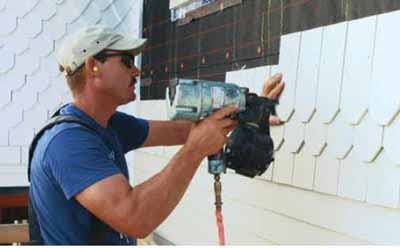
A coil nailer with good depth adjustment is the tool of choice
for nailing fiber-cement siding. After trying guns from several
manufacturers, I settled on Hitachi's NV83A2, which has a
precise and reliable depth-of-drive adjustment.
Even using depth adjustment, I have to turn the air pressure
down to avoid overdriven nails. I usually start at around 80 to
85 psi, then vary the pressure depending on the type and
thickness of the sheathing and how many layers of siding I'm
nailing through.
Overdriving is a big issue with fiber cement: Drive a nail too
deep and you cut through the facing, weakening the siding and
leaving a deep hole that's difficult to fill. Setting nails by
hand is quicker than trying to fix ones that are overdriven. In
visible areas where I want the job to look perfect — such
as around the front door — I set the depth so the heads
are a little proud; then I set them by hand.
I use a 4 1/2-inch angle grinder fitted with a sanding disk to
smooth out butt joints, elevation mismatches, and rough edges
of trim. A 36-grit disk works well for general material
removal; 80 grit is good for final smoothing. The sanding disks
don't last very long, but even after they're too dull for fiber
cement they're suitable for softwood. I always wear a
respirator with a HEPA filter when I'm sanding.
I have an all-terrain forklift with a workbasket that I
consider invaluable for installation. It holds all my tools and
about 100 shingles at a time (Figure 5). Luckily, the coastal
areas where I build are relatively flat and there's usually
enough space to reach all sides of the house.
Figure 5. An all-terrain forklift with a
workbasket holds tools and siding and provides a safe elevated
platform (top and bottom left). When the forklift can't get
access, the author uses pipe staging (bottom right).
Hiding Face Nails
I caulk every exposed nail with latex caulk. Most folks just
dab the hole with a tube of caulk and then smooth the blob with
their finger. Coil nails often leave a small piece of collation
wire that can prick your fingers, so it's a good idea to hammer
down any protruding wires as you go along. There's no need to
worry about the wire rusting; it's stainless.
For smoothing the caulk, I have a plastic auto-body spreader
— the kind used for applying Bondo. This tool vastly
improved my caulking: It produces a smooth finish that makes
the nails almost invisible when painted (Figure 6). It also
saves a lot of wear and tear on the fingers.
Figure 6. A Bondo spreader is ideal for
pushing caulk into holes created by face-driven
nails.
Surprisingly, the spreaders work great on wood-grain siding,
too — I just hold them at a right angle to the grain.
Since they're so cheap, I always carry an extra in my toolbelt
in case I drop one from the scaffold.
Making Shingles
Most fiber-cement siding manufacturers produce shingles, and
I've used these on a few houses. They're expensive, though, and
come in limited patterns and exposures. Plus the shingle
material can be extremely brittle.
After a while I figured out that making make my own shingles
with siding scraps cost me about the same as buying
manufactured ones. At first I used them only for gable details,
but my customers liked the look so much I now put decorative
designs on other parts of the house.
I make the shingles out of either smooth or wood-grain lap
siding, depending on the customer's preference. I use different
widths of siding so that I can get different shingle widths
without having to rip material on a table saw. In general,
fiber-cement siding has a 1 1/4-inch overlap, so
4-inch-exposure lap siding measures 5 1/4 inches wide, which is
a good shingle size.
The length of the shingles depends on the exposure you want and
the complexity of the decorative cuts. Because we get a great
deal of wind-driven rain on the coast, I usually use "three-ply
coverage," which means there are three layers of shingles on
the wall at any point. This guarantees proper overlap when I
have different widths or fancy cuts mixed together in complex
designs.
A rule of thumb for three-ply shingling is that shingle length
should be three times the exposure. Since I like a 4-inch
exposure, most of my shingles are 12 inches long. With plain
(square-butt) shingles in more moderate climates, two-layer
coursing should be adequate. With two-layer coursing, shingle
length should be twice the exposure plus 2 inches.
Cutting. I cut the shingles to length
with a 12-inch chop saw mounted on a homemade stand. Since each
piece of siding weighs about 15 pounds and I normally cut five
12-foot pieces at a time, the stand is very sturdy. An angled
stop block prevents dust buildup, which would otherwise cause
the shingles to get progressively shorter. The number of siding
pieces that can be cut at once is typically determined not by
the saw's capacity but by the amount of weight that can be slid
along the table (Figure 7).
Figure 7. The author's saw stand is sturdy
enough to support up to five 12-foot lengths of lap siding
— a good 75 pounds of material (top). Stops made from
wood scraps can be quickly screwed to the top for repetitive
cuts (bottom).
Once the shingles are cut to length, the pattern can be cut.
This is usually done with a stop block and with the saw set at
an angle. If the points on diamond shingles exceed the maximum
angle of the chop saw, I use a jig to hold the shingle
perpendicular to the fence (Figure 8). I generally cut 10
shingles at a time because that's the maximum number I can get
my hands around; also, using stacks of 10 makes counting
easy.
Figure 8. After the blanks are cut to
length, shingles are given diamond points and diagonal cuts on
the miter saw (top). A simple jig screwed to the saw stand
holds a stack of shingles perpendicular to the fence when the
angle exceeds the saw's capacity (bottom).
The final step is to ease the bottom edge of the shingles,
which I do with an angle grinder and an 80-grit sanding disk
(Figure 9).
Figure 9. Single edges are eased with a
small angle grinder equipped with an 80-grit disc. The tool is
enclosed in a plywood box; a large nail holds down the paddle
switch.
One person can easily make 1,500 to 2,000 shingles in a day; I
find that it's a good task for a helper or a less experienced
crew member.
Matt Thompson owns Thompson Construction
in Bokeelia, Fla.