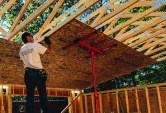
My partners and I were recently hired to apply a manufactured-stone veneer to the above-grade face of a drive-in basement foundation. Though we had previously worked with other, geometric veneers under the same brand name, Cultured Stone (Owens Corning, 800/255-1727, www.culturedstone.com), this job was different — for a couple of reasons. First, the foundation tucked diagonally into a hillside, with the grade retained on one side by natural stone boulders. The veneer selected by the designer was made up of irregular, “natural” shapes that would match the boulders in the retaining wall. Second, whereas in the past we had applied manufactured stone to poured concrete and masonry walls — which provide ideal backing for masonry veneers — this foundation was built with Reddiform ICFs (insulating concrete forms). I was confident that the foam facing would provide adequate support for the veneer, because integral webs inside the blocks tie the interior and exterior faces together. But I wasn’t sure whether the standard cement mortar typically used to install manufactured stone would bond directly to the polystyrene foam.
However, the project’s builder, Todd LaBarge, had extensive experience with ICF construction and had already researched direct-applied concrete coating options with various industry consultants. He was confident we could proceed without worry. For reference, I checked the Cultured Stone product literature for specific installation guidelines.
Spec Check
The manufacturer’s guidelines include instructions for application over foam sheathing, but not in a direct bond. The recommended approach calls for a weather-resistant membrane such as 15-pound felt to be applied first over the foam board, followed by a layer of expanded metal lath and a portland-cement scratch coat. The manufactured stone is then bonded to the scratch coat in a 1/2- to 3/4-inch-thick mortar bed and pressed firmly in place to squeeze out excess mortar and any air pockets. The latter are potential water traps that can freeze, expand, and pop the concrete veneer off the wall.
Todd reasoned that while eliminating air pockets is important, there’s no practical reason to install a moisture barrier over an ICF wall, because it isn’t susceptible to fungal decay. And metal lath, while entirely appropriate over an applied foam sheathing, is unnecessary as a structural base over ICFs, since the rough-textured expanded polystyrene foam provides plenty of “tooth” for the mortar to key into.
By the Numbers
Installation was pretty straightforward. We used a layout process we developed on the job. The first step was to break out several boxes and spread the irregular “fieldstone” shapes on the ground to ensure a good blend of sizes and color.
Layout involved lots of trial and error. We wanted to fit the stones together tightly to minimize the mortar joints, and we also wanted to avoid cutting them whenever possible, since cutting would reveal uncolored concrete edges. Arranging the stones on the ground in measured plots that represented the walls’ dimensions and window openings saved us a great deal of time.
The wood siding above the foundation line provided an overhang roughly equal to the stones’ average thickness of 11/2 inches, so we began by looking for tapered edges that would tuck under the siding and worked down from there. The bottom edge of the veneer would be buried just below grade and could therefore run random.
Once we had worked out a section of the layout on the ground, we took each stone in turn and traced its outline on the foam with a felt pen. We marked both the stone and its outline with corresponding numbers and stacked the stones by the wall for installation. As the job progressed and we became comfortable with the material, we were able to plan the layout directly on the wall, without working it out on the ground first.
To bond the stone, we used ordinary Type N masonry cement, a medium-compressive-strength (750 psi) mortar made of one part portland cement, one part lime, and six parts sand, which is recommended for most exterior above-grade masonry applications exposed to weather.
In addition to mix water, we used an acrylic latex additive, Silpro C-21 (SilPro, 800/343-1501, www.silpro.com), which enhances the mortar’s initial stickiness and ability to bond to both concrete and polystyrene. It’s been our experience that a masonry wall built with C-21 will break before the mortar bond will give.
To eliminate trapped air, we troweled mortar directly onto the wall and completely back-buttered every stone, pressing each firmly against the wall to force out excess mortar. Occasional removal of a just-set piece assured us that we were getting a solid bond.
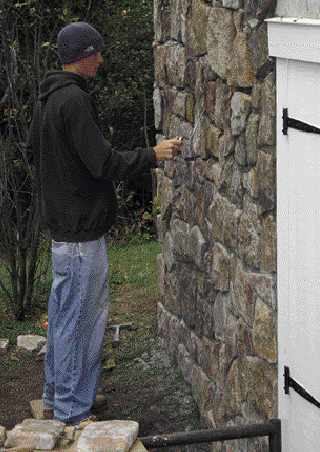
We installed the stone working horizontally from the bottom up, so that each successive course would be supported by those below. We jointed the stones as we went along, using a tuck pointer, then brushed the face clean of excess mortar. Tuck pointing after every few courses helped prevent the stone from slipping before the mortar set up (Figure 4).
The completed veneer looks very convincing against the natural boulders in the retaining wall, and the transformation from white foam to rustic stone foundation is an aesthetic winner.
Stephen Minsterco-owns Abednego Builders in Orleans, Mass., with partners Ryan Haig, Paul Witter, and Kyle Norman.