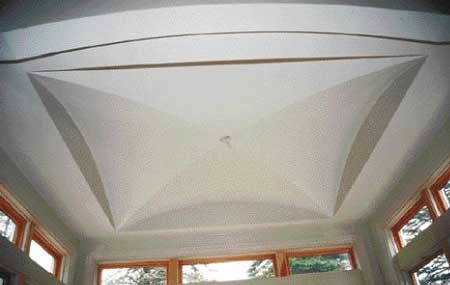
As a custom framer, I welcome the challenge to do something a little out of the ordinary. A recent job called for a recessed cross-vault ceiling in a rectangular morning room off the kitchen. In that section of the house, we’d framed the basic ceiling flat at a height of 10 feet. The recess would be built as a nonstructural assembly beneath the ceiling consisting of two equal barrel vaults intersecting at right angles.
Classically, this configuration is called a groin vault. When framed within rectangular confines, the barrel segments intersect in diagonal “hips” that form a pair of diagonal segmental arches. While it may sound like a difficult piece of framing, in fact, the process was relatively simple.
It seems that every builder I’ve framed for — and I work with some great builders — has at some point attempted to fit an arch into an opening by bending a skinny stick from point to point or fooling around with a loop of string, then stepping back to appraise the line with an artful eye. To me, the trial-and-error approach is crude and inefficient. In a nutshell, the problem is to find an accurate, geometric, and repeatable radius for any predetermined arch height and span. I carry the formula printed on a wallet-size card that I can pull out when I want it to remind me what to do with my scientific calculator.
Layout
The idea for the ceiling treatment came from the clients, who’d seen the design in a California home and had shot a few Polaroids. In lieu of construction drawings, the builder, Mark Reilly, gave me the photos and asked me to figure out how to build it.
Mark left it to me to decide where the limit of the vault area would be, a somewhat tricky decision. The breakfast nook measured roughly 10×12 feet, with window walls on three sides; the fourth “side” opened onto the kitchen area.
The nook was in an ell off the main structure, with an inside corner that was chamfered at 45 degrees to accommodate an egress door. The general ceiling area was rectangular, not square, so I created an 8-foot-square “recess” in the nook’s ceiling by building 12-inch-high soffits along the three window walls and a fourth soffit across the open end. I used 2x4s, ladder style, on 16-inch centers for the underside of the soffit and paneled the vertical faces with 3/4-inch cdx plywood. In effect, I’d installed a dropped ceiling in the nook, with a coffered center.