Imagine the home as a work of art. The cabinetry, trim, and furnishings are the composition, and the drywall is the canvas they’re arranged on. In building as in art, the quality of the canvas affects the quality of the finished piece. Think about it: If you assemble a perfectly mitered crown molding in a corner with a cracked seam and popped nails, what do you think is going to attract the customer’s attention?
Good artists spend hours preparing their canvases, but even good builders sometimes neglect the details that make a great drywall finish possible. After 24 years in the drywall business, I have seen many builders who should have known better do the same dumb things over and over. Sometimes the slip-ups are outright mistakes. Other times they’re easy-to-overlook details. Most have simple solutions — which demand a bit more time and care from the framer but pay off in a more durable finish and happier customers.
My goal here isn’t to criticize other trades, but to show how one phase influences the next, so that we can work together to fix problems before they get built into the job.
Poor Planning and Prep
It’s obvious that poor planning can throw the job off schedule and cost money. Less obvious, perhaps, is that poor planning can guarantee a poor finish.
Wet framing. One of the biggest planning mistakes is not taking time to let the framing dry before calling the drywaller. Wet lumber will start to dry and shrink as soon as the heat is turned on. If the drywall is already in place, you’ll get cracked corners, ridged seams, and popped fasteners.
In winter, of course, drying the framing requires a functional heating system. Some contractors balk at having the heat on before and during the drywall work, because of the cost of fuel and worries about drywall dust in the furnace. But the fuel cost is money well-spent, and it’s easier to clean the furnace filter than to go through the entire house patching walls and ceilings.
By the way, forget about temporary heat. I’ve never seen temporary heaters provide even heat for an entire work area. Temperature and humidity fluctuations will inevitably cause problems with the finish.
Insufficient lead time. Builders sometimes ask if I can start a drywall job “next week.” The answer is no. Even if I had time for a last-minute job, haste breeds mistakes. I need a minimum two-week lead time. This gives me time to measure the job, order the materials, and have them delivered. I also like to give the drywall a few days to acclimate to the home’s humidity and temperature.
An inaccessible job site. Drywall is usually delivered by boom truck, and since I’m not going to ask my crew to carry a truckload of drywall across the site, the truck needs to pull up next to the house (see Figure 1). You need to get power lines, tree limbs, and ditches out of the way.
You also have to think about booming in upper-story deliveries. I turned down a large brick house with small windows in the upper story because we were too busy to hand-carry all those sheets. One option is to leave one or two windows out of each level of the house, so that we can bring the drywall in through the rough openings. On one job, the builder left the plywood sheathing off one wall until we had delivered the drywall.
If leaving windows or sheathing out is not an option, consider scheduling an early delivery.
Other people’s trash. Some builders neglect to clean the site before we arrive. But the hanging crew has to install heavy, cumbersome panels in every part of every room, and the tapers have to keep a steady hand and stay focused on their work. If tools, materials, and debris are scattered all over the place, the quality of the work will suffer.
Cleanliness cuts both ways. The next group of contractors shouldn’t have to deal with drywall scrap, globs of dropped joint compound, filled electrical boxes, and thick dust. I clean all of this up when I’m done. I want the customer to notice the quality of my work, not the mess I left behind.
Problems With the Framing
Most of the homes I work in have framing errors that make it hard to do quality drywall work. Because of this, I like to have a carpenter on the job while I’m hanging. The builders I work for have learned to plan ahead so that the carpenter has other work to do. On two recent jobs, there was a guy building stairs and doing other things in the basement while we hung the drywall. I used him probably 10 times to correct little framing problems, but the end result was a much better, more durable finish.
Fixing these problems also makes the home easier to trim. One contractor I know considers this important enough that he has the door installer do his own walkthrough, using a can of orange spray paint to mark problems the framers have to correct before the drywall goes up. Not only does that one hour the installer spends inspecting the job make my life easier — it probably saves him a couple of days’ work.
Here are the most common framing problems we find.
Poorly crowned lumber. I’m surprised how many framers don’t pay attention to this, but the crowns on a row of studs or joists should all face in the same direction. If they don’t, it can be hard to pull the drywall tight to the framing, and screws will be more likely to pop loose if the framing moves or if someone leans on the wall. And those bumps caused by opposing crowns will become glaringly obvious when you turn on the lights or install a chair rail or countertop.
Even if all the crowns face in the same direction, any stud crowned more than 1/4 inch will cause problems. If the crown faces the finished surface, it may create a bulge in the wall that you can’t hide. If it faces away, it may be impossible to pull the drywall tight.
So, do everyone a favor: Cut excessively crowned studs up for blocking. And since framing can twist and bow after it’s installed, check the framing before the drywall arrives and straighten any studs that need it. (You can do this by nailing the offender to a straight stud, or by cutting it and scabbing on a piece of scrap.)
Too-rough openings. Crowned lumber can play havoc at door and window openings, which are surrounded with doubled-up framing members. Quite often, this framing isn’t nailed together with the greatest of care. Drywall doesn’t bend much, so framing that’s misaligned by as little as 1/8 inch can leave gaps that cause the drywall to crack as it’s fastened.
Misaligned framing also makes for unhappy finish carpenters. Most prehung doors have 45/8-inch-wide jambs. If the framing isn’t straight, the drywall may bulge out past the jamb in places, making it a nightmare to trim. The same goes for windows with factory-installed extension jambs. You won’t have these problems if you fix the framing before the drywaller shows up.
Fire stops at seam height. Installing fire-stop blocking behind a drywall seam sounds like a good idea at first, since the blocks will provide a strong backing. The problem is that if the blocks — or the nails used to attach them — protrude past the edges of the studs, there will be a ridge in the drywall seam. The ridge may appear only in spots along the wall, but it can be difficult to fix. And it’s an annoyance homeowners may notice only after they move in and turn on their lamps.
Keep fire blocking away from seams. And no matter where you put it, take the time to install it flush.
Unshimmed shower walls. Whose job is it to shim out the walls around fiberglass shower units? The plumber isn’t going to do it, and neither is the drywall contractor. I’d have to say it’s the GC’s job. Leaving these walls unshimmed creates a gap between the drywall and the framing all around the unit. This is easy enough to fix by having someone rip 1/4-inch-thick plywood strips and nail them to the studs.
Keep in mind, too, that when an outside corner is too close to the unit, I have to fasten the drywall through the unit’s flange and thus risk scratching the fiberglass with the screw gun. Anything less than 2 inches is difficult to finish, as there won’t be enough room to fasten a strip of drywall and a corner bead.
Not enough corner framing. The narrow fastening surfaces at most inside wall corners drive me crazy. On the typical three-stud corner, even if I hang the wall with the narrow edge first, that edge is so close to the corner that I can’t drive a screw straight with a screw gun. I prefer to see the studs 2 inches from each corner. Yes, it takes a few more minutes to frame this way, but I can drive the screws straight and set them properly. Plus the corner will be easier to insulate.
Hiding Butt SeamsYou can reduce the number of butted seams by using the longest sheets of drywall possible. Placing a seam above a doorway or window will make it less noticeable. For a stronger seam, attach butt seams to framing with screws and adhesive and cover them with paper tape embedded in a setting compound. Or you can try back-blocking, a technique I’ve used successfully for years. I place the seam between the framing members and fasten it to a specially designed wood or metal backing made by Wilco Drywall Tools (www.wilcotools.com), which attaches to the back of the drywall but not to the framing (see photos). The center of the backing is recessed; fastening the drywall creates a shallow void that, when filled with tape and compound, yields a nice flat surface. And because the seam floats independently of the framing, it’s less likely to crack as the house moves and settles. A recessed butted seam is easier to conceal. The author attaches butt seams to a specially designed wood backing (top left) placed between the studs or joists. Screwing the drywall to the backing creates a shallow recess, which can then be filled with tape and compound. Note how the butt seams in the ceiling above fall between the joists. |
Corners at the tops of wall partitions are just as bad. Where a partition runs parallel to the ceiling joists, some builders tack lengths of scrap to the top of the wall to catch the edge of the ceiling drywall. But these strips usually aren’t solid enough or straight enough. I would rather see the wall framed with a single piece of wide lumber nailed over the top plate and left protruding over the sides.
If the ceiling joist is within 6 inches of the wall, I don’t need nailers: The wall panels will support the edge of the ceiling drywall.
Unrecessed joist hangers. I understand the structural importance of joist hangers, but when they’re attached to a flush beam in the middle of the ceiling they can create bumps in the drywall. It’s often a shallow bump, but it’s still enough of one that seams placed near it are difficult to hide, and the installers are more likely to drive screws through the drywall’s paper facing, weakening the attachment. If the structure settles, these seams and screws are likely to crack and pop. Even without such problems, the bump will be noticeable under certain lighting conditions.
One solution is to notch the ends of the joists so that the hangers sit flush with the framing; this takes extra time but produces a better drywall finish.
Unfurred ceilings. You won’t have to worry about joist hangers if you fur the ceiling. Furring also compensates for a number of other sins, including low beams, ceiling framing that runs in different directions, and sagging ceiling insulation. The few extra dollars it costs to fur the ceiling will speed up the drywall process and save you from having to explain that unsightly hump to your customers.
I like to fur ceilings with metal resilient channel, because it spans inconsistencies in the joists, offers excellent sound control, and reduces fastener pops and joint cracking.
Protruding insulation. On occasion I will turn down a drywall job on a site where the insulation has been sloppily installed. Overstuffed or sagging insulation puts pressure against the board, making it difficult to get it tight to the framing. More often than not, the insulation wins, and the resulting gaps lead to popped screws and sagging sheets.
Furring solves this problem on ceilings. On walls, I don’t like to see the paper flange of kraft-faced insulation stapled over the face of the framing. Unless the insulator does a perfect job by pulling the paper tight and driving the staples flush, the flanges make it difficult to fasten the drywall tight to the framing.
Energy-conscious builders don’t like to inset-staple batts because it creates a break in the kraft vapor and air retarder. As an alternative, you can fill the stud bays with unfaced batts, then either stretch a poly vapor retarder across the studs or coat the exterior walls and ceilings with vapor-retarding primer before painting.
Hanging and Fastening Problems
Hanging drywall probably isn’t your duty, but it still helps to know the dos and don’ts of a good job so you can communicate your expectations to the drywall sub.
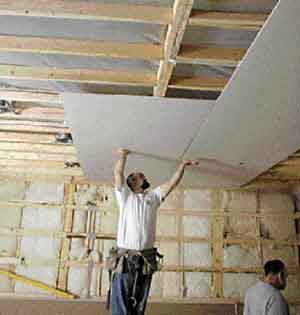
Parallel sheets. On some jobs, you may be able to reduce butt seams by hanging sheets of drywall parallel to the framing. Regardless, I prefer perpendicular attachment for all jobs. Otherwise, if the framing isn’t exactly 16 or 24 inches on-center, I may have to cut the beveled edge off a sheet of drywall, making it hard to finish. Perpendicular attachment also floats over imperfections in the framing instead of highlighting them. Ceilings hung this way are stronger and less likely to sag.
If you’re worried about butt joints, try arranging the sheets so that the butts are around the edges of a room rather than in the middle. Or you can use the back-blocking technique described in the sidebar (see “Hiding Butt Seams,” below).
Seams over framing transitions. Transition areas like flush ceiling beams or plates running across two-story walls are bad places for drywall seams. Unless the framing is perfectly aligned, a seam here will be tough to hide and prone to cracking or ridging. It’s best to span these areas with a single sheet. I minimize fastener pops by using adhesive only on the plate or beam, with screws on either side.
Improper screwing. Most people know that screws are better than nails. They’re faster to install, do less damage to the drywall surface, and hold the drywall more tightly against the framing. Despite these advantages, I still see a lot of problems with screws.
If a screw is set too deep, it will tear the face paper. Screws need to penetrate the framing only 5/8 inch, so 11/4-inch-long screws are optimal for most installations. Longer screws are harder to drive straight and are more likely to pop. Also, because lumber shrinks more across its width, screws driven into door and window headers are more likely to pop. I try to minimize screws in headers and instead screw to the plates above.
Not using panel adhesive. Some contractors don’t want me to use adhesive because it can add $100 or $200 to the cost of hanging drywall in a house. But the fact that adhesive holds a sheet of drywall along its entire length and can even bridge minor framing irregularities means it keeps ceilings from sagging and can minimize cracks and screw pops. The bond created by adhesive is strong enough that you can use up to 75 percent fewer screws. And adhesive is not affected by moisture or temperature changes.
Myron R. Ferguson, a drywall contractor from Galway, N.Y., moderates the jlconline.com drywall forum and is the author of Drywall: Professional Techniques for Great Results.