Route Planning
Because my
quick estimating system works so well, I don't have to plan the
exact repiping routes until after I get the job. When the time
comes, however, route planning is the most important aspect of
the work. On repipes, I find that branch routing works much
better than home-run routing because there are fewer lines to
run. I carefully consider several different route options, then
choose the one that minimizes damage to finish walls, ceilings,
and floors.
In southern California, where the original plumbing is
usually installed in the slabs of homes without basements,
repiping generally involves leaving the old pipes in the slabs
and running the new pipes in the ceilings. In a one-story
house, this can mean that most of the work takes place in the
attic and very little damage is done to drywall.
One drawback to running pipes in an attic is that cold water
lines are often heated up during hot weather, resulting in tap
waits for cold water. Most times, however, homeowners will
choose this over other more expensive and disruptive options.
Of course, plumbers in cold areas of the country will have to
worry about the opposite problem - pipes freezing if they are
installed outside of heated spaces. Many houses in those areas,
however, have the advantage of a full basement or insulated
crawlspace.
In general, routing water supply lines on a repipe job
involves a few rules of thumb and a healthy dose of common
sense. On most jobs, work starts at the front service. Often, I
leave the existing pressure regulator and ball valve, and run a
new main line to the water heater. From there, most houses
require two primary runs, one heading toward any full bathrooms
and another heading toward the kitchen. Secondary branch lines
can usually pick up half-baths, hose bibbs, mop sinks, washing
machines, dishwashers, and ice makers.
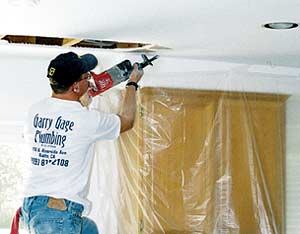
Running primary lines through ceiling joist bays usually
works best for long runs. Drywall cutouts need to be spaced to
accommodate PEX hangers, which should be installed every 2 to 3
feet on horizontal runs and every 4 to 5 feet on vertical runs.
When running secondary lines beyond ceiling bays or attic
space, the best route is the one with the fewest cutouts and
drillouts. For example, choosing a ceiling bay that delivers a
primary run as close as possible to a bathroom branch can
reduce the number of joists that have to be drilled.
I've seen lots of jobs where the plumbers spend too much
time going over alternatives or where lots of second-guessing
goes on after work has actually begun. The fact is that there's
almost always more than one good way to route the many runs on
a job. What's more important is making sure nothing critical is
overlooked, such as structural limitations that are strictly
defined in the code. Sometimes, it's necessary to make a few
exploratory cuts early on to verify that particular beams can
be drilled through. What material a beam is made from, as well
as manufacturer specs, can determine routing decisions by
forbidding certain drillouts. For most cases, code rules for
drilling holes are clearly defined (Figure 3).


Figure 3.
The plumbers in the
author's company follow basic rules for drilling holes in floor
joists (top). With wood I-joists (middle) and other types of
engineered lumber, it's best to consult the manufacturer's
literature. The example provided above is courtesy of Trus
Joist MacMillan.
Once a route is planned, it's easy to size piping. After
determining the incoming water pressure, a chart in the
plumbing code specifically defines how many fixtures can be run
off of each size of piping. If I haven't had to replace the
pressure regulators, I always check them to make sure they're
working properly. Typically, water pressure on a water supply
system should be regulated at around 65 psi.