Before
Not long ago, the small design-build company my brother Bill and I own remodeled a kitchen in an 1875 Victorian house. The project presented us with a classic design challenge: how to expand and update a tiny, nearly dysfunctional space without weakening its physical and aesthetic connection to the rest of an old but charming building.
In this case, the homeowners had been mulling over the idea of a new kitchen for several years, so they pretty much knew what they wanted — an advantage in any project. Their absolute musts included adding space and new appliances; incorporating a children’s work area; and building a mudroom entry.
Expanding Outward
Central to our design was the concept of a multifunctional kitchen. To be successful, we all agreed, this kitchen needed to be more than a site for preparing food; it must serve as a gathering spot for family and friends, a station for children’s activities, and the organizational center of the home. It would also be an entry point into the house.
Clearly, we wouldn’t be able to comfortably accommodate all these uses unless we significantly expanded the 200-square-foot room. In keeping with the homeowners’ wishes, we looked to the yard — rather than adjacent rooms — for the extra space. By extending the house’s front elevation outward by 8 feet, we were able to gain some 250 square feet. We tied the new exterior wall into an existing porch roof that wrapped around the rest of the house and installed three pairs of double-hungs; the new windows vastly improve the exterior elevation and bring ample light and views into the remodeled space.
Embracing Multiple Uses
Next we set about loosely dividing the expanded kitchen into various functions: the requested children’s work station, near enough to the food-prep area for the homeowners to monitor homework and computer use; a raised breakfast counter handily located between the cooking area and a beverage center with a mini refrigerator; and a mudroom entryway lined with individual cubbies for each family member. The cooking area itself is laid out for maximum convenience and comfort, with plenty of counter space and enough cabinets to guarantee that the owners never run out of storage.
Before
All of these parts flow together in what is essentially a large L, sharing light and a feeling of openness. We carved a wide doorway in the wall between the homework nook and the living room (formerly an exterior wall) to establish a circular passage through the three main downstairs rooms — kitchen, dining room, living room — thereby extending the sense of flow and strengthening the link between old and new spaces.
Striking a Balance
For many of our trim and material choices, we took cues from the surrounding house: The kitchen’s wide yellow-pine floorboards and oversize molding, for instance, match existing floors and trim.
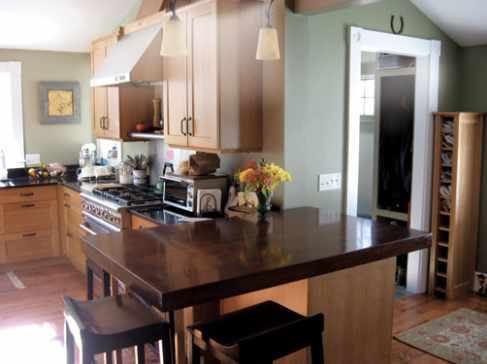
At the same time, we didn’t shy from giving the new space its own toned-down contemporary look. Though made of mahogany — a common material in the old parts of the house — the gleaming breakfast bar is unmistakably modern, as are the black granite counters. Simple cherry cabinetry, unobtrusive (but high-end) stainless appliances, and a combination of recessed lights, undercabinet fixtures, and pendants reinforce the kitchen’s melding of traditional and contemporary elements.
Cost, Reward
In addition to updating the kitchen, we remodeled a combination bath-and-laundry and extended the house’s back porch to incorporate a new outdoor eating area. The final cost for the 550-square-foot job was $120,000, or $218 per square foot.
Gratifyingly enough, the homeowners claim that the renovation has transformed their lives, making their daily routine both more efficient and more pleasurable. My brother and I have resolved to strive for no less than this reaction on every project: If we can change people’s lives by improving their homes, we will forever have passionate customers who are also our advocates.
Doug Storey is the managing partner of Two Storey Building in Bolton, Mass.