Kitchen & Bath: Installing a Custom-Height Kitchen
After you’ve gotten a couple of kitchen cabinet installations under your belt, the standard, ergonomic dimensions become somewhat ingrained and taken for granted. Countertops finish out at 36 inches above the floor, wall cabinets hang 18 inches above the countertop, and their tops wind up at 7 feet to 7 feet 6 inches above the floor. For the average carpenter, these dimensions become nearly automatic, and, for the average person, they’re fairly suitable.
I was recently called upon to serve a customer with a nonstandard need. Although her existing kitchen was well laid out and still in good shape, much of it was beyond her reach. Standing 4 feet 10 inches in her stocking feet, she wanted full functionality from her kitchen. That meant bringing things down to her size. I worked with her to determine dimensions that would personalize the kitchen for her, measuring her standing elbow height from the floor to determine the ideal countertop height and checking the practical extent of her reach by having her touch the existing wall cabinets as high as she could comfortably stretch.
Limitations
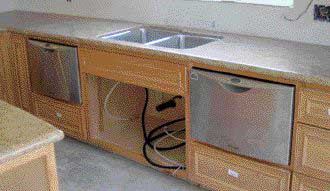
Once we determined our finished countertop height — we were shooting for 33 inches above the floor — we knew we’d be building custom, 32 1/4-inch-high base cabinets (allowing for a 3/4-inch-thick stone countertop). Not a stretch — no pun intended — until we took standard appliance dimensions into account. Our dishwasher options were limited, as far as I know, to one. Instead of a standard unit, we used two Fisher & Paykel single-drawer dishwashers, one on either side of the sink (see Figure 1), a nearly ideal solution, notwithstanding the $700 cost per unit.
Figure 1.A pair of single-drawer Fisher & Paykel dishwasher units solve the problem of fitting a standard unit beneath a countertop of substandard height.
No standard range would work at the 33-inch height, so we settled on a cooktop and found a wall oven with dimensions that would work under the island counter. To get the oven to fit, however, we had to cut out the kick. We’d already made it a nonstandard 2 1/2 inches high to regain the inches lost to the countertop height and allow us to work with stock cabinet doors. A kick of 2 1/2 inches still allows a foot to tuck comfortably under the cabinet face when working at the countertop.
Although we adhered to the existing, sensible kitchen layout, we had to lower all above-the-counter outlets accordingly. Since the majority of the boxes were fed from overhead, we had to replace the existing wiring. My electrician joked that this was the first kitchen he’d wired where he could make up the counter outlets on his knees.
Figure 2.At 16 inches above the countertop, the tops of the wall cabinets were displayed and the client’s access remained limited by her reach, so the author maintained a standard 18-inch spacing above the countertop and focused on base cabinet storage.
Wall cabinet height. We ran into a bit of a problem with the upper cabinet height. Since upper cabinets were relatively useless to the client (Figure 2), we decided to use 30-inch-high upper cabinets, 16 inches above the countertop and dropped from the ceiling. But when we hung a trial cabinet, we discovered that its overall height was too low; we could easily see its top. We went back to a standard 18 inches above the counter and added a 2-inch-high crown molding around the top for a more pleasing appearance. Even so, the wall cabinets topped out at 83 inches above the floor and 7 inches below the ceiling, unlike the original, 36-inch-high wall cabinets they replaced.
Solutions
Due to the lower height of the cabinets, we spent considerably more time than usual on the layout of both cabinets and appliances. Because the wall cabinets would remain of less use to my client, we had to carefully consider the functionality of the base cabinets and make sure that they would serve everyday use (Figure 3). We installed a 36-inch-wide, standard-height pantry cabinet (albeit on our lower-than-standard kickspace) to replace a narrower predecessor.
Figure 3.The author relied on full-extension drawer storage for pots, pans, and dishes and relocated the microwave from above the range to the island cabinet (left). The gas shutoff valve, installed in the back of an adjacent cabinet, allows the cooktop to be strapped in for earthquake-proof stability. A ball-valve shutoff on a dedicated water line for a pot-filler spigot and the refrigerator’s icemaker shares the same cabinet (right)
Amenities include built-in organizers on the pantry cabinet doors and adjustable shelving, along with full-extension hardware on all drawers, which we sized to store specific pots, pans, dishes, small appliances, and utensils. There’s an electric warming drawer under the cooktop, and a pot drawer under that. Once we had the cabinets configured and built, the actual construction time overall wasn’t noticeably different from that of a standard kitchen remodel.
By and large, we remained faithful to the footprint of the original kitchen, although we reduced the number of upper cabinets and increased the size of the island, from 46 by 26 inches to 48 by 53 inches. The island accommodates the oven, a microwave (relocated from above the stove), and expanded, drawer-based storage.
Convenient shutoffs. Rather than running a line from the sink base around the wall to supply the refrigerator’s icemaker and a pot-filler spigot at the cooktop, I installed an independent supply with a ball-valve shutoff, concealed in the back of a narrow tray cabinet next to the fridge. The dividers are removable for easy access to the valve. I also installed the gas line safety shutoff in this location, a feature I’ll include in all future kitchen installations because it allows the gas to be turned off without having to pull the stove forward. This way, the stove can be strapped or screwed into place, securing it in the event of an earthquake.
Ultimately, the new kitchen not only improved accessibility for the client, but also expanded our awareness of how others might interact with an environment and a set of standards we’d previously taken for granted.
Mark Eisenhauer is a general contractor in Marina, Calif.