Last month, Coastal Connection looked at the devastating storm surge damage that could result if Houston suffered a direct hit from a major hurricane.This month we look at a similar risk to New York City — a hazard that some experts consider to be even more extreme. Houston’s risk — along with a proposal for large dikes and movable floodgates — is described in a report from Rice University’s SSPEED Center (“ Learning the Lessons of Hurricane Ike: Preparing for the Next Big One ”). The risk to New York City is the topic of a recent guest post by consulting engineer Douglas Hill at Jeff Masters’ Weather Underground blog (“ The City that Plans to be Flooded ”). Based in Huntington, N.Y., Hill is an adjunct professor at the School of Marine and Atmospheric Sciences at the State University of New York at Stony Brook, and has been studying the surge risk to the city for years. In his post, Hill notes that the National Hurricane Center considers a direct hit by a Category 3 storm on the New York harbor to be a very real possibility. And if a big enough storm does make landfall there, warns Hill, the associated flooding could cripple the nation’s financial sector and require massive evacuations — evacuations for which there is no real plan.
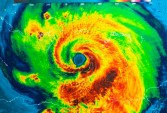
Hurricane Irene (shown making landfall in the image above, courtesy of NOAA) was just a comparatively mild warning of what could happen in a more serious event. Hill says: “If the eye of a Category 3 hurricane crossed the New Jersey shore, the surge could reach 24 feet–compared with 4.5 feet in Hurricane Irene’s–flooding the World Trade Center site and Wall Street, with City Hall resting on a separate island south of the rest of Manhattan. The ripples from a crippled financial district in lower Manhattan would be felt worldwide. In a severe hurricane, the OEM [the city’s Office of Emergency Management] has estimated that up to three million people would have to evacuate, if that can be imagined.” In Irene (which struck New York as only a tropical storm with peak winds of 65 mph), Mayor Bloomberg ordered 370,000 low-lying residents to evacuate, notes Hill — but the city also shut down the subways and buses. “Evacuation without transportation: a novel concept,” remarks Hill. Hill’s suggestion — very similar to the SSPEED Center’s idea for protecting Houston — is for a massive public works project: the construction of storm surge barriers across key passages between the New York Harbor and the Atlantic Ocean. Writes Hill: “Barriers are being completed to protect St. Petersburg, Russia, and Venice, Italy. The heart of New York City could be protected in the same way. Moveable barriers, closed only when the city is threatened with major coastal flooding, could be placed at the upper end of the East River, across the Narrows and at the mouth of the Arthur Kill. Possibly, the latter two could be replaced with a single, longer barrier extending from Sandy Hook to the Rockaway peninsula. Modeling studies have demonstrated that the barriers would work. Four major engineering firms have presented conceptual designs and cost estimates for barriers at these locations. The estimated costs for these individual barriers range from $1 billion to $4.6 billion, with the total of the two or three needed less than $10 billion, comparable to other major infrastructure projects planned or underway.” A concept drawing of one proposed structure: a wall equipped with giant swinging gates that could be built near the Verrazano-Narrows Bridge that connects Brooklyn with Staten Island (image by Arcadis, Inc.). Hill’s post is part of a three-part series on the Jeff Masters blog. In the second post (“ Hurricane Irene: New York City dodges a potential storm surge mega-disaster ”), Masters explains how Hurricane Irene could easily have been a far more destructive event. Writes Masters, “I met last year with the head of the National hurricane Center’s storm surge unit, Jaime Rhome, and asked him what his number one concern was for a future storm surge disaster. Without hesitation, he replied, ‘New York City.’ I agreed with him. Strong hurricanes don’t make it to New York City very often… But if you throw the weather dice enough times, your number will eventually come up.” In the first installment of the series, Masters describes how some New England cities have installed flood barriers to protect against a similar risk (“ Storm surge barriers: the New England experience ”). Stamford, Conn., built a storm wall in the 1960s in response to catastrophic floods in 1938 and 1954: “Completed in 1969, the barrier across Stamford Harbor is high enough to protect the city from a storm surge of 14.8 feet above mean sea level. Had the barrier been in place during Hurricane Carol, the Army Corps of Engineers estimates damage to Stamford could have been reduced by 85%.” Those same two storms also wreaked havoc in Providence, R.I., and New Bedford, Mass., notes Masters. The 1938 storm flooded Providence with 8 feet of water, while 1954’s Hurricane Carol brought a flood 12 feet deep there. “In response to the devastation wrought by these storms, a $15 million hurricane barrier 25 feet (7.6 m) high was built across the 1000-foot (300 m) entrance to Providence Harbor between 1961 – 1966,” writes Masters. After similar damage, New Bedford built its own flood wall: “A hurricane barrier 23 feet (7 m) high and 4900 feet (1500 m) long across New Bedford Harbor was completed in 1966 at a cost of $19 million (1966 dollars.) The barrier separates the New Bedford Harbor from Buzzard’s Bay, and successfully kept out the 8 foot (2.5 m) storm surge from Hurricane Bob in 1991, and a 6.5 foot (2 m) surge from the January 1997 Nor’easter.” Both walls have been effective, Masters writes: “Storm surge barriers in Stamford, New Bedford, and Providence have already proved their worth and prevented damages more than the cost of their construction.” A New York City version, Masters and Hill both argue, would also be worth the expense. But at tens of billions of dollars, New York’s theoretical hurricane protection system would be far more costly — and whether the political will exists to get the job done remains a big question mark.