Flapping panels. When vinyl is installed on a new two-story home, it sometimes comes unlocked above the first-floor top plate, and begins to flap in the wind. “It’s a common problem,” says Robert Long, marketing manager for vinyl siding at Louisiana-Pacific. “It’s the worst thing that gives vinyl siding a bad name.”
The cause of the problem is joist shrinkage and settlement. “Where you see unlocking panels is usually at the band between the first and second floor,” says Doug Price of Norandex. “When the joists shrink, the short return leg of the siding comes loose from the lock. You’ll sometimes see bowing or oil-canning of the siding at that plate.”
Some installers try to prevent the problem by pulling the siding up tight in areas where shrinkage is expected. “The manufacturers recommend letting the lock drop before you nail,” says installer Mark Logan. “But I like to pull it tight. By starting tight, especially in the band joist area, it allows for some settlement.” How tight to pull it is a matter of judgment, since many manufacturers warn against pulling up too tightly on the siding. “Some installers stretch the siding up as they nail it, instead of letting it drop,” says Doug Price of Norandex. “But that causes fish-mouthing at the laps.”
The Latest Developments In the last few years, manufacturers have introduced a variety of new vinyl siding products, hoping to stand out in a crowded market. Whether or not the innovations are useful depends partly on the preferences of the installer.
• At least five manufacturers – Heartland, Mitten, Norandex, Reynolds, and Vytec – sell panels designed to be installed vertically, to mimic board-and-batten siding.
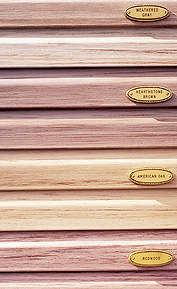
• Several manufacturers, including Heartland, Mastic and Mitten, sell two-tone or streaked panels designed to look like stained wood (Figure 5).
|
Figure 5.Variegated or two-tone siding, like this Cedar Lane vinyl from Georgia-Pacific, has color streaks intended to mimic the look of stained wood. |
• Vipco sells vinyl siding fused to a panel of foam insulation.
• Norandex sells siding with a nail hem with a built-in “hammer stop” to inhibit nails from being driven too tightly. The siding is also designed to permit stapling.
• CertainTeed sells siding with a special nailing hem, called the “Stud-Finder,” with graphics permitting the installer to easily locate 16-inch-on-center studs.
• Wolverine’s “Benchmark 44” siding has an integral fiberglass rod to increase stiffness (Figure 6).
|
Figure 6.Several manufacturers have introduced innovations to improve the stiffness of vinyl siding. Wolverine’s Benchmark 44 siding includes a sliding fiberglass rod that locks adjacent panels together. |
• Wolverine’s Millennium siding has a flexible nailing hem connected to the siding by string-like plastic fibers. The hem is designed to permit nails or staples to be driven all the way home, without restricting expansion (Figure 7).
|
Figure 7.Tight nailing prevents vinyl siding from expanding freely, leading to buckling. An exception is Wolverine’s Millennium siding, which includes a flexible nailing hem designed to accommodate tight nailing. |
Not all of these innovations have been greeted enthusiastically by installers. Some siders, for example, complain that the fiberglass rod in the Benchmark 44 siding makes the panels impossible to cut with shears. Others note that the flexible nail hem on the Millennium siding makes it harder for the installer to adjust courses of siding up and down, to make them line up at the corners.
There may also be technical disadvantages to some new features. “The two-tone variegated products are more impact-susceptible,” says Doug Price of Norandex. “The combination of the two-color concentrates weakens the cap on the product. Everybody in the industry has experienced the same problem.” Laminated two-tone products, which are significantly more expensive than non-laminated siding, do not have this problem.
“Everybody is coming out with gimmicks,” says John Karp, national product manager for vinyl siding at Georgia-Pacific. “But I haven’t seen many real improvements lately.” To some extent, vinyl siding is a fairly generic product. “Vinyl siding is vinyl siding,” says Alan Hoying of Alcoa. “A lot depends on the skill of the installer. A good installer can make a bad panel look good, and a bad installer can take a good panel and make it look disappointing.”