Q. I used 25-gauge steel studs to frame the partition walls in an upstairs renovation. Now my client wants to install a wall-mounted lavatory in the bathroom. What’s the best way to reinforce and block the wall so I can hang the sink?
A. Don Wheeler, a custom builder in Anaheim, Calif., who frames primarily with steel, responds: Though lighter, 25-gauge steel studs are plenty strong for framing interior walls, I usually use 20-gauge steel studs. These feel a little more substantial and tend to suffer less abuse around the job site. The following method of reinforcement will work with either size of steel framing, however.
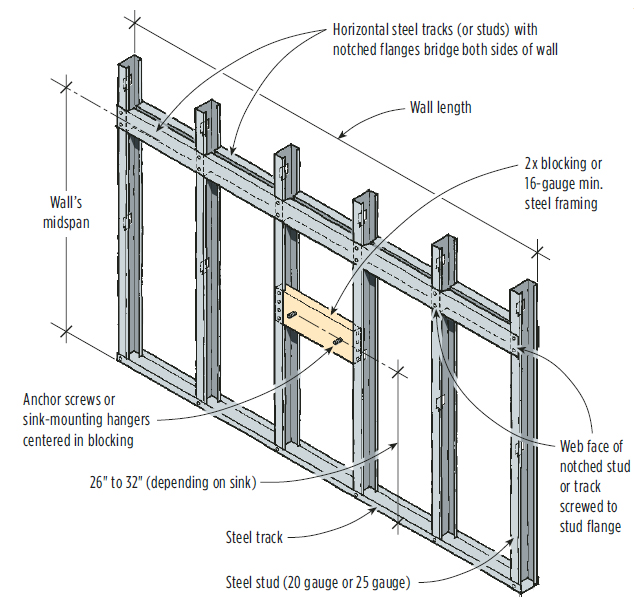
First, you want to strengthen the wall behind the sink. To do this, “bridge” the studs with a stud or track cut so that it’s equal to the length of the wall. Holding this cut stud (or track) in position with the web facing out, mark the top and bottom flanges where they intersect with the wall stud flanges. Using a circular saw fitted with an abrasive blade, make cuts in the flanges on these marks flush with the web.
If you’re using 25-gauge material, you can then just bend the cut sections of flange over so that they lay flat on the web. With heavier-gauge material, you’ll need to cut the flange sections away with the saw.
Next, place the stud on the front of the wall approximately midspan (so that it won’t interfere with any electrical boxes or other wall openings) and screw the web face to the flanges of the vertical stud wall.
I’d also recommend bridging the back of the wall the same way with another stud. This gives the vertical studs more strength and helps prevent them from twisting.
Now you need to bridge again to create a place to screw in the mounting hangers, this time between the two vertical studs that will support the sink. Be sure this bridging is positioned so that the sink-mounting hangers will be at the correct height. Here, I would not recommend using 25-gauge material; instead, to prevent the hangers from pulling out, use a minimum of 16-gauge framing.
You could also use 2×10 or 2×12 blocking, cut to fit tightly between the two opposing webs. On one side, you’ll need to screw through the flange into the end grain of the 2-by blocking; I’d use at least four screws to do this.
On the other stud, you can screw through both the web and the flange.