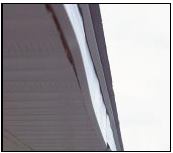
- Q. Last winter, our siding sub installed aluminum fascia in very cold temperatures. When the weather warmed up, the fascia expanded and buckled severely. What’s the proper way to install aluminum fascia to prevent this from happening?
A.George Schambach responds: To prevent the buckling you describe (see Figure 1), fascia should be installed using a “nail-less” technique. By fastening F-channel to the bottom edge of the subfascia and utility trim under the drip-edge, the fascia material is held firmly in place but is still able to expand and contract with changes in temperature (Figure 2).
Using a snap-lock punch, form locking tabs in the top edge of preformed fascia, then press the fascia into the utility trim. The tabs prevent the fascia from pulling out of the utility trim, but don’t restrict movement. Many contractors form their fascia on site using painted aluminum coil stock. Since coil stock is thinner than factory fascia (.019 vs. .024 inch thick), you should form a continuous locking hem on the top edge and insert this into the utility trim.
To prevent the rake fascia from creeping downhill, the bottom edge of the fascia should be slot punched, then held in place with three or four aluminum trim nails driven into the subfascia. These slots permit the fascia to expand and contract lengthwise without buckling.
Finally, aluminum fascia should never turn a corner. Instead, fit a small insert at all inside and outside corners and break the fascia at these points. The insert provides a background that prevents the wood subfascia from showing at the corner joint.
George Schambach is a former siding contractor and a sales representative for Norandex Corporation in Deposit, N.Y.
Q&A: No-Nails Approach to Aluminum Fascia
Connecting Receptacles
1 MIN READ