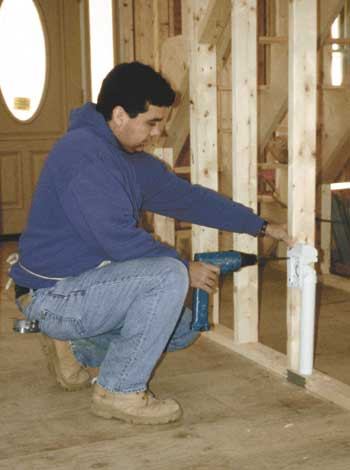
by Bob and Ron Boffoli
We started our business, Cape Cod Vacuum Mart, back in the 1980s, selling portable vacuums and only the occasional central vacuum system. As convenient as they are, it has taken up until the last several years for central vacuums (CVs) to begin to catch on in this country. Currently, only about 200,000 CV units are installed annually in the United States (according to an industry spokesman, this represents a 2% to 3% market penetration). Meanwhile, north of the border, Canadian builders and homeowners made central vacuums a standard item back in the 1960s — according to Mark Bruneau of Industries Trovac, CV systems in Canada “are as common as toilets.” In fact, in the mid-80s, we’d set up a booth at a home show and the most common reaction to our CV display was, “What’s that?” Today, we have three trucks on the road installing nothing but central vacuums, which represents a full 50% of our current business. In spite of this brisk trade, the popularity of CVs remains regional, with installations mostly concentrated in the Northeast, the Northwest, California, the Southwest, and Florida.
Why Install a Central Vacuum?
An important reason is health. One in three people in the U.S. has dust-related allergies. Even though portable vacuum makers may call attention to their HEPA (high-efficiency particle arrestor) filtration, the seal around the filter is often ineffective, allowing microscopic dust to bypass the filter and recirculate in the room. Ordinary dust bags offer no resistance to these tiny particles; microbe-laden dust passes through a standard bag like a fly through a chainlink fence. By contrast, CVs have standardized superior built-in filtration, and many models can be exhausted directly to the outdoors. Even when vented to the outside, high-grade filtration ensures that exhausted dust won’t collect on shrubbery or walkways. The second reason is power: While the average portable vacuum has an airflow of 60 to 90 cubic feet per minute (cfm), one of our dual-motor CV units responds with 185 cfm. Because of the remote location of the power unit, the sound produced by a running CV (without a power head) is not much louder than a person forcefully exhaling. It’s easy to talk over the sound of an operating central vac, and TV, music, and telephones remain clearly audible. Where remote installation isn’t practical, many manufacturers offer super-quiet power units for installation within the living space. Finally, a CV system eliminates the need to drag a clumsy machine around the house, banging up walls and furniture in the process. Portable vacs have to be lugged up and down stairs, sometimes descending on their own when tugged while cleaning. CV container capacity is generous, too; it usually requires emptying only once per year. As a final enticement to the homeowner, built-in systems typically retain their full value when a home sells — something that can’t be said for a portable vacuum.
Yesterday and Today
The typical system of the 1960s included PVC plastic tubing and a separate run of low-voltage wiring. To activate the motor, you inserted the metal-tipped vacuum hose into the wall valve, which closed the circuit between two contact points in the valve. The system shut off only after you removed the hose from the inlet. Although this was still more convenient than hauling a portable machine around, under-powered units, poor system configuration, and amateur installations all served to dampen the popular interest in central vacuums. Today’s equipment is vastly improved. In-wall tubing is dedicated 2-inch-diameter, vacuum-rated PVC, similar in appearance to schedule-20 pipe. The best tubing is made of virgin PVC; regrind content in lower grade PVC can have a rough interior finish that creates airflow friction. The standard wall valve is equipped with 20-gauge, low-voltage wiring to control the main power unit (Figure 1). However, rather than being activated by hose-insertion at the inlet, the low-volt wire continues inside the hose coils to a rocker-switch at the nozzle. This makes it more convenient to pause during vacuuming, to answer the phone for example. In carpeted rooms, the inlet will typically include a line-voltage circuit to operate a power nozzle attachment.
Figure 1. Low-volt, 20-gauge wire makes a home run from each inlet valve to the power unit. Contact points in the hose base connect the circuit to an on-off switch in the wand. |
Even if the homeowner doesn’t want to spring for the full system initially, it’s still a good idea to install the tubing. It’s an easy and inexpensive job, especially in new construction. The average cost of a rough-in — wall valves mounted, tubing stubbed to basement, garage, or utility room — is $80 to $120 per valve by region. A 2,000-sq.-ft. home usually requires a minimum of three valves. We use a 2 1/4-inch-diameter spur bit to bore the necessary holes through the framing, walls, and floors. Tubing comes in 8-foot and 10-foot lengths but, unless the ceiling height is over 8 feet, we stick with the 8-foot tubing to reduce cut-off waste. We cut the tubing with a special thin-wall tubing cutter (Figure 2) to avoid leaving rough, burred ends that can snag vacuumed dust and hair. The tubing sections are joined with solvent-weld adhesive, just like plumbing lines.
Figure 2. A thin-wall tubing cutter ensures clean, burr-free cuts for unimpeded airflow within the tubing. |
Short 90-degree elbows are best reserved for use at the inlet connection, where there’s usually not enough room for a sweep. All other offset jogs should be configured with a full-sweep 90 or two 45-degree ells to ease the radius and reduce airflow resistance (Figure 3).
Figure 3. Short 90-degree ells are used at the inlet valve only. Full-sweep 90s elsewhere ensure unrestricted airflow in the system tubing. | |
For best results, wait to install the tubing until the electrician and plumber have completed their rough-ins. That allows you to match the height of the inlet valve to the outlet boxes in the room and avoid conflicts with plumbing and wiring runs (Figure 4).
Figure 4. To avoid conflicts, central vac tubing is best installed after the electrician and the plumber have completed their rough-ins. Inlet valves can also then be mounted to match electrical box heights. |