Faced with building two opposing eyebrow dormers across a narrow, stress-skin foam panel gable roof, Narragansett, R.I., builder David Baud and collaborator Mike Rand came up with a SIPS-inspired approach.
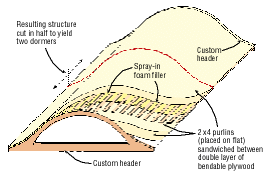
They cut dormer face profiles from 3/4-inch-thick medium-density overlay (MDO) plywood and glue-nailed them over 2x lumber blocking to create two custom sandwich “headers.” Then they stood the headers parallel to each other, 12 feet apart on the shop floor, and joined them by a series of flat 2×4 “purlins” spaced about 8 inches apart (see illustration, below). Rand cross-laminated a double layer of 3/8-inch bendable plywood over both sides of the purlins, filled the cavities between purlins with expanding urethane foam, then cut the structure into two matching, monolithic units.
Plywood patterns, which were later installed as permanent structural bracing, served as straightedge guides to establish the curved valley profile on the dormer.
To establish a precise cut line for the curvy valley intersection, Rand stood the dormer between a set of plywood patterns cut to match the main roof pitch, then dragged a long, marker-tipped straightedge down the slope. A similar setup provided the skewed line of cut on the interior side.
Foam-packed, primed, and stacked, the two dormers are ready for transport to the job site.
Roof panel sections and dormers were assembled in sequence, working end to end. The dormers’ weight is largely supported by the bearing walls directly below.
They defined the roof opening by positioning the completed dormer on the SIPS panels, laid on the shop floor in their installed positions, and tracing the dormer’s valley outline.
On site, Baud used his Lull to assemble the components like a big 3-D jigsaw puzzle. An injection of expanding foam sealed the seam between dormer and SIPS.