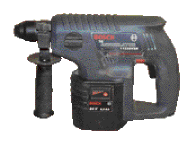
My company specializes in commercial office retrofits in New York City and residential construction and renovations in the surrounding suburbs. It seems like we can’t open a gang box without having to drill, chip, or fasten into concrete. Behind all the stunning office spaces we build, there’s nothing but a concrete box for us to secure all our framing, fixtures, and finishes to. We don’t use as many nails as a stick framer does, but we use tons of anchor bolts to hold these places up. Our rotary hammers make it all possible.
Pulverizing concrete is pure power work. A battery is fine for my drill/driver, but considering what rotary hammers go through on my jobs, I was skeptical about cordless models performing well. I was also hopeful though, because when you’re hanging out on a 20-foot skyjack or wiggling around in a crawlspace, you’d prefer not to have a cord tangling around your legs, weighing you down or otherwise jamming things up.
Test Criteria
Although you can fit these tools with bit adapters to drill wood, I’ve never seen anyone do it. They’re used almost exclusively for drilling concrete and other inorganic hard stuff. Drilling concrete isn’t exactly fun work, so we evaluated these tools for speed and power, for helping us get our work done faster. We also evaluated features that make them more comfortable to use, as well as their balance, size, and chucks. We sized up battery power, too — we don’t want to climb off ladders and lifts to replace batteries every few holes.
In the field, we drilled holes for anchor shields and Tapcon screws ranging from 1/8 to 1/2 inch in diameter. Next, we went underground into a basement crawlspace for some seismic-hurricane retrofitting. We reanchored sill plates to cured foundations, which required drilling various-sized anchor holes. We finished up with a drilling contest: We drove a 1/2-inch bit into a huge chunk of 3,500-psi concrete from a demolished foundation to see which battery-motor combination pounded the longest.
We tested the Bosch 11225VSRH, DeWalt DW004K, Hitachi DH 20DV, Makita BHR200SH, and Panasonic EY6812NQKW, all 24-volt models; and the 36-volt Hilti TE 6-A. All use SDS bits.
Cool Features
Big, muscle-bound, corded rotary hammers don’t usually come with many ergonomic features. These brutal breaker tools are designed to kick butt and go home. The newer cordless versions we tested are a little smaller and smarter than the big guys. They have some unexpected features that seem likely to help your tools endure and make your work go more smoothly.
Panasonic leads the pack here. First, its flexible telescoping cone attaches behind the chuck and fits over the bit. The cone compresses and catches dust created during drilling. This is a godsend for overhead work, especially with known silica hazards. Panasonic’s air intake also has a fabric filter to help keep dust out of the motor and windings.
Makita’s chipping option is very nice, although it’s limited to fairly light work. Engage the feature with the quick flip of an easy-to-reach switch, and you’re ready to roll. On this setting, you insert masonry chisels to clear out annoying chunks of mortar or knock down a small high spot in a wavy slab. It’s not meant to replace a jack or breaker hammer, but with a fresh 24-volt battery, it’s surprising how strong, effective, and convenient the chipping option is. I wouldn’t be surprised to see this feature on other manufacturers’ future tools.
Side handle and depth gauge. I like the bigger side handles on the Bosch, DeWalt, and Hilti models. They hold securely and are large and sturdy enough for big, gloved hands to hold on to all day. Hilti’s side handle is even made of shock-suppressing, grippy rubber.
The Hitachi tool’s depth gauge is nicely calibrated, but it’s made of weak-looking plastic and makes me think it might not last. I liked Bosch’s depth gauge best; you can quickly adjust the depth with a wing nut without loosening the entire side handle.
Operation
All of these hammers work similarly, but some have features that make them easier to use.
Chuck. The chuck enables the tool to handle the wicked pounding and torque generated by pulverizing concrete. Most of the tools we tested have fairly good chucks, but Hilti’s, Bosch’s, and Panasonic’s are the best. They work so solidly and dependably we didn’t miss a beat installing or releasing bits. The Hitachi chuck gave us some trouble. It’s difficult to install bits, and the chucks’ fit and finish aren’t on par with those of the others. Struggling with bit installation or having slop in the chuck can add unnecessary hassle to your day.
Balance. Drilling concrete in tight spots like basements and crawlspaces makes a cordless rotary hammer shine. A well-balanced tool shines even brighter. Since we had limited room to move into perfect drilling position, balance and feel were paramount during our seismic-hurricane hardware installations.
Hanging on. I expect a rotary hammer to vibrate, but I don’t expect it to vibrate me as much as the bit. That gets old fast. I found the lighter tools easier to hold and lift, but they don’t have enough beef to counter blows from the hammering action. That sends the impact into your hand and the bit, causing operator fatigue. You lose any comfort or efficiency afforded by a lightweight tool.
The Hilti, DeWalt, and Bosch tools counter vibration nicely. The Panasonic shook us up a bit more. Rotary hammer auxiliary handles can send annoying shivers up your arm. Hilti, a veteran of concrete pounding, obviously took this into consideration and wrapped its handle in thick tough rubber, which greatly reduces fatigue.
Batteries. Working in the basement made us grateful for the Bosch, Makita, and Panasonic tools, which come with two batteries. DeWalt, Hitachi, and Hilti come with one. Consider the cost of extra batteries when deciding which cordless tool to buy. You’ll definitely need more than one battery.
Clutch. A rotary hammer has enough power to twist out of your hand. If it catches something that stops the bit dead, the tool will spin out of control. Thankfully, all the tools we tested have torque clutches that automatically stop them from spinning when they hit something like a huge chunk of rebar. They all work great. Like the clutch on your cordless drill, these clutches chatter when stopped, which prevents the tool’s internal components from being shredded and your hand from being twisted off.
Power
When push comes to shove, features take a back seat to muscle. Concrete is merciless, so lots of oomph is essential. The Panasonic and Makita models run on NiMH battery packs, while the rest juice up on NiCad.
Checking to see if battery chemistry played a measurable role in performance, I couldn’t tell a difference (especially in our controlled drilling contest) between the NiMH and NiCad run times.
We quickly found out that size does indeed matter. The 24-volt machines all performed pretty well, but Hilti’s 36-volt hammer outdistanced them all.
Knocking holes in 3,500-psi concrete with brand-new 1/2-inch bits, it dashed my earlier skepticism about battery-powered tools making the grade. These batteries are surprisingly strong and provided unexpectedly generous run times per charge. I ran each battery from a full charge until it noticeably bogged out. The 36-volt Hilti hammer drilled 31 3-inch-deep holes without a rest, and the 24-volt tools all drilled 15 to 18 holes.
A few of these tools heated up badly without a rest. Overheating isn’t good for batteries, tools, or work crews, but the test indicated the tools’ maximum output. Big batteries make all the difference when it comes to the pure power and endurance I need from a cordless tool.
Favorites
All in all, I was pleasantly surprised at how well these tools performed. Most had good power and seemed to be well engineered. The 36-volt Hilti hammer is the top choice by leaps and bounds. It’s well engineered, full of power, and comfortable to use. You can tell that it’s designed and built by a company that makes its living in the concrete business. It’s also expensive, however.
The Bosch tool is my second choice. It’s fairly quiet, has a high-quality chuck, and operates with low vibration. The DeWalt model comes in third, just slightly ahead of the Makita. The DeWalt hammer is very comfortable to use, performs well, and is a little cheaper. The Makita is also an excellent performer and has that cool chipping setting.
The rest of the pack finished off with Panasonic and Hitachi, in that order. I really like the Panasonic hammer’s low weight and appreciate some of its features, but I have some concern about its durability. It heated up in the 1/2-inch bit test, and the plastic appears too flexible.
Erik Elwell is a contractor in the New York metro area who specializes in office build-outs and high-end residential construction. Thanks to Dril-Tec for providing the bits for this test. This article first appeared in Tools of the Trade magazine.
Editor’s Note: Since the test, DeWalt has replaced the DW004K with the DW005K. The new drill has DeWalt’s new fan-cooled battery and charger system. DeWalt claims that the new battery and charger will provide 40% longer run time and three times the number of charges before needing to be replaced, as compared with its previous 24-volt hammer drill. DeWalt is also including two battery packs in the basic kit and has added a chipping mode similar to Makita’s. The street price on the DW005K is $550.
Bosch Power Tools 877/267-2499 http://www.boschtools.com Volts: 24 Weight: 9.2 pounds Battery type: NiCad Blows per minute: 0-4,400 Number of batteries supplied: 2 Street price: $589 | |
This well-engineered tool has plenty of power. Its compact design and balance are rivaled only by Hilti’s. Low vibration and an excellent chuck help put it near the top of the list. Its handle is a little weak, but the depth gauge is very easy to use. The well-designed switches can be used while wearing gloves. The battery-life gauge is a nice feature, as is the storage box — it’s the second best of the bunch. | |
DeWalt DW004K | |
DeWalt Industrial Tool 800/433-9258 http://www.dewalt.com Volts: 24 Weight: 9 pounds Battery type: NiCad Blows per minute: 0-5,800 Number of batteries supplied: 1 Street price: $549 | |
I’ve always been impressed with the strength of DeWalt’s plastics, and this tool’s no exception. It’s a well-engineered, well-balanced, compact model with plenty of power and an easy-to-use chuck. The strong side handle is big enough to get a firm grip on. The rubber front end is a nice feature that reduces wear and tear and reduces vibration. | |
Hilti TE 6-A | |
Hilti Inc. 800/879-8000 http://www.us.hilti.com Volts: 36 Weight: 10.4 pounds Battery type: NiCad Blows per minute: 0-5,000 Number of batteries supplied: 1 Street price: $995 | |
This one’s the cream of the crop. It’s compact and extremely well engineered and balanced. You can hang on to the side handle all day with or without gloves. This model’s the heaviest of the bunch, but it’s worth every ounce. Its strong chuck holds the bit firmly in place. The tool comes with a great storage box. Hilti says it sells the TE 6-A in different packages ranging from $620 to $1,500, so be sure you’re getting the correct tool. | |
Hitachi DH 20DV | |
Hitachi Power Tools 800/546-1666 http://www.hitachi.com/powertools Volts: 24 Weight: 8.1 pounds Battery type: NiCad Blows per minute: 0-4,400 Number of batteries supplied: 1 Street price: $455 | |
This compact, well-balanced tool is powerful enough to keep up with the rest of the 24-volters. The plastic seems a little on the light side, and I question its long-term survival on a concrete site. The lightweight chuck is a little awkward. | |
Makita BHR200SHE | |
Makita USA 800/462-5482 http://www.makitatools.com Volts: 24 Weight: 8.4 pounds Battery type: NiMH Blows per minute: 0-4,700 Number of batteries supplied: 2 Street price: $625 | |
This solid tool has ample power. Although the plastic is a little flimsy, it’s got a nicely designed side handle and a separate depth-adjustment knob. The chipping feature is very cool. Balance and feel are good, and the compact design definitely comes in handy in tight spaces. | |
Panasonic EY6812NQKW | |
Panasonic Professional Cordless Tools 800/338-0552 http://www.panasonic.com/cordlesstools Volts: 24 Weight: 8.1 pounds Battery type: NiMH Blows per minute: 0-4,600 Number of batteries supplied: 2 Street price: $599 | |
I wanted to like this tool more than I actually did. It has great features like a dust-collection cone and a fabric filter on the air intake. A surprisingly easy-to-use chuck makes bit installation a snap. However, the tool’s plastic housing seems too flexible, and it vibrates much more than the rest. | |