During my 30 years as a carpenter, I have framed several
hundred complicated roofs, and have read nearly every book on
the subject. A particularly good one is The Steel Square, by
H.H. Siegele, which uses drawing techniques rather than
advanced math to illustrate complex rafter cuts.
I began using these drawing techniques because I wanted to
better understand the geometry of roof planes. Not only did
these methods help me grasp the way complex roofs fit together,
but they also increased my cutting speed — and have been
excellent teaching tools to boot.
In this article, I'll show how I use this technique to develop
the basic cuts for an irregular hip. The method explained here
is accurate for concealed 2-by roof framing. Where accuracy is
more critical — as in the timber-frame homes we build,
where a half-degree error on an 8/12 timber valley really shows
— I also use basic trigonometry, but that's another
story.
Figure 1. When teaching framing to novice
carpenters, the author uses a simple cardboard model to help
them "think in triangles."
Thinking in Triangles
This method helps you think of a roof in terms of its component
triangles and how they relate to each other. All the triangles
that make up the roof are drawn on a flat surface. Think of the
horizontal leg of each triangle — the run — as a
hinge. Once the drawing is complete, the triangles can be
mentally rotated on their hinges to form a three-dimensional
model of the roof. When I teach this method, I use a cardboard
model as a visual aid to show how each part of the roof relates
to the others (see Figure 1). Mastering the technique takes
time — I'm still learning — but the basics can be
grasped quite easily.
Plywood Worksheet
I usually make my drawings on a piece of plywood, using the
12ths scale on the framing square. This makes sense on the job
site, and lets me draw the cut angles full-scale. The only
special tools I use are a large compass (Lee Valley Tools sells
one; 800/267-8735, www.leevalley.com) and an oversized bevel
square. The aluminum bevel square in the photos came from
Germany, but any large one will work. (Quint Measuring Systems'
contractor-grade True Angle Tool is available online in 24-inch
and 36-inch lengths; www.quintmeasuring.com.)
The blueprints I'm typically given include only the most basic
information about a roof: a plan view, an elevation, and the
basic pitches. But this is enough information to develop the
drawings, if you follow the correct steps. The easiest method
is to break the drawing sequence down into discrete parts, each
of which builds on the previous one:
• plan angle for the hip rafter
• common and hip lengths and cut angles
• hip backing angle
• roof surface
Draw the Common and Hip Runs
The example roof has a 5/12 pitch on the hip end and a 10/12
pitch on the building's long dimension, and the eaves meet at a
90-degree angle (Figure 2). Note that I'm ignoring the overhang
and working from the plate line.
Figure 2. The full-scale drawing for an
irregular hip roof begins with a basic rectangle — a plan
view that represents a corner of the roof. The sides are the
two common runs; the diagonal is the hip rafter.
To get started, you first have to accurately draw the angle at
which the hip rafter intersects the eaves at the corner. I
start with an imaginary point on the hip rafter where the rise
is 12 inches above the outside of the plate, then determine the
run of the common rafters from that point to the plate line.
You can do this quickly with a calculator, but I just use a
simple table I've printed out (Figure 3).
Figure 3. To start the full-scale layout
drawing, the author finds the two common runs at 12 inches of
rise; that is, he converts the 5-inch-over-12-inch roof pitch
to 12 inches over 28 13/16 inches (left). Rather than do the
math each time, he works from a chart.
A 5/12 common rafter has a run of 28 13/16 inches at 12 inches
of rise, while the 10/12 rafter runs 14 3/8 inches. I use these
numbers to draw a rectangle, which is the basis for all the
drawings to follow. A diagonal across the middle (line BD)
represents the hip in plan. If you've drawn accurately, you've
already got the side cut angles for the jacks, which you can
transfer to the stock with a bevel square.

Draw the Common and Hip Rises and
Lengths
Next I draw the rise — 12 inches — of one of the
common rafters by extending one end of the rectangle (Figure
4). So, for example, I extend line CD 12 inches to point E;
this represents the rise of the 5/12 common rafter. Line AE
represents the 5/12 common length.
Figure 4. The next step is to "develop"
the lengths of the commons (top, center) by drawing right
triangles along the sides of the rectangle. The base of each
triangle is the common run, the adjacent side is the 12-inch
rise, and the hypotenuse is the common length. The hip length
(bottom) is developed from the diagonal through the rectangle.
Using a compass to swing a 12-inch arc saves time
measuring.
Here's where the compass comes in handy. I set its points at D
and E, then swing an arc around the end of the rectangle so I
don't have to measure the rise three times. Next I draw the
10/12 common in exactly the same way as the 5/12, then the hip,
using the framing square to draw its rise (DG) perpendicular to
its run (BD).
You've now got the plumb cuts as well as the seat cuts for both
commons and the hip.
Draw the Hip Backing Angle
Figuring the backing angles for an irregular hip is usually
tricky, but not with this method. Start by drawing a line
perpendicular to the hip length, anywhere along its length.
Extend the line to the hip run; this is line JK in the drawing
(Figure 5).
Figure 5. To develop the hip backing angle
(angle LNM in the example), first draw a line perpendicular to
the hip length extending to the base of the hip — from
point J to point K. Next, draw a line from point K
perpendicular to the hip run extending in both directions until
it crosses the plate lines (LM). Then, using K as the pivot
point, swing an arc from point J to the hip run — to
point N in the example. Finally, draw lines from N to L and M;
the resulting angle, illustrated in the cardboard model (photo,
left), represents the top of the hip rafter.
Next, starting at point K, draw a line perpendicular to the hip
run and extend it far enough in both directions that it crosses
the plate lines (LM). You may have to extend one or both of the
plate lines, as in the drawing, in order to intersect this new
line.
Now I set the point of the compass on K and swing an arc from J
to the hip run; the intersection is point N.
Finally, drawing lines from this point — N — to
points L and M gives you the backing angle for the hip
rafter.
Draw the Roof Surface
You can also easily figure out the angled cuts for the roof
sheathing (Figure). Put the point of your compass at point A
and the pencil end at E — the distance along the 5/12
common length. Then swing this arc in the opposite direction,
make a mark, and extend the 5/12 run line (AD) until it
intersects at point O. Draw a line from O to B; the triangle
you've drawn represents the roof surface on the 5/12 side of
the hip rafter.
Repeat these steps for the other side (triangle BCP).
Figure 6. To draw the sheathing cuts at
the hip corner, first extend both common runs well beyond the
plate lines, then draw arcs from the tops of the common lengths
to these new line extensions (arcs EO and FP). The cardboard
model (left) shows how rotating triangle OAB creates a
perfectly fitted roof surface.
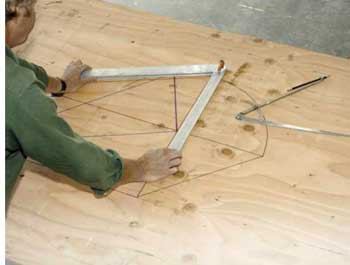
Figure 7. Pulling cut angles off the
developed drawing is a matter of setting the bevel square and
transferring the angles to the stock. Here, the author
transfers the plumb cut for the 10/12 common (A, B) and sets
the bevel angle for the 5/12 hip backing (C, D).
At this point, you can transfer the cut angles to the stock for
cutting (Figure 7).
William Dillon is a job supervisor with
South Mountain Co., an employee-owned design-build firm on
Martha's Vineyard, Mass.