Like many of the contractors in this area, the first contractor I worked for had a portable saw trailer for each crew. When I went out on my own, he gave me one of the old trailers, and my company has been using trailers ever since. I’ve built a number of them for myself and for other contractors.
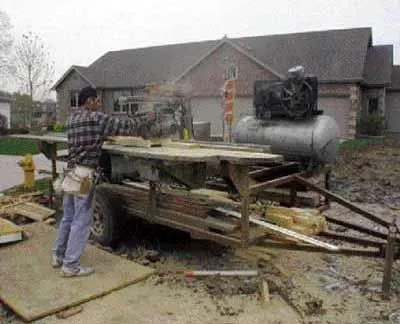
The trailers have two levels. The lower portion is a rack for storing and hauling lumber, siding, ladders, staging planks, and pump jacks. The top of the trailer is a combination work-storage platform and contains job boxes, a compressor, and a radial arm saw. An electrical distribution box is mounted on the side. My company does general contracting and also frequently work as framing and exterior trim subs for other builders. A saw trailer really cuts down on setup time for this kind of work. We take it to the site, connect it to a power source, and the crew is ready to go.
Our current trailer has a carriage made from 2-inch square steel tubing. A metal fabricator built the carriage and we attached the other parts ourselves. The tubing is welded together and connected to an axle and wheels that came from a local trailer and truck supply house. The frame was left unpainted because the paint would chip off anyway and the tubing is heavy enough that it won’t rust through. We built this trailer so the hitch can be removed by pulling a pin. The tires come off in a similar manner. This allows us to leave the trailer on site without having to worry that someone will steal it. The trailer has tail lights, turn signals, and a license plate. It’s registered as a 1/2-ton home-built trailer.
Equipment and Storage Boxes
On the right side of the trailer there’s a 14-inch radial arm saw. The saw is bolted to the frame, so at night we have to cover it up with a tarp. The cut table and fence are made from two-by lumber and are also bolted to the frame. We’re building another trailer right now and its cut table will be made from Trex decking.
The left side of the trailer contains a couple of job boxes and a large air compressor. The boxes are bolted to the frame and used to store air hoses, electrical cords, and supplies such as nails, joist hangers, and construction adhesive. The air compressor has a two-stage pump, 5-hp motor, and a 50-gallon tank. I don’t know how many framing guns it will run, but we’ve run 10 guns at the same time and not had problems. It’s unusual for us to run this many guns, so we could probably get by with a 30-gallon compressor.
Radial arm saw. We use the radial arm saw to gang-cut framing and siding. We also use it to rip framing, sheathing, and exterior trim. We bought the saw used from a local company that sells new and used equipment but specializes in rebuilding radial arm saws (Wolfe Machinery Company; Johnston, Iowa; 800/345-6659; www.wolfemachinery.com). I’ve considered using a sliding miter saw because it’s smaller and cheaper than what we have. However, a slide miter saw is not as powerful or durable as a big radial arm machine. In addition, a miter saw can’t rip, so we’d have to start bringing a table saw, which we don’t currently do.
The trailer is equipped with three adjustable legs. They fold down from the frame and are used to level the work surface. The trailer should be positioned so the front of the work table is slightly higher than the back. That way there is no tendency for the saw carriage to roll forward by itself. Our saw is equipped with an OSHA required return device that automatically pulls the carriage to the rear position.
We drop the trailer close to the front of the building but far enough back that it doesn’t obstruct work traffic. Most of the builders around here have all-terrain fork lifts, which we use to bring material to the saw and from there to the building.
Electrical Supply
The left side of the trailer houses an electrical distribution box plus 110-volt and 220-volt receptacles. It takes a lot of juice to start a big 220-volt compressor and run a large 220-volt radial arm saw. Power is supplied to the box through a four-conductor eight-gauge wire, which provides plenty of power without much voltage drop. The wire is 150 feet long and is run to a temporary power pole. The distribution box is a standard breaker box that contains breakers for the saw, compressor, and receptacles. The 110-volt dual duplex receptacles to the right of the box are connected to ground fault breakers inside.
We also have a two-wheel cart that contains a breaker box and more 220-volt and 110-volt outlets. We roll the cart into the building to provide power there. The cart has a long cord that plugs into the covered yellow receptacle on the side of the trailer. This auxiliary power box comes in handy when we’re framing three-story apartment buildings because it has enough outlets for my crew plus all the subs on site.
We built this trailer about 10 years ago and it cost around $4500 complete. It was $1500 for the wheels and frame, $1200 for the compressor, and $1800 for a used radial arm saw. The same trailer would cost between $5500 and $8000 to build today, depending on what you got for a saw.
If I had it to do over, I’d make the trailer smaller and lighter so it was easier to move around the site by hand. The main body of our current trailer is 5 feet wide by 10 feet long. I’d make the new one 4 feet by 8 feet long. There would be less storage capacity, but we can get by with less because we’ve replaced our collection of wooden pump jacks with a smaller number of Alum-A-Poles. I’d also lower the work surface to make it easier for short people to use the saw.
We like having a work trailer because it allows us to rip material and do accurate production cutting. It’s also very convenient to roll onto a site and have a ready-made power distribution system, air compressor, and centralized storage for miscellaneous supplies. Someone once asked what I’d do if I didn’t have one of these trailers. I told him I’d make do, but it would really cut into our productivity.
Mark Parleeis a general contractor and owner of Parlee Projects, Inc. His company does remodeling, framing, and siding in and around Des Moines, Iowa.