- Q. We have an ongoing debate on our job site concerning the proper way to adjust the blade depth on a circular saw. One group says that the blade should be set just slightly deeper than the thickness of the material being cut. The other group says that the blade should usually be left at the maximum depth, since this allegedly gives better control, is less stressful on the saw, and gives the longest blade life. Who’s right?
A.Steve Dassoulas, a technical manager at DeWalt, responds: Both groups are partly right. It really depends on what the user wants — better finish or better blade life. For a given cutting speed, setting a deeper cut depth does increase blade life. A deeper cut is less stressful on the saw and the blade, because fewer teeth are in contact with the wood at any one time. The downside to this approach is that it increases the entry and exit angles of the teeth with the wood, which reduces the quality of cut finish. So if it’s finish you want, adjust the blade depth to slightly more than the thickness of the material.
Minimizing blade depth also improves safety. Keep in mind that kickback can occur when the back of the blade gets pinched. With less depth of cut, less blade area is exposed to the wood, decreasing the chance of kickback. Because there is always a risk that an operator can accidentally get in the way of the blade, reducing the amount of exposed blade improves safety. It also decreases the likelihood that the saw will cut unknown pipes or wires that may be hidden behind the material being cut.
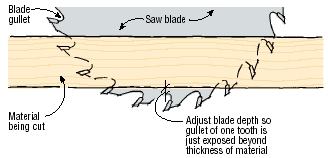
For the best quality of finish and the greatest level of personal safety, set the blade so that the gullet of one tooth is slightly exposed beyond the thickness of the material being cut.
Q&A: Saw Blade Depth Adjustment
Bubbling Laminate
2 MIN READ