by Matthew Lukovsky
Skil 3600 SpecsBlade diameter: 4 3/8 inches No-load speed: 11,000 rpm Cutting width, 90/45 degrees: 15/8 1/2 inches Cutting height: 3/4 inch Miter range: 0° to 47° Miter stops: 0°, 22.5°, 45° Weight: 25 pounds Street price: $160 Robert Bosch Tool Corp. 877/754-5999 skiltools.com |
I started doing my own hardwood-floor installations almost 20 years ago. My biggest hassle on these jobs has been finding a suitable space to set up a table saw and a chop saw; more often than not, I end up in the driveway, which means I spend a lot of time going back and forth between my outdoor cutting station and indoor workspace.
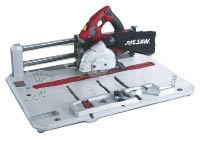
With the Skil 3600 Flooring Saw, all that running around is unnecessary. At 25 pounds, with a 27-inch-by-18-inch footprint, the tool is light and compact enough to be carried from room to room. And you can use it to crosscut, miter, and rip any type of flooring – solid, engineered, laminate – as long as it’s no thicker than 3/4 inch.
Weighing only 25 pounds – and with a convenient handle milled into the table – the Skil 3600 is easy to pick up and carry from task to task.
I gave the 3600 a try on a recent job that required installing 1,100 square feet of solid cherry flooring in an occupied house. Here’s how it performed.
Operation
The 3600 is essentially a compact sliding miter saw mounted on a table-saw top. Its unique feature is a removable rotating fence that can be positioned in front of the saw blade to perform miter cuts, or alongside the blade to serve as a rip fence. Thanks in part to the tool’s straightforward instructions, setup was easy. Getting the saw ready for work required only a few minor adjustments to properly align the fence for ripping (and for miter cuts, as I was to discover; more on that later).
For miter cuts, the fence pivots from 0 to 47 degrees (left). A spring-loaded ball bearing is captured by slots that correspond to settings at 0, 22.5, and 45 degrees (right).
For common miter cuts, the bottom of the fence is fitted with a roller ball that mates with slots on the table to position the fence at 0, 22.5, and 45 degrees. The tabletop is inscribed with a miter scale that allows the user to approximate less common angles.
To switch to rip mode, you unscrew the locking knob and flop the fence around to the other side of the table. The locking knob attaches to a sliding bushing that rides in a groove beneath the tabletop. At first, aligning the knob with the threaded bushing was a hassle, but after a while I got the hang of sliding the fence to the edge of the table before unscrewing the knob and removing it.
Safe ripping. I still have nightmares about attempting rip cuts on a radial arm saw, so I was relieved to discover how safe and easy it was to perform this operation with the Skil. After engaging a lock pin that secures the saw in the middle of the rail assembly, you start the motor with a “bump” switch conveniently located on the front of the handle. This switch also lets you to stop the machine with a fingertip. The blade guard and anti-kickback features were effective and unobtrusive.
Although a conventional trigger switch controls the motor for miter cuts, an oversize “bump” switch is used for ripping.
Nice touches. The table top includes mounting holes so you can bolt it to a workbench or sheet of plywood. But I suspect that most users will simply work off the floor, as I did. Conveniently, the table top is exactly 1 1/2 inches thick, which means that two pieces of 3/4-inch flooring or any scrap 2-by can serve as a work support. Other notable features include a 11/4-inch sawdust port, a built-in cord wrap, a plastic push stick and hex wrench stored on the underside of the table, and a built-in carry handle.
A push stick and hex wrench are housed beneath the table.
Performance
Despite its small size, the Skil flooring saw easily ripped and mitered its way through a huge pile of solid cherry flooring. I’m sure it would be equally effective with other hardwood species or laminates. The standard 4 3/8-inch (40T) carbide-tipped blade made clean cuts and didn’t begin to show signs of wear until I was nearly finished (a 36T carbide-tipped blade specially designed to stay sharp when cutting laminate flooring is an optional accessory). The dust collection was adequate, but I’d still recommend putting up plastic when working in an occupied space.
Beefs. I do have a couple of complaints. For one, I discovered that the detents were about 1 degree out of alignment when I made miter cuts. Although the owner’s manual included precise instructions for aligning the rip fence, it made no mention of any procedure for fine-tuning the miter settings. I thought I was out of luck until I tried loosening the screws that secure the roller ball and the miter pin (which the fence pivots on). This gave me the wiggle room I needed to fix the problem, but it was a pain having to figure this out on my own.
I was also disappointed to discover that the rip fence cannot be set up to cut a strip narrower than 1 inch – though I could have drilled and tapped the milled aluminum face to accommodate an auxiliary fence.
Conclusion
For small tasks like flooring repairs and for working in tight spaces, the 3600’s compact all-in-one design offers distinct advantages. And its mitering and ripping performance is perfectly acceptable for most flooring work. Contractors who do a lot of floor jobs in occupied spaces may find the saw well worth its $160 price. As for me, though, I disliked having to relocate the fence every time I needed to switch between modes, and I found myself missing the solidity of my chop saw and table saw. Truth be told, I’ll probably stick with my old tools – even if they are out in the driveway.
Matthew Lukovsky is a contractor in New Milford, Conn.