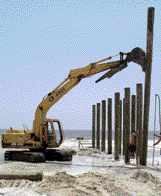
Watching from a distance as Fred Sprinkle quickly set pilings with his excavator, I had the impression he was handling much smaller sticks of wood: Up went the pole, automatically swinging upright against the bucket, over and down into a hole scoured into the sand with water pumped out of the Gulf of Mexico. Eyeball for plumb, adjust, and on to the next one.
But in fact they weren’t sticks; they were 30-foot piles with 12- to 14-inch butts, and it took only a few minutes to realize how skilled Sprinkle is with the controls. By 3 o’clock — a short day — the pilings were in. After five days for settling, as required by the local building department of Dauphin Island, Ala., they were ready for the carpenters.
Sprinkle is not one to make much of his abilities, or to question what the ocean can throw at a house on the shore. When I caught up with him a year later — post-Katrina — the house I’d watched him build stood nearly alone on that stretch of beach. I asked him whether there was any particular reason his foundation had survived when others nearby hadn’t.
“No,” he answered, shaking his head. “You never know what might hit a house in a storm.” Sometimes it’s just a close call — as in the case of the Louisiana oil platform that blew in on top of the 13-foot seas that crossed the island’s western end two years ago this month.