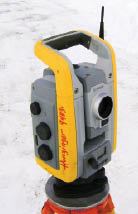
It was always a relief, back in the day, when I managed to hire a foundation contractor who truly respected layout. I can recall just a few too many times when I had to adjust the building dimensions to fit an out-of-whack foundation. Although precise methods for layout have existed for thousands of years, not everyone seems to accord them equal value. Ponying up, say, $40,000 for a transit may strike you as over the top, but Hunzinger Construction of Brookfield, Wis., did just that. Of course, this was no ordinary transit — it isn’t even called a transit. It’s a “Total Robotic Station.” And Hunzinger is a commercial contractor specializing in industrial-size jobs. Says project superintendent Brad Caspari, “The first time I set up the unit on the corners for a 290-by-110-foot building, I was only ‘off’ the surveyor’s points by 1/16 inch. Try that with string and a tape measure.”
The tool requires only one person to operate; it relies on a tripod-mounted head unit that uses radio signals to track a hand-held computer-equipped marking rod. The robotics come into play as the head unit turns and tilts to follow the rod around the job site. Once it locks on, the head bounces a laser beam off a prism at the top of the rod to calculate the rod’s distance, height, and angle relative to a pair of established control points. Layout data or CAD drawings downloaded to the computer are referenced and selected on the tool’s screen. The computer applies the necessary geometry to locate the rod precisely on point.
“One of our superintendents recently used our unit to configure the interiors of a pair of 20-story towers,” Caspari says. “He located every column, electrical box, and opening in the slab of each floor. It saved about 10 man-hours per floor.” On that scale of magnitude, you can start to see how the thing could pay for itself in time saved and errors omitted. But if the price is still a bit much for you, maybe your foundation guy would be interested. Just mutter, “Competitive edge.“