Rescuing a Block Foundation, continued
Securing the Brackets
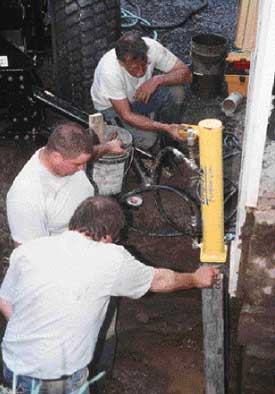
When all the posts are in the ground, we leave the hydraulic
cylinder connected to the final post installed and attach
smaller hydraulic cylinders to the posts installed earlier
(Figure 7). This important step equalizes the loading on both
piers. These smaller cylinders have just about 4 inches of
travel, so we use them only for equalizing the bearing pressure
between all the posts.
Figure 7. After both
piers are in place, a second small hydraulic ram is attached to
the hydraulic pump and attached to the first post (top left).
With both rams connected, pressure is applied to equalize the
loading on the two posts (top left). Once the bolts are
tightened with a pair of adjustable wrenches, the hydraulic
cylinders are removed (bottom right).
On larger jobs, we can connect up to 16 cylinders at a time,
allowing us to work on foundation walls as long as 40 feet. On
the job shown here, there were only two piers, so the process
went quickly. With the pump connected to both cylinders, we
again brought the pressure to 4,000 psi. With both piers under
equal pressure, we bolted the caps that lock the piers in their
final position. We then moved on to the second part of the job,
the bulging foundation wall.
Installing Wall Ties
Grip-Tite's wall ties consist of two 24-inch steel plates
connected by a section of 3/4-inch galvanized rod. One wall
plate is placed in the center of the bulge inside the building
and the other goes in a hole outside, buried about 9 feet away
from the foundation in virgin soil (Figure 8). Tightening the
nut on the threaded rod draws the two plates together and
straightens the wall. In this case, the outside earth anchor
was located about 36 inches below grade in a 2-foot-diameter
hole, which we dug with an auger, saving the sod so we could
replant it later.
Figure 8. To bring the
bulging wall back into line, the author uses a wall plate and
an earth anchor connected by a threaded rod — the wall
plate goes against the inside face of the wall; the earth
anchor goes in a hole in the ground outside (bottom). A
hardened point screwed on to the end protects against thread
damage as the rod is driven (top right).
Wall ties go in pretty easily. The only difficulty is lining
up the threaded rod so that it hits in the center of the hole
outside. We look for pipes and wires running to the outside and
use them as landmarks, but if there's nothing close to the
hole, we measure off a house corner. We drill through the block
with a 7/8-inch bit on our rotary hammer. The proprietary rods
are 9 feet long, and the manufacturer offers 4 1/2-foot
extensions that connect with a coupling. The extensions are
handy when we have to locate the holes outside around obstacles
such as sidewalks, trees, and decks.
Grip-Tite recommends a pneumatic demolition hammer for driving
the rods; we have one, but sometimes it's easier just to use a
sledgehammer, which is fine for most soils. A pair of hex nuts
on the threaded rod prevents thread damage while driving it,
and a hardened conical tip on the other end breaks through most
obstructions without a problem. It's usually just a matter of
driving the rod until it appears in the hole outside. Having a
second person steady the rod makes it easier to hit, and a
spotter on the outside watching the hole prevents us from
driving the rod too far — it's tough pulling it back
toward the house.
Before installing the washer and nut, we slip a plastic sleeve
over the threaded rod (Figure 9). Once all of the ties are in
position and hand-tightened, I use a torque wrench to tighten
the bolts in 10-pound increments until the wall is back in
place or we reach 80 foot-pounds.
Figure 9. A plastic
sleeve over the end of the rod (top) prevents the threads from
catching on the block instead of transferring the force to the
wall anchor. The three bolts are tightened incrementally with a
torque wrench (middle) to gradually move the wall back in line
without breaking the block. After the bolts are tightened, the
soil in the hole outside is compacted (bottom) to prevent water
from collecting there and causing frost movement.
We can often bring bulging block walls back in line without
any excavation, but it's obviously easier when there's no soil
pushing back. So when we have a hole already dug, as on this
job, we tighten the wall ties before backfilling. In this case,
we were able to almost eliminate the 3-inch bulge in the center
of the wall.
Once all the wall ties are tight, we backfill the holes in
6-inch lifts, using a hand tamper to compact the soil.
Cost
One advantage of a Grip-Tite repair is that it generally costs
less than other methods. The foundation work on this house cost
about $3,000 and was completed over three days. The next-door
neighbors, whose home was built at the same time and had a
similar problem, spent more than $15,000 having their bulging
foundation wall completely rebuilt.
Steve Shackett is
project foreman and Scott Anderson is
president of Tri-State Basement Systems in Berlin, Vt.