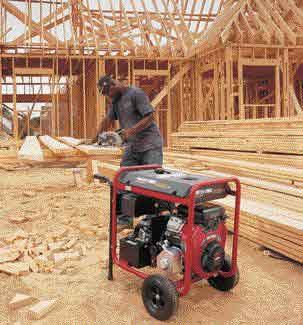
Generator users want dependability and power. The generator is the only power source out there, and it needs to work or the job comes to a halt. Often, workers beat up on this critical tool like it owes them a gambling debt. Then they expect the machine to start on one pull and provide gobs of power for circ and recip saws, miter boxes, even compressors. The good news is that they can usually get away with that treatment for a long time because many of today’s generators are tough enough to hack it.
This article will help you determine the right-sized generator for your needs — and one you can afford — with features that’ll last through the job-site demolition derby.
Power
Each job site is different, of course, but any crew running off mobile power needs enough electricity to stay moving. You can probably get away with a 3,500-watt machine on many sites, but most generator manufacturers recommend 5,000 to 6,000 watts to cover just about every power need — even starting compressors — on a residential job site.
One generator-sizing method suggests that you list all the tools you use on site simultaneously (for example, three circ saws, a miter saw, and a recip for your framers, or two miter saws and a 2-horse compressor for your trimmers). Then multiply the tools’ combined amps by 120 volts:
amps x volts = watts needed
That equation, theoretically, tells you how many watts your generator should have.
The problem with that method is that once you’ve added up all your tools and battery chargers, plus the radio, you usually come to a number that exceeds 5,000 or 6,000 watts. The reality is that to start, electric motors need about triple their amp rating for a split second. But once the tool is running, a motor draws about half that number. For instance, a circ saw that’s rated for 15 amps needs about 45 amps to start. That same saw needs only 8 amps to run unless somebody binds the blade. So the more realistic equation is:
amps x volts x .75 = watts needed
Surge capacity and sustained watts. Since electric motors require about triple their amp rating to start, the generator engine cranks way up for about a third of a second to double or triple its rated watts. This is called surge capacity. This statistic, some manufacturers say, is a tricky number to define, and many don’t even publish it. Most generators have sufficient surge capacity to start your tools. The number that matters is that of sustained watts. Sustained watts measures what the generator can produce consistently.
Generator manufacturers suggest 4,500 to 6,000 sustained watts for residential job sites. Using an underpowered machine can starve your power tools for current, which means they’ll start slowly and generate unnecessary heat. That heat can slowly cook the windings in your electric tools, shortening their useful life, according to generator makers.
While it’s easier to take a smaller 3,500-watt machine out of the truck every day, and it may feel like it’s got plenty of power, manufacturers say that it may be damaging your tools. Moving up to a 5,000-watt machine can keep your tools — and your generator — alive longer.
Durability
A generator’s performance is difficult to measure and quantify on site. Unlike a miter saw, whose positive adjustments and excess vibration you can feel and whose accuracy you can measure, your generator produces invisible current. But even though
it’s probably 50 to 100 feet away when you’re using it and you’re used to its background noise, there are things you can see — and hear — that make a difference in performance.
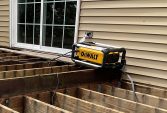
Control panel. Better generators have a control panel that’s protected from impact yet easy to access. Having enough places to plug in is important, too. Dividing the current from your generator through multiple circuits and multiple cords saves wear on both the generator and your tools. You probably can’t tell how many circuits your generator is wired with, but you can count the receptacles. Look for a generator to have a 120/240 twist lock and as many GFCI receptacles as you can get. Lots of high-quality generators come with only one GFCI receptacle. DeWalt provides two, giving you four places to plug in cords. Doing that disperses the current over several cords and cuts down on heat.
A well-protected yet accessible control panel is important. Also, you want as many receptacles to plug in to as possible. Spreading the current over numerous cords makes the generator’s work easier.
The DeWalt DG6000 features a 120/240 twist lock and two GFCI receptacles.
Frames. Manufacturers have also improved the frames that these machines ride in, making them tougher and better positioned to take a beating from falling debris or a bumpy truck ride. And a frame with a skyhook can make moving the machine around on site much easier. If you have a forklift on site, you can equip it with a chain and move the generator where you need it.
Idle control. Idle control revs the generator down when there’s no current draw, and it’s a must-have for some generator users, especially those working in tight quarters. It saves fuel, significantly cuts down on noise, and limits wear and tear. The static on your job-site radio is loud enough without having to listen to a generator crank out 3,600 rpm for no reason. This feature also affects the price tag. Typically, the units that have it are more expensive.
Low oil. There are plenty of stories of builders having to rebuild or replace generators that a rookie set up on a hill, trapping all the oil in the pan. Low-oil shutoff isn’t considered a feature anymore as much as it’s thought of as standard equipment. If enough oil doesn’t reach the piston, the generator shuts itself down instead of seizing.
Gas tank. A metal gas tank also might save you a trip to the repair shop. Plastic gas tanks swell in the summer and become brittle and breakable in the cold months. Metal tanks are tougher. You’ll typically find them on Honda, Kubota, Makita, Mitsubishi, Robin, DeWalt, and Yamaha equipment. Plastic gas tanks are usually found on lower- and moderately priced models, but think about this: The gas tank you fill your generator from is likely plastic. You can probably expect your generator gas tank to last about as long.
A metal gas tank can take a beating. It doesn’t swell in the heat or get brittle in the cold like plastic can.
Convenience
If your generator will be used all the time, spring for a wheel kit. A wheel kit not only makes moving the generator from the truck and around the site easier, it also makes maintenance easier. By getting the oil plug off the ground, it facilitates access to it and the air filter.
Wheels. You’ll find three types of wheels out there: solid rubber, pneumatic, and semi-pneumatic. Solid rubber wheels like you’ll find on Honda’s machines are typically about 2 inches wide and roll well on hard, dry surfaces. They’re a little trickier in ankle-deep mud. Pneumatic tires (about 4 inches wide), like the big 12-inchers you’ll find on Generac wheel kits or the smaller tires on Makita and Robin units, roll great in most terrain –especially mud — because they’re bigger, softer, and wider than the solid wheels. The downside is that they can pop, leaving you with one flat tire and 175 pounds of generator to get in the truck. The semi-pneumatic tires that are now available on some DeWalt and Porter-Cable models are made from thick rubber with an air pocket inside for cushioning. They’re not as easy rolling as pneumatic tires, but they’re big and wide enough to ride over soft ground and they won’t pop if you run over a roofing nail.
A wheel kit makes everything from mobility to maintenance easier. Look at the tire choices to see what’s right for you: pneumatic, semi-pneumatic, or solid.
Footprint. Some generators — like Honda’s, Mitsubishi’s, Yamaha’s, and Kubota’s — are compact. They’re snugged inside their low-profile frames. Others — such as the Campbell Hausfeld, Generac, and Porter-Cable machines — take up a bit more space. A larger machine is no big deal on site, and these airy designs actually help keep the unit cool; the size matters more in the back of your van or pickup. Compact units that pack the punch you need usually also pack a higher price tag.
A tight, compact design makes sense for a lot of users. It takes up less space in the truck and is easier to move around. A model with a skyhook adds even more options — you can move it around the site with a forklift.
Electric start. The jury is split on this one. Some guys just don’t want to pull a cord. They want to turn a key and hear their generator fire right up. Others say that an electric start is just one more thing to break, and they’ll go for the cord every time. Still others just don’t want to pay for the extra feature.
Maintenance
Every manufacturer I spoke with laughed when I asked about maintenance. To a person, they said that not maintaining the generator at all is the biggest maintenance problem they see. Maintenance can make a big difference. Yamaha reports that the company has had the same generators active daily in rental fleets for five to seven years and that they’ve logged thousands of hours.
An oil change is due on a typical generator about every 100 hours. Some generators, such as Generac units, come with hour meters so you know when you’re supposed to change the oil — or, more realistically, how far past the recommended time your guys have taken the machine.
Largely, the meter gets ignored, however. Most users who change the oil change it by date, not by hours run. Often when a worker pulls the dipstick and sees low oil, he dumps in another quart instead of taking the time to change it. As the machine burns oil, workers keep adding it and still expect the unit to start on one pull.
Changing the oil regularly will markedly improve the engine’s performance and longevity. You should use a multiweight oil, such as 10W-30 or 10W-40. If you don’t like doing the work yourself, a good place to have your generator maintained is your local rental shop. You should change or clean your air filter (and oil filter if there is one) at the same time.
Another generator killer is fouled gas. Gas can become fouled in two ways. It can go bad during a period of non-use, or it can get polluted by sand, water, or rust from the inside of your gas can. A good way to prevent pollution is to use a multi-stage filter system to make sure the gas that fires in the cylinders is pure.
What You Don’t See
While you’re up to your shoulders in generator boxes and specs, trying to decide which machine is best for your present and future needs, don’t forget to consider the elements that you don’t see. A lot of that invisible stuff can greatly affect the price you pay. Of the five main parts of a generator — engine, alternator, frame, gas tank, and control panel — only the engine and the alternator produce electrical current.
Alternators. There are two kinds of alternators: brush and brushless. They produce the same current, but a brush alternator requires maintenance, because eventually the brushes wear out. Manufacturers that put brushless alternators on their machines say they’ve eliminated a wear part, which increases generator life. Many manufacturers offer brushless alternators, including Honda, Kubota, Mitsubishi, Porter-Cable, and Yamaha.
There are two kinds of alternators: brush and brushless. Brushes wear out and need to be changed. A brushless alternator needs no maintenance.
The alternator is the mechanism that converts mechanical energy (the engine turning) into electrical current (zap). If the engine runs at 3,600 rpm, the alternator transfers that motion into 60 hertz, the requisite frequency to run an electric motor. One measure of the current coming out of the alternator is harmonic distortion, which measures the “cleanliness” of the current. The current that comes out of the wall in a house is 1% to 2% distorted and is considered “clean.” Some generators run at 14% distortion, which is considered dirty. A high-end generator runs quite a bit cleaner than that, at 5% to 6%. Now that you know this, how can you look at it? Good luck. Your tool supplier might know, but current cleanliness isn’t listed in manufacturer specs.
Current. The problem with dirty current, according to some manufacturers, is its byproduct: heat. Heat is bad for your tools for the same reason it’s bad for your car — it melts things. The cleaner the current, the longer your tools will last. The cleanest current of all comes from the newest generator technology, called inverter technology. Inverters replace the alternator and turn the mechanical energy into electrical energy by using sophisticated electronics. Presently, Honda, Mitsubishi, and Yamaha have this technology on smaller generators (1,000 to 3,000 watts) and are developing it for larger units. Inverter generators use less fuel, weigh about a third less, have super-clean current, and cost about the same as a regular unit.
Automatic voltage regulation. AVR is another upgrade feature that separates generators. It’s sort of like electronic feedback control (EFC) in your power tools. EFC draws more power from its source, as needed, to keep rpm constant during an application. For instance, when your router bit hits a knot, it needs more power to keep bit speed constant. AVR provides even current on demand so your circ saw doesn’t bog out during a cut when the compressor kicks on. Manufacturers say it puts less strain on your tools.
Dollars
Many builders buy either the lowest-cost tool or the brand they’ve been using for years. Others go for the high end and big power, assuming that more expensive is better. Typically, when it comes to generators, the more expensive tools start easier, last longer, are smaller, and have more well-thought-out features, like protected control panels, wheel kits, AVR, clean current, and brushless alternators. Lower- and moderately priced machines mix up the features: To save money a company might put a plastic gas tank and an okay muffler on a unit with AVR, a brushless alternator, and semi-pneumatic tires. At the low end — units that lack GFCIs, run loud and hot, and have plastic gas tanks — you can expect to pay $600 to $900. In the middle of the road, you’ll find units with a mix of features — good engines and solid design features but not as compact — for $1,000 to $1,500. Once you reach the higher end of the price spectrum, you’ll find all the details and bases covered: good sustained power, easy-starting engines, compact design, ample plug-in choices, idle control, and quiet operation. These units will set you back $2,000 to $2,700.
Mark Clement is senior editor of Tools of the Trade magazine.
Sources of Supply | |
Campbell Hausfeld 800/803-1436 Coleman Powermate 800/445-1805 http://www.colemanpowermate.com Desa International 866/672-6040 Generac Portable Products 800/270-1408 http://www.generac-portables.com Honda 800/426-7701 Kubota 888/458-2682 Makita USA 800/462-5482 | Mitsubishi Generators and Pumps 888/387-3464 http://www.mitsubishi-generators.com NAC Construction Equipment 800/869-0321 Porter-Cable 800/487-8665 Robin America 800/277-6246 Winco Power Systems 800/733-2112 or 800/324-8174 Yamaha Motor Corp. 800/962-7926 |